Malvaceae
Desert Globe Mallow: Edible Plant
Sphaeralcea ambigua
Desert Globe Mallow requires full sun and very well-draining, sandy-gravelly soil. Once established, it needs very little water and cannot tolerate standing water or heavy, clay-rich soils. Pruning after the flowering period encourages compact growth and stimulates new blooms.
Every 21 days
Direct sun
-9° - 45°C
20% - 40%
Categories
What is Desert Globe Mallow?
Desert Globe Mallow (Sphaeralcea ambigua) is a easy-care plant from the Malvaceae family. The Desert Globe Mallow (Sphaeralcea ambigua) is a perennial, woody subshrub in the mallow family (Malvaceae), native to the deserts of the southwestern United States and northwestern Mexico—ranging from California, Nevada, Utah, and Arizona to Sonora and Baja California. It thrives in the Mojave, S...
Desert Globe Mallow grows up to 1.2m, spread of 90cm, watering every 21 days, -9°C – 45°C, 20–40% humidity. It is not suitable for indoor environments and safe for pets.
Unlike many tropical plants, Desert Globe Mallow tolerates watering mistakes. Best for beginners. Unlike many popular species, Desert Globe Mallow is safe to keep around pets.
How to Care for Desert Globe Mallow?
TLDR: Desert Globe Mallow needs Direct sun, watering every 21 days, and temperatures between -9-45°C with 20-40% humidity.
How Often Should You Water Desert Globe Mallow?
Water thoroughly and then allow the soil to dry out completely. Once established, watering once a month is usually sufficient, perhaps twice during hot summer months—overwatering promotes root rot.
How Much Light Does Desert Globe Mallow Need?
Full, direct sun is essential—the Desert Globe Mallow does not tolerate shade and will only bloom profusely with sufficient light.
What Is the Best Soil for Desert Globe Mallow?
Sandy to gravelly, highly permeable soil with a neutral to slightly alkaline pH is ideal. The plant also tolerates nutrient-poor and calcareous soils.
What Pot Should You Use for Desert Globe Mallow?
If cultivated in a container: use an unglazed terracotta pot with large drainage holes and fill it with a mineral-based potting mix suitable for cacti and succulents to ensure standing water is avoided.
What Is Desert Globe Mallow and Where Does It Come From?
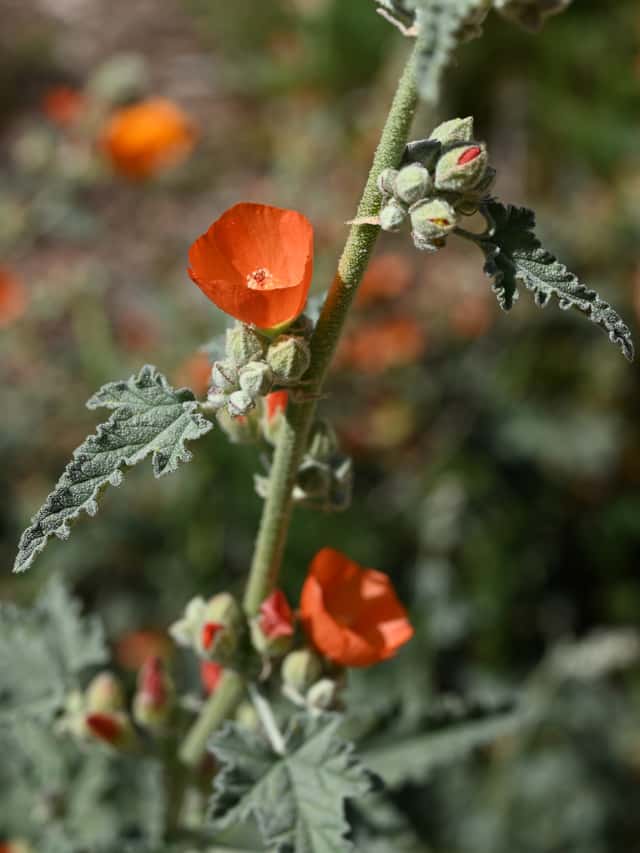
The Desert Globe Mallow (Sphaeralcea ambigua) is a perennial, woody subshrub in the mallow family (Malvaceae), native to the deserts of the southwestern United States and northwestern Mexico—ranging from California, Nevada, Utah, and Arizona to Sonora and Baja California. It thrives in the Mojave, Sonoran, and Great Basin deserts at elevations between 500 and 8,000 feet. The plant produces grayish-green, three-lobed, fuzzy leaves and bears cup-shaped, apricot to orange flowers that can bloom nearly year-round depending on the climate. As an extremely drought-tolerant species, it easily survives long dry periods and poor, rocky soil.
How to Propagate Desert Globe Mallow?
How Big Does Desert Globe Mallow Grow?
TLDR: Desert Globe Mallow can reach up to 1.2m tall with Fast growth rate.
Max height
1.2m
Spread
90cm
Growth rate
Fast
Foliage
Semi-evergreen
Plant Uses
Ornamental
Great for decoration
Medicinal
Medicinal properties
Edible
Can be consumed
Medicinal Uses
- Root infusion traditionally used as an eye wash (Shoshone)
- Used externally as a poultice for swelling and rheumatic complaints
- Traditionally used to treat colds
- Root tea used for sore throats
Culinary Uses
- Young leaves eaten raw or cooked (mucilaginous texture)
- Fruits traditionally used as a food source
Is your plant showing symptoms?
Click on the symptom to discover possible causes:
What Diseases Commonly Affect Desert Globe Mallow?
TLDR: Desert Globe Mallow is susceptible to 4 known diseases. Monitor regularly for early detection.
Rust
Rust is a common fungal disease caused by fungi in the order Pucciniales that affects a wide variety of plants. The disease gets its name from the characteristic orange, yellow, or reddish-brown pustules that appear on leaves, resembling metal rust. This obligate fungal parasite requires living plants to survive and can cause significant economic losses in agricultural crops.
Aphids
Aphids are small, soft-bodied, pear-shaped insects (1/16 to 1/8 inch long) that feed by sucking nutrient-rich sap from plants. They reproduce rapidly and can quickly weaken plants, causing distorted growth and transmitting plant viruses. Aphids come in various colors including green, black, red, yellow, brown, and gray. They secrete honeydew, a sticky substance that attracts ants and encourages sooty mold growth.
Spider Mites
Spider mites are tiny arachnids (less than 1/20 inch long) related to spiders and ticks that feed on plant sap. They thrive in hot, dry conditions and can cause significant damage to ornamental and vegetable plants. During severe infestations, crop losses can reach 14% or higher as these pests disrupt vital plant processes including photosynthesis, carbon dioxide absorption, and transpiration.
Root Rot
Root rot is a serious fungal disease that affects the root system of plants, causing them to decay and die. It is primarily caused by overwatering, poor drainage, or soil-borne fungi such as Pythium, Phytophthora, Rhizoctonia, and Fusarium. The disease thrives in waterlogged conditions where roots are deprived of oxygen, making them susceptible to fungal infection.
Meaning & Symbolism
The Desert Globe Mallow symbolizes resilience and adaptation to harsh conditions. As a traditional medicinal plant for many indigenous peoples of North America—such as the Shoshone, Hopi, and Navajo—it also represents care and natural healing power.
Compare with similar plants
| Attribute | Difficulty | Light | Watering | Pet Safe |
|---|---|---|---|---|
| Field Maple | Easy | Bright indirect | 14d | ✓ |
| Silver Birch | Easy | Direct sun | 14d | ✓ |
| Common Blanketflower | Easy | Direct sun | 10d | ✓ |
| Cushion Bush | Easy | Direct sun | 14d | ✓ |
Choose & Compare
Sources & References
- Sphaeralcea Ambigua Plant Care & Growing Basics | PlantIn
- Sphaeralcea ambigua (Desert Mallow) - Gardenia.net
- Sphaeralcea ambigua - Wikipedia
- Sphaeralcea ambigua (Desert Globemallow) - Lady Bird Johnson Wildflower Center
- Sphaeralcea ambigua | Globemallow | Medicinal Uses - Applied Medical Botany
- Malvaceae (Sphaeralcea) Propagation Protocol - RNGR





