Commelinaceae
Dichorisandra
Dichorisandra
A forest-shade plant: bright filtered light, no midday sun, rich soil kept lightly moist and humid air. It does not tolerate cold below about 12 °C.
Every 7 days
Partial shade
12° - 30°C
50% - 80%
Categories
What is Dichorisandra?
Dichorisandra (Dichorisandra) is a medium-care plant from the Commelinaceae family. Dichorisandra is a genus of about 45 species in the spiderwort family (Commelinaceae), native to humid forests of tropical America, mostly Brazil. They are clumping perennials with upright, cane-like stems and glossy leaves arranged in a spiral. The best known is D. thyrsiflora, blue ginger, which r...
Dichorisandra grows up to 1.5m, spread of 60cm, watering every 7 days, 12°C – 30°C, 50–80% humidity. It is suitable for indoor environments and safe for pets.
Unlike many popular species, Dichorisandra is safe to keep around pets. Without adequate drainage, root rot can develop within 14 days.
How to Care for Dichorisandra?
TLDR: Dichorisandra needs Partial shade, watering every 7 days, and temperatures between 12-30°C with 50-80% humidity.
How Often Should You Water Dichorisandra?
Water once the top third of the soil is dry. In autumn and winter let about half the pot dry out. Soggy soil leads to root rot.
How Much Light Does Dichorisandra Need?
Bright, indirect light near a window. Strong direct sun scorches the leaves; deep shade means no flowers.
What Is the Best Soil for Dichorisandra?
Rich, well-drained potting mix, slightly acidic to neutral. Mix loam-based compost with leaf mould and some perlite.
What Pot Should You Use for Dichorisandra?
A deep plastic or ceramic pot with drainage holes, only slightly larger than the root ball; it likes being a little pot-bound.
Care Schedule
Fertilize
Every 30 days
Misting
Every 7 days
Repot
Every 1095 days
What Is Dichorisandra and Where Does It Come From?
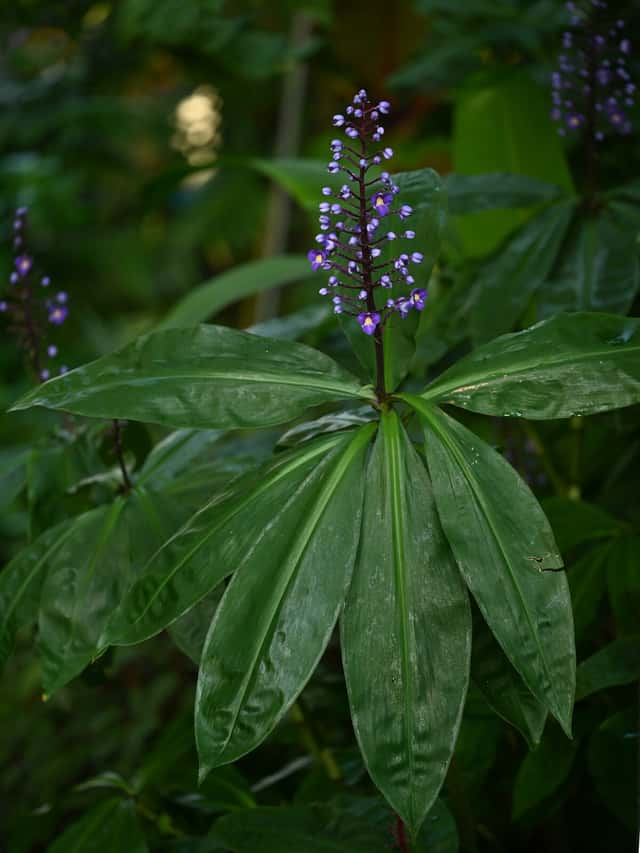
Dichorisandra is a genus of about 45 species in the spiderwort family (Commelinaceae), native to humid forests of tropical America, mostly Brazil. They are clumping perennials with upright, cane-like stems and glossy leaves arranged in a spiral. The best known is D. thyrsiflora, blue ginger, which reaches about 1.5 m and carries upright spikes of violet-blue flowers with yellow centres in summer and autumn. Despite the name, it is not related to true ginger. Smaller species with striped or mottled leaves, such as D. vittata and D. reginae, are grown for their foliage.
How to Propagate Dichorisandra?
Division
Water the day before so the roots handle the move better.
- 1 Unpot the plant in early spring
- 2 Split the clump into pieces with stems and roots
- 3 Pot each piece in moist potting mix
- 4 Keep in bright shade until new growth appears
Materials needed:
Stem cutting
Cuttings root best with bottom heat or in a propagator.
- 1 Cut a 10 cm piece of stem just below a node
- 2 Remove the lower leaves
- 3 Root in water or moist potting mix
- 4 Keep warm and bright, out of direct sun
Materials needed:
How Big Does Dichorisandra Grow?
TLDR: Dichorisandra can reach up to 1.5m tall with Medium growth rate.
Max height
1.5m
Spread
60cm
Growth rate
Medium
Foliage
Evergreen
Plant Uses
Ornamental
Great for decoration
Is your plant showing symptoms?
Click on the symptom to discover possible causes:
What Diseases Commonly Affect Dichorisandra?
TLDR: Dichorisandra is susceptible to 9 known diseases. Monitor regularly for early detection.
Mealybugs
Mealybugs are small, soft-bodied insects covered with a white, waxy, cottony material. They are common pests of houseplants and outdoor plants in mild climates. These sap-sucking insects feed on plant tissue, causing damage, stunted growth, and can lead to plant death if left untreated. They produce sticky honeydew which attracts sooty mold.
Spider Mites
Spider mites are tiny arachnids (less than 1/20 inch long) related to spiders and ticks that feed on plant sap. They thrive in hot, dry conditions and can cause significant damage to ornamental and vegetable plants. During severe infestations, crop losses can reach 14% or higher as these pests disrupt vital plant processes including photosynthesis, carbon dioxide absorption, and transpiration.
Root Rot
Root rot is a serious fungal disease that affects the root system of plants, causing them to decay and die. It is primarily caused by overwatering, poor drainage, or soil-borne fungi such as Pythium, Phytophthora, Rhizoctonia, and Fusarium. The disease thrives in waterlogged conditions where roots are deprived of oxygen, making them susceptible to fungal infection.
Aphids
Aphids are small, soft-bodied, pear-shaped insects (1/16 to 1/8 inch long) that feed by sucking nutrient-rich sap from plants. They reproduce rapidly and can quickly weaken plants, causing distorted growth and transmitting plant viruses. Aphids come in various colors including green, black, red, yellow, brown, and gray. They secrete honeydew, a sticky substance that attracts ants and encourages sooty mold growth.
Fun Facts
The name comes from Greek and refers to the doubled anthers of the flowers
Most species in the genus are Brazilian
One species, D. saundersii, is considered extinct
Frequently asked questions
Is blue ginger related to ginger?
Why won't my Dichorisandra flower?
Can it grow indoors?
Why are the leaf tips turning brown?
Compare with similar plants
| Attribute | Difficulty | Light | Watering | Pet Safe |
|---|---|---|---|---|
| Dark Fieldcap | Medium | Low light | 2d | ⚠️ |
| Azalea | Medium | Partial shade | 3d | ⚠️ |
| Muriel's Bamboo | Medium | Partial shade | 3d | ✓ |
| Bougainvillea | Medium | Direct sun | 7d | ⚠️ |




