Lamiaceae
Diviner's Sage (Salvia divinorum)
Salvia divinorum
A plant for bright shade and humidity. Filtered light, rich, well-drained soil kept lightly moist. Not frost hardy. Check the law where you live before growing it.
Every 4 days
Partial shade
° - °C
% - %
Categories
What is Diviner's Sage?
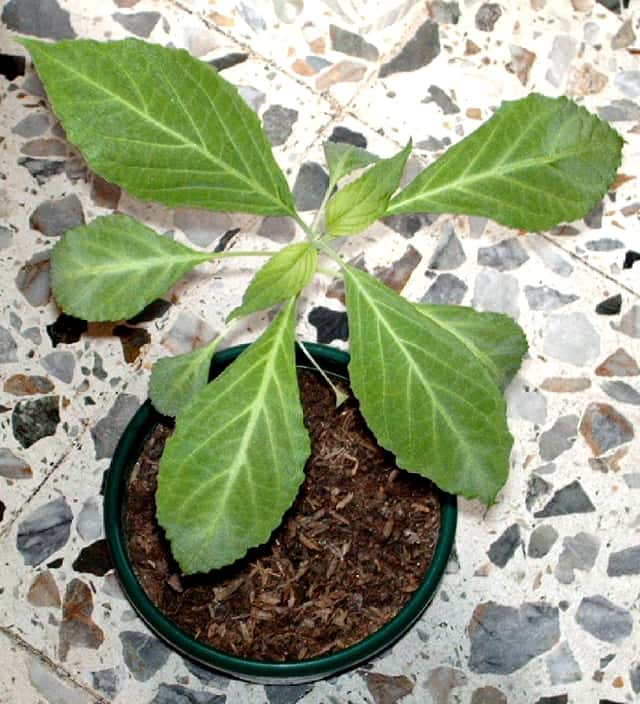
Diviner's Sage (Salvia divinorum) is a medium-care plant from the Lamiaceae family. Diviner's sage (Salvia divinorum) is a perennial herb in the mint family (Lamiaceae), endemic to the Sierra Mazateca in Oaxaca, Mexico. There it grows in cloud forest on dark soil along stream banks, in shade and high humidity. It has hollow, square stems that break easily and root where they touch...
Diviner's Sage grows up to 2.0m, watering every 4 days. It is suitable for indoor environments and safe for pets.
Unlike many popular species, Diviner's Sage is safe to keep around pets. Without adequate drainage, root rot can develop within 8 days.
How to Care for Diviner's Sage?
TLDR: Diviner's Sage needs Partial shade, watering every 4 days, and temperatures between 15-30°C with 40-70% humidity.
How Often Should You Water Diviner's Sage?
Keep the soil lightly moist but never waterlogged. In summer it may need water every few days; drooping leaves mean it is thirsty.
How Much Light Does Diviner's Sage Need?
Bright, filtered light, like sun coming through a tree canopy. Strong direct sun scorches the leaves.
What Is the Best Soil for Diviner's Sage?
Loose, humus-rich soil with good drainage; avoid heavy clay. Slightly acidic soil is preferred.
What Pot Should You Use for Diviner's Sage?
A large pot, 30 cm or more, with drainage holes; tall plants need a stake.
What Is Diviner's Sage and Where Does It Come From?
Diviner's sage (Salvia divinorum) is a perennial herb in the mint family (Lamiaceae), endemic to the Sierra Mazateca in Oaxaca, Mexico. There it grows in cloud forest on dark soil along stream banks, in shade and high humidity. It has hollow, square stems that break easily and root where they touch the ground, and large green leaves 10-30 cm long. It grows over 1 m tall and up to about 2 m with support. Flowering is rare: when days get short it produces spikes of white flowers held in violet calyces. It sets almost no viable seed, and known wild populations appear to be clones. The leaves contain salvinorin A, a potent psychoactive compound, so the plant is banned or controlled in a number of countries.
How to Propagate Diviner's Sage?
Cuttings in water
Don't leave the roots in water too long: they get brittle and break when transplanted. Cover the new plant for the first days to keep humidity up.
- 1 Cut a 5-20 cm branch tip just below a node
- 2 Stand it in tap water, one cutting per glass
- 3 Keep in bright light out of direct sun
- 4 Pot up when roots are 1-2 cm long
Materials needed:
Natural layering
This is how it spreads in the wild: stems fall over and root at the nodes.
- 1 Lay a long stem on moist soil
- 2 Pin a node into the mix
- 3 Cut it from the parent once rooted
Materials needed:
How Big Does Diviner's Sage Grow?
TLDR: Diviner's Sage can reach up to 2.0m tall with Fast growth rate.
Max height
2.0m
Growth rate
Fast
Foliage
Evergreen
Warning: Toxic Plant
This plant can be toxic if ingested. Keep out of reach of:
Is your plant showing symptoms?
Click on the symptom to discover possible causes:
What Diseases Commonly Affect Diviner's Sage?
TLDR: Diviner's Sage is susceptible to 3 known diseases. Monitor regularly for early detection.
Whiteflies
Whiteflies are small, soft-bodied, winged insects closely related to aphids and mealybugs. They are moth-like in appearance, about 1/16 inch long, triangular in shape, and gray-white in color. These sap-sucking pests feed on plant tissue, causing yellowing, stunted growth, and wilting. They also excrete honeydew, which attracts ants and promotes sooty mold growth. Whiteflies can transmit serious plant viruses.
Spider Mites
Spider mites are tiny arachnids (less than 1/20 inch long) related to spiders and ticks that feed on plant sap. They thrive in hot, dry conditions and can cause significant damage to ornamental and vegetable plants. During severe infestations, crop losses can reach 14% or higher as these pests disrupt vital plant processes including photosynthesis, carbon dioxide absorption, and transpiration.
Root Rot
Root rot is a serious fungal disease that affects the root system of plants, causing them to decay and die. It is primarily caused by overwatering, poor drainage, or soil-borne fungi such as Pythium, Phytophthora, Rhizoctonia, and Fusarium. The disease thrives in waterlogged conditions where roots are deprived of oxygen, making them susceptible to fungal infection.
Fun Facts
Botanists took years to describe it because the Mazatec kept its growing sites secret.
Early descriptions called the flowers blue, but that was the violet calyx around a still-closed white corolla.
No seeds have ever been seen on wild plants: all populations appear to be clones.
Frequently asked questions
Is Salvia divinorum toxic?
Is it legal to grow?
Why doesn't my plant flower?
How do I propagate it?
Can it take cold?
Compare with similar plants
| Attribute | Difficulty | Light | Watering | Pet Safe |
|---|---|---|---|---|
| Dark Fieldcap | Medium | Low light | 2d | ⚠️ |
| Azalea | Medium | Partial shade | 3d | ⚠️ |
| Muriel's Bamboo | Medium | Partial shade | 3d | ✓ |
| Bougainvillea | Medium | Direct sun | 7d | ⚠️ |




