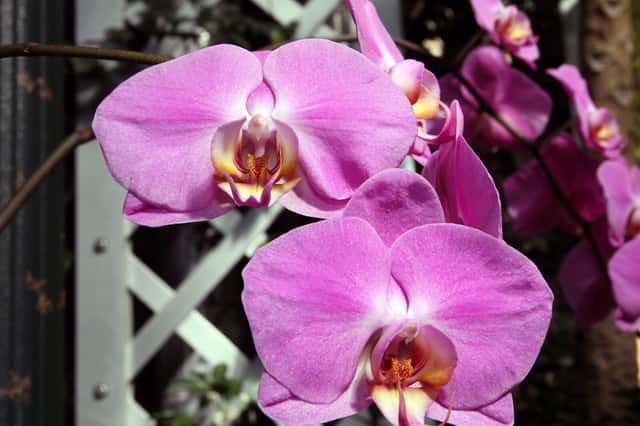
Orchidaceae
Doritaenopsis: Perfect Indoor Houseplant
Doritaenopsis
Grow in bright, indirect light in a free-draining bark mix, watering when the medium begins to dry and keeping humidity moderate to high. Avoid standing water at the roots or in the crown. It is one of the easiest orchids to keep indoors.
Every 7 days
Partial shade
16° - 29°C
50% - 70%
Categories
What is Doritaenopsis?
Doritaenopsis (Doritaenopsis) is a easy-care plant from the Orchidaceae family. Doritaenopsis is a cultivated orchid nothogenus (× Doritaenopsis) created by crossing Doritis with Phalaenopsis; most such plants are now treated within the genus Phalaenopsis. They are epiphytic orchids with broad, fleshy leaves and are among the most popular flowering houseplants. Their flower spi...
Doritaenopsis grows up to 60cm, spread of 40cm, watering every 7 days, 16°C – 29°C, 50–70% humidity. It is suitable for indoor environments and safe for pets.
Unlike many tropical plants, Doritaenopsis tolerates watering mistakes. Best for beginners. Unlike many popular species, Doritaenopsis is safe to keep around pets. Without adequate drainage, root rot can develop within 14 days.
How to Care for Doritaenopsis?
TLDR: Doritaenopsis needs Partial shade, watering every 7 days, and temperatures between 16-29°C with 50-70% humidity.
How Often Should You Water Doritaenopsis?
Water roughly once a week, soaking the bark thoroughly and letting all excess drain away, then allow it to dry slightly before watering again. Never leave the pot sitting in water, and keep water out of the central crown to prevent rot.
How Much Light Does Doritaenopsis Need?
Provide bright, filtered light such as an east-facing window. Thanks to its Doritis parentage it tolerates a little more light than a standard Phalaenopsis, but hot midday sun will scorch the leaves.
What Is the Best Soil for Doritaenopsis?
Use a dedicated orchid mix based on medium-grade fir bark, optionally with sphagnum moss and charcoal. The medium should hold some moisture yet drain fast, keeping the roots airy.
What Pot Should You Use for Doritaenopsis?
A clear pot with plenty of drainage holes lets you monitor the roots and supports root photosynthesis; purpose-made orchid pots are ideal.
Care Schedule
Fertilize
Every 14 days
Rotate
Every 14 days
Repot
Every 730 days
What Is Doritaenopsis and Where Does It Come From?
Doritaenopsis is a cultivated orchid nothogenus (× Doritaenopsis) created by crossing Doritis with Phalaenopsis; most such plants are now treated within the genus Phalaenopsis. They are epiphytic orchids with broad, fleshy leaves and are among the most popular flowering houseplants. Their flower spikes, often more upright than those of ordinary moth orchids, carry numerous long-lasting blooms in vivid pink, magenta, white and purple.
How to Propagate Doritaenopsis?
Keiki (plantlet on flower spike)
A keiki is a baby plantlet that forms naturally at nodes on the flower spike and is genetically identical to the mother plant; let it mature before removing.
- 1 Wait until the keiki has at least 3 leaves and 3 roots 5-8 cm long
- 2 Cut the keiki from the spike with a sterile blade, keeping its roots intact
- 3 Pot it in fine orchid bark or sphagnum moss
- 4 Keep high humidity, indirect light and light watering until established
Materials needed:
How Big Does Doritaenopsis Grow?
TLDR: Doritaenopsis can reach up to 60cm tall with Slow growth rate.
Max height
60cm
Spread
40cm
Growth rate
Slow
Foliage
Evergreen
Plant Uses
Ornamental
Great for decoration
Is your plant showing symptoms?
Click on the symptom to discover possible causes:
What Diseases Commonly Affect Doritaenopsis?
TLDR: Doritaenopsis is susceptible to 6 known diseases. Monitor regularly for early detection.
Root Rot
Root rot is a serious fungal disease that affects the root system of plants, causing them to decay and die. It is primarily caused by overwatering, poor drainage, or soil-borne fungi such as Pythium, Phytophthora, Rhizoctonia, and Fusarium. The disease thrives in waterlogged conditions where roots are deprived of oxygen, making them susceptible to fungal infection.
Crown Rot
Crown rot is a serious fungal disease that attacks the crown (base) of the plant where the stem meets the soil. It is caused by various fungal pathogens including Phytophthora, Fusarium, and Rhizoctonia. The disease thrives in waterlogged conditions and can quickly spread to kill the entire plant if not addressed promptly.
Mealybugs
Mealybugs are small, soft-bodied insects covered with a white, waxy, cottony material. They are common pests of houseplants and outdoor plants in mild climates. These sap-sucking insects feed on plant tissue, causing damage, stunted growth, and can lead to plant death if left untreated. They produce sticky honeydew which attracts sooty mold.
Scale Insects
Scale insects are small sap-sucking pests that appear as brown, shell-like bumps on plant stems and leaves. There are over 25 species, divided into armored (hard) and unarmored (soft) scales. They feed by piercing plant tissue and extracting sap, which weakens the plant and can lead to yellowing, stunted growth, and even death if left untreated. They also excrete honeydew, which attracts ants and promotes sooty mold growth.
Meaning & Symbolism
Moth orchids symbolize beauty, elegance, refinement and enduring love.
Compare with similar plants
| Attribute | Difficulty | Light | Watering | Pet Safe |
|---|---|---|---|---|
| Field Maple | Easy | Bright indirect | 14d | ✓ |
| Silver Birch | Easy | Direct sun | 14d | ✓ |
| Common Blanketflower | Easy | Direct sun | 10d | ✓ |
| Cushion Bush | Easy | Direct sun | 14d | ✓ |





