Pinaceae
Douglas Fir: Aromatic Plant
Pseudotsuga menziesii
A tough, cold-hardy evergreen for full-sun landscapes with cool summers. Needs consistently moist, well-drained, slightly acidic soil and is not tolerant of hot, dry, or waterlogged sites. Establishes best with regular deep watering for the first few years, then requires minimal routine care once mature.
Every 10 days
Bright indirect
-30° - 35°C
40% - 80%
Categories
What is Douglas Fir?
Douglas Fir (Pseudotsuga menziesii) is a medium-care plant from the Pinaceae family. Douglas fir (Pseudotsuga menziesii) is a large, fast-growing evergreen conifer native to western North America, ranging from the Rocky Mountains to the Pacific coast. Despite its common name, it is not a true fir (Abies) but belongs to its own genus, Pseudotsuga. It has a conical, pyramidal form wit...
Douglas Fir grows up to 100.0m, spread of 1500cm, watering every 10 days, -30°C – 35°C, 40–80% humidity. It is not suitable for indoor environments and safe for pets.
Unlike many popular species, Douglas Fir is safe to keep around pets.
How to Care for Douglas Fir?
TLDR: Douglas Fir needs Bright indirect, watering every 10 days, and temperatures between -30-35°C with 40-80% humidity.
How Often Should You Water Douglas Fir?
Water deeply and infrequently so the soil stays evenly moist but never waterlogged, especially during the first few growing seasons while the root system establishes. Mature trees tolerate short dry spells but decline in prolonged drought or hot, dry sites.
How Much Light Does Douglas Fir Need?
Needs full sun (6+ hours of direct light daily) for healthy, dense growth; it cannot grow in shade and becomes sparse and weak in low-light conditions.
What Is the Best Soil for Douglas Fir?
Prefers moist, well-drained soil that is slightly acidic to neutral (pH 5-7). Tolerates sandy, loamy, or clay soils as long as drainage is good, but dislikes poor, dry, waterlogged, or alkaline/calcareous ground.
What Pot Should You Use for Douglas Fir?
This is a large forest tree, not a true container plant. Young saplings can be kept temporarily in a large, sturdy pot with generous drainage holes and well-draining potting mix, but should be transplanted into open ground within a couple of years before the root system outgrows the container.
Care Schedule
Fertilize
Every 180 days
What Is Douglas Fir and Where Does It Come From?
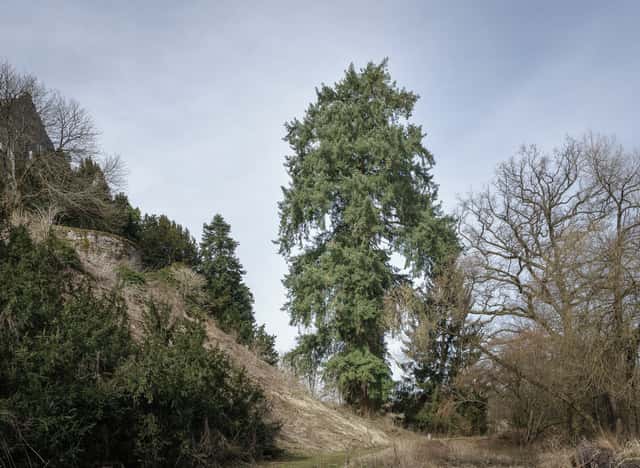
Douglas fir (Pseudotsuga menziesii) is a large, fast-growing evergreen conifer native to western North America, ranging from the Rocky Mountains to the Pacific coast. Despite its common name, it is not a true fir (Abies) but belongs to its own genus, Pseudotsuga. It has a conical, pyramidal form with soft, flat, blue-green to dark-green needles arranged spirally around the twig, and distinctive pendant cones with three-pointed, snake-tongue-like bracts protruding between the scales. In its native range it is among the tallest trees in the world, historically reaching over 90 m (300 ft); in cultivated landscapes it more typically grows 12-24 m (40-80 ft) tall with a 4-6 m spread. Douglas fir is the backbone of the Pacific Northwest timber industry and is Oregon's official state tree, and its fragrant foliage makes it one of the most popular Christmas trees in North America.
How to Propagate Douglas Fir?
Seed Propagation
- Seed has natural dormancy and needs cold stratification for reliable germination.
- Grow seedlings on in partial shade before hardening off to full sun.
- 1 Cold-stratify seeds by sowing in autumn/winter in a cold frame, or store dry seed and stratify in a refrigerator over winter
- 2 Sow stratified seed in free-draining seed compost in light shade in late winter to spring
- 3 Keep compost consistently moist until germination
- 4 Prick out seedlings into individual pots once large enough to handle, growing on in light shade
- 5 Plant out into a permanent, sunny position in late spring or early summer after the last frost, once well established
Materials needed:
How Big Does Douglas Fir Grow?
TLDR: Douglas Fir can reach up to 100.0m tall with Medium growth rate.
Max height
100.0m
Spread
15.0m
Growth rate
Medium
Foliage
Evergreen
Plant Uses
Ornamental
Great for decoration
Air Purifying
Improves air quality
Edible
Can be consumed
Medicinal
Medicinal properties
Aromatic
Pleasant fragrance
Medicinal Uses
- Antiseptic resin from the trunk traditionally used as a poultice for cuts, burns, and wounds
- Needle and bark infusions used traditionally by Indigenous peoples of the Pacific Northwest for coughs, sore throats, colds, and rheumatic joint pain
Culinary Uses
- Young needle tips and twigs steeped into a citrusy, vitamin C-rich herbal tea
- Inner bark historically dried and ground into a meal used for making bread in times of scarcity
- Resin chewed as a natural, gum-like substance by Indigenous North Americans
Is your plant showing symptoms?
Click on the symptom to discover possible causes:
What Diseases Commonly Affect Douglas Fir?
TLDR: Douglas Fir is susceptible to 6 known diseases. Monitor regularly for early detection.
Root Rot
Root rot is a serious fungal disease that affects the root system of plants, causing them to decay and die. It is primarily caused by overwatering, poor drainage, or soil-borne fungi such as Pythium, Phytophthora, Rhizoctonia, and Fusarium. The disease thrives in waterlogged conditions where roots are deprived of oxygen, making them susceptible to fungal infection.
Canker
Canker is a disease caused by various fungi and bacteria that create necrotic, sunken areas on bark of branches, stems, and trunks. Pathogens enter through wounds and natural openings, especially when plants are stressed. Canker can gradually weaken or kill branches by disrupting water and nutrient flow.
Gray Mold (Botrytis Blight)
Gray mold, caused by the fungus Botrytis cinerea, is a widespread necrotrophic pathogen affecting over 1,400 plant species. It thrives in cool, humid conditions and attacks weakened or aging plant tissues, causing soft rot and characteristic gray fuzzy growth.
Aphids
Aphids are small, soft-bodied, pear-shaped insects (1/16 to 1/8 inch long) that feed by sucking nutrient-rich sap from plants. They reproduce rapidly and can quickly weaken plants, causing distorted growth and transmitting plant viruses. Aphids come in various colors including green, black, red, yellow, brown, and gray. They secrete honeydew, a sticky substance that attracts ants and encourages sooty mold growth.
Meaning & Symbolism
As Oregon's official state tree, Douglas fir symbolizes the resilience, strength, and timber heritage of the Pacific Northwest. It is also one of the most widely used Christmas trees in North America, representing holiday tradition, warmth, and natural abundance.
Compare with similar plants
| Attribute | Difficulty | Light | Watering | Pet Safe |
|---|---|---|---|---|
| Dark Fieldcap | Medium | Low light | 2d | ⚠️ |
| Azalea | Medium | Partial shade | 3d | ⚠️ |
| Muriel's Bamboo | Medium | Partial shade | 3d | ✓ |
| Bougainvillea | Medium | Direct sun | 7d | ⚠️ |
Choose & Compare
Sources & References
- Douglas Fir - Pseudotsuga menziesii | The UFOR Nursery & Lab (UMN)
- Pseudotsuga menziesii | Plants For A Future (PFAF)
- Douglas-fir | Pseudotsuga menziesii | The Morton Arboretum
- Pseudotsuga menziesii | NC State Extension Gardener Plant Toolbox
- Common Douglas Fir Diseases and Pests - Biology Insights
- Oregon State Tree | Douglas Fir - State Symbols USA
- Is Douglas Fir (Pseudotsuga menziesii) Toxic to Cats? - Cat World




