Primulaceae
Cyclamen coum - Eastern Cyclamen Care Guide
Cyclamen coum
Plant the tuber shallowly, hollow-side up, in gritty, humus-rich soil that drains fast, and let winter and spring rain do most of the watering. Keep it dry and undisturbed once the foliage dies back for summer dormancy; overly wet soil at that stage is the most common cause of failure.
Every 10 days
Partial shade
-15° - °C
% - %
Categories
What is Eastern Cyclamen?
Eastern Cyclamen (Cyclamen coum) is a medium-care plant from the Primulaceae family. Cyclamen coum, the eastern sowbread, is a tuberous winter- and spring-flowering perennial native to the region around the Black Sea, from Bulgaria through northern Turkey to the Caucasus, with an isolated population reaching Lebanon and northern Israel. It forms a low, flattened tuber that rests dor...
Eastern Cyclamen grows up to 10cm, spread of 10cm, watering every 10 days. It is suitable for indoor environments and not safe for pets.
Without precautions, ingestion can cause irritation in pets. Keep out of reach of cats and dogs. Without adequate drainage, root rot can develop within 20 days.
How to Care for Eastern Cyclamen?
TLDR: Eastern Cyclamen needs Partial shade, watering every 10 days, and temperatures between -15-30°C with 40-70% humidity.
How Often Should You Water Eastern Cyclamen?
Water only during active winter-spring growth, letting the top of the soil dry between waterings; withhold water almost entirely once the leaves yellow and the plant goes dormant for summer.
How Much Light Does Eastern Cyclamen Need?
Give it dappled or partial shade, such as under deciduous trees, where it gets bright winter light once the tree canopy is bare.
What Is the Best Soil for Eastern Cyclamen?
Use a well-draining, humus-rich mix with added horticultural grit; the plant tolerates acidic to alkaline soils but will not tolerate waterlogging around the tuber.
What Pot Should You Use for Eastern Cyclamen?
A shallow, wide terracotta pan or bulb pan with generous drainage holes, sized just slightly larger than the tuber.
What Is Eastern Cyclamen and Where Does It Come From?
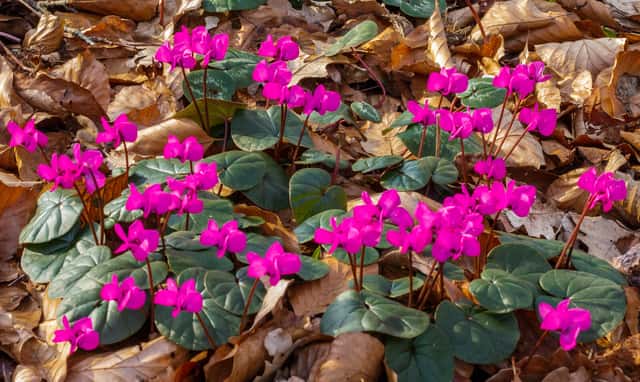
Cyclamen coum, the eastern sowbread, is a tuberous winter- and spring-flowering perennial native to the region around the Black Sea, from Bulgaria through northern Turkey to the Caucasus, with an isolated population reaching Lebanon and northern Israel. It forms a low, flattened tuber that rests dormant through summer heat, then pushes up rounded, heart-shaped leaves - often marbled silver - alongside shell-shaped flowers in white, pink, or deep magenta from late winter into spring. One of the hardiest cyclamen species, it naturalises readily under deciduous trees and shrubs, self-seeding into drifts over the years.
How to Propagate Eastern Cyclamen?
Seed Propagation
Cyclamen seed germinates best in darkness and cool temperatures, so cover trays or keep them in a shaded cold frame; expect flowering tubers only after 2-3 growing seasons.
- 1 Collect ripe seed pods in early-to-mid summer once the coiled flower stalks straighten and the pod splits open.
- 2 Soak the sticky seeds in lukewarm water for 12-24 hours to soften the seed coat and remove the sugary coating that attracts ants.
- 3 Sow seeds thinly on the surface of a gritty, free-draining seed compost and cover with a thin layer of horticultural grit.
- 4 Keep the tray in a dark, cool spot (around 15-18C) until germination, which can take 4-12 weeks.
- 5 Move seedlings into bright, indirect light once they emerge, and transplant into individual small pots after the first true leaf appears.
Materials needed:
How Big Does Eastern Cyclamen Grow?
TLDR: Eastern Cyclamen can reach up to 10cm tall with Slow growth rate.
Max height
10cm
Spread
10cm
Growth rate
Slow
Foliage
Deciduous
Warning: Toxic Plant
This plant can be toxic if ingested. Keep out of reach of:
Plant Uses
Ornamental
Great for decoration
Ground Cover
Soil coverage
Is your plant showing symptoms?
Click on the symptom to discover possible causes:
What Diseases Commonly Affect Eastern Cyclamen?
TLDR: Eastern Cyclamen is susceptible to 3 known diseases. Monitor regularly for early detection.
Spider Mites
Spider mites are tiny arachnids (less than 1/20 inch long) related to spiders and ticks that feed on plant sap. They thrive in hot, dry conditions and can cause significant damage to ornamental and vegetable plants. During severe infestations, crop losses can reach 14% or higher as these pests disrupt vital plant processes including photosynthesis, carbon dioxide absorption, and transpiration.
Gray Mold (Botrytis Blight)
Gray mold, caused by the fungus Botrytis cinerea, is a widespread necrotrophic pathogen affecting over 1,400 plant species. It thrives in cool, humid conditions and attacks weakened or aging plant tissues, causing soft rot and characteristic gray fuzzy growth.
Root Rot
Root rot is a serious fungal disease that affects the root system of plants, causing them to decay and die. It is primarily caused by overwatering, poor drainage, or soil-borne fungi such as Pythium, Phytophthora, Rhizoctonia, and Fusarium. The disease thrives in waterlogged conditions where roots are deprived of oxygen, making them susceptible to fungal infection.
Meaning & Symbolism
Represents resignation and farewell in Victorian flower language, with its swept-back petals read as flowers taking flight; also linked to tender love.
Fun Facts
The common name sowbread comes from wild pigs digging up and eating the tubers.
Its leaf patterns are so varied that growers collect named forms purely for the marbling.
The tuber produces roots only from the center of its underside, unlike most other bulbs.
Sicilian fishermen once crushed cyclamen tubers to stun fish thanks to their toxic saponins.
Frequently asked questions
Is Cyclamen coum toxic to cats and dogs?
Why did my Cyclamen coum disappear in summer?
Can I divide the tuber to make more plants?
What is the biggest threat to potted Cyclamen coum?
How cold-hardy is Cyclamen coum?
Compare with similar plants
| Attribute | Difficulty | Light | Watering | Pet Safe |
|---|---|---|---|---|
| Dark Fieldcap | Medium | Low light | 2d | ⚠️ |
| Azalea | Medium | Partial shade | 3d | ⚠️ |
| Muriel's Bamboo | Medium | Partial shade | 3d | ✓ |
| Bougainvillea | Medium | Direct sun | 7d | ⚠️ |
Choose & Compare
Sources & References
- Cyclamen coum | eastern cyclamen - RHS
- Hardy Cyclamen Care | RHS Advice
- Cyclamen coum - Wikipedia
- Toxic and Non-toxic Plants: Cyclamen - ASPCA
- Sowbread - ASPCA
- Pests & Diseases - Cyclamen Society
- Hardy Cyclamen for the Home Garden - Penn State Extension
- Cyclamen - King's American Dispensatory (Henriette's Herbal)
- Growing from Seed - Cyclamen Society
- Sow Cyclamen In June And July - Horticulture Magazine




