Asteraceae
English Daisy: Ground Cover Plant
Bellis
An easy outdoor plant. Provide full sun or partial shade, fertile soil that retains moisture without becoming waterlogged, and regular watering in small amounts. Fertilize every 2-3 weeks in spring, remove spent flowers to extend the blooming period, and protect it from intense summer heat. It is frost-resistant down to about -15 °C (5 °F).
Every 4 days
Bright indirect
-15° - 25°C
40% - 70%
Categories
What is English Daisy?
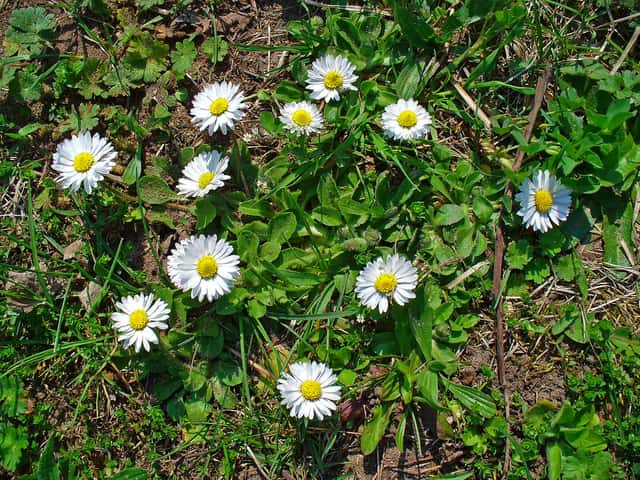
English Daisy (Bellis) is a easy-care plant from the Asteraceae family. Bellis is a genus of small plants in the Asteraceae family, with about 10 species native to Europe and the Mediterranean basin. They form low rosettes of spoon-shaped leaves from which short stems emerge with a single flower: white, pink, or red ray florets around a yellow center. The typical cultiv...
English Daisy grows up to 20cm, spread of 23cm, watering every 4 days, -15°C – 25°C, 40–70% humidity. It is not suitable for indoor environments and safe for pets.
Unlike many tropical plants, English Daisy tolerates watering mistakes. Best for beginners. Unlike many popular species, English Daisy is safe to keep around pets.
How to Care for English Daisy?
TLDR: English Daisy needs Bright indirect, watering every 4 days, and temperatures between -15-25°C with 40-70% humidity.
How Often Should You Water English Daisy?
Keep the substrate consistently slightly moist: water lightly and often (generally every 3-5 days during the growing season, more frequently in pots and during hot weather). Avoid waterlogging, which causes root rot, and water at the base to avoid wetting the flowers and leaves.
How Much Light Does English Daisy Need?
It blooms best in full sun or bright partial shade. In hot climates, it prefers morning sun and shade during the hottest hours, as intense summer heat weakens the plant and stops flowering.
What Is the Best Soil for English Daisy?
Prefers loamy soil, rich in humus, cool, and well-draining. It tolerates slightly acidic to alkaline soils (pH 5.5-7.5). For pots, use a high-quality universal substrate mixed with some compost.
What Pot Should You Use for English Daisy?
A pot or planter 15-20 cm deep with drainage holes; terracotta works well. In winter, wrap the pot and place it in a sheltered spot.
Care Schedule
Fertilize
Every 21 days
What Is English Daisy and Where Does It Come From?
Bellis is a genus of small plants in the Asteraceae family, with about 10 species native to Europe and the Mediterranean basin. They form low rosettes of spoon-shaped leaves from which short stems emerge with a single flower: white, pink, or red ray florets around a yellow center. The typical cultivated species is Bellis perennis, the common daisy, and the care instructions in this guide are based on it. Garden varieties (pomponette, double-flowered) are almost always treated as biennials: they are sown in summer and bloom the following spring.
How to Propagate English Daisy?
Sowing
They bloom the following spring: they need a period of cool days to form flowers. Resow every year if you want continuous flowering.
- 1 Sow between June and July in a seedbed or directly in the ground
- 2 Scatter the seeds over the substrate without covering them, as they need light to germinate
- 3 Keep the substrate moist at about 18 °C (64 °F)
- 4 Transplant the seedlings to their permanent location in autumn
Materials needed:
Division
Divide just after flowering or in early autumn. Discard old and weak rosettes.
- 1 After flowering, carefully lift the clump
- 2 Separate individual rosettes, each with its own roots
- 3 Replant them about 15-20 cm apart
- 4 Water well and keep the soil moist until they take root
Materials needed:
How Big Does English Daisy Grow?
TLDR: English Daisy can reach up to 20cm tall with Fast growth rate.
Max height
20cm
Spread
23cm
Growth rate
Fast
Foliage
Semi-evergreen
Warning: Toxic Plant
This plant can be toxic if ingested. Keep out of reach of:
Plant Uses
Ornamental
Great for decoration
Edible
Can be consumed
Medicinal
Medicinal properties
Ground Cover
Soil coverage
Medicinal Uses
- In traditional European medicine, it was used in infusions and ointments for bruises and minor wounds (hence the old name "bruisewort"); there is no solid scientific backing for these uses.
Culinary Uses
- The flowers and young leaves, which have a somewhat bitter taste, are eaten raw in salads or used as an edible garnish in small quantities.
Is your plant showing symptoms?
Click on the symptom to discover possible causes:
What Diseases Commonly Affect English Daisy?
TLDR: English Daisy is susceptible to 10 known diseases. Monitor regularly for early detection.
Powdery Mildew
Powdery mildew is a common fungal disease caused by various fungi species including Erysiphe, Podosphaera, Oïdium, and Leveillula. It affects over 10,000 plant species worldwide. The disease thrives in warm, dry climates with high humidity and appears as a distinctive white powdery coating on plant surfaces.
Gray Mold (Botrytis Blight)
Gray mold, caused by the fungus Botrytis cinerea, is a widespread necrotrophic pathogen affecting over 1,400 plant species. It thrives in cool, humid conditions and attacks weakened or aging plant tissues, causing soft rot and characteristic gray fuzzy growth.
Root Rot
Root rot is a serious fungal disease that affects the root system of plants, causing them to decay and die. It is primarily caused by overwatering, poor drainage, or soil-borne fungi such as Pythium, Phytophthora, Rhizoctonia, and Fusarium. The disease thrives in waterlogged conditions where roots are deprived of oxygen, making them susceptible to fungal infection.
Aphids
Aphids are small, soft-bodied, pear-shaped insects (1/16 to 1/8 inch long) that feed by sucking nutrient-rich sap from plants. They reproduce rapidly and can quickly weaken plants, causing distorted growth and transmitting plant viruses. Aphids come in various colors including green, black, red, yellow, brown, and gray. They secrete honeydew, a sticky substance that attracts ants and encourages sooty mold growth.
Meaning & Symbolism
Innocence, purity, and new beginnings. Its name is often derived from the Latin bellus, meaning "beautiful," and it is the flower used for the "he loves me, he loves me not" game.
Compare with similar plants
| Attribute | Difficulty | Light | Watering | Pet Safe |
|---|---|---|---|---|
| Field Maple | Easy | Bright indirect | 14d | ✓ |
| Silver Birch | Easy | Direct sun | 14d | ✓ |
| Common Blanketflower | Easy | Direct sun | 10d | ✓ |
| Cushion Bush | Easy | Direct sun | 14d | ✓ |





