Annonaceae
Mast Tree: Medicinal Uses & Care Tips
Polyalthia longifolia
An easy-to-grow tree with moderate growth, drought-tolerant once established. It prefers full sun to partial shade, well-drained soil, and regular watering only while young. It is widely used as a hedge, windbreak, and street tree due to its dense, columnar canopy.
Every 10 days
Bright indirect
10° - 40°C
50% - 80%
Categories
What is Mast Tree?
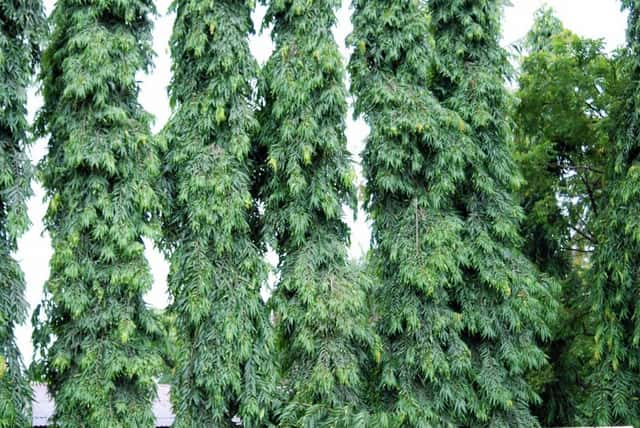
Mast Tree (Polyalthia longifolia) is a easy-care plant from the Annonaceae family. The Mast Tree is an elegant tropical evergreen with a columnar canopy, native to southern India and Sri Lanka. Its long, narrow leaves with wavy margins emerge in a coppery-bronze tone and mature into a glossy dark green, cascading downward along the branches—giving it a 'weeping' appearance. In spr...
Mast Tree grows up to 20.0m, watering every 10 days, 10°C – 40°C, 50–80% humidity. It is not suitable for indoor environments and safe for pets.
Unlike many tropical plants, Mast Tree tolerates watering mistakes. Best for beginners. Unlike many popular species, Mast Tree is safe to keep around pets.
How to Care for Mast Tree?
TLDR: Mast Tree needs Bright indirect, watering every 10 days, and temperatures between 10-40°C with 50-80% humidity.
How Often Should You Water Mast Tree?
Water regularly until established (first year); after that, the tree tolerates drought periods well, requiring watering only during prolonged dry spells or when grown in a pot.
How Much Light Does Mast Tree Need?
Prefers full sun for dense and compact growth, but tolerates partial shade. Low light makes the canopy sparse and growth slower.
What Is the Best Soil for Mast Tree?
Grows best in loamy soil, rich in organic matter and well-drained, with a slightly acidic to neutral pH (5.5–7.5). Avoid waterlogged soils, which promote root rot.
What Pot Should You Use for Mast Tree?
For young seedlings, use a large, deep pot with good drainage holes; as it is a large tree, it is ideal to transfer it to a permanent planting site in the ground as soon as possible.
Care Schedule
Fertilize
Every 90 days
What Is Mast Tree and Where Does It Come From?
The Mast Tree is an elegant tropical evergreen with a columnar canopy, native to southern India and Sri Lanka. Its long, narrow leaves with wavy margins emerge in a coppery-bronze tone and mature into a glossy dark green, cascading downward along the branches—giving it a 'weeping' appearance. In spring, it produces small, star-shaped pale green flowers for a few weeks, followed by clusters of fruits that ripen from green to dark purple, which are favored by birds. It is often confused with the true Ashoka tree (Saraca asoca), which is why it is commonly called 'False Ashoka'.
How Big Does Mast Tree Grow?
TLDR: Mast Tree can reach up to 20.0m tall with Medium growth rate.
Max height
20.0m
Growth rate
Medium
Foliage
Evergreen
Plant Uses
Ornamental
Great for decoration
Medicinal
Medicinal properties
Medicinal Uses
- Leaves and bark used in traditional Indian medicine for fever, skin diseases, and hypertension
- Seed oil with antioxidant and antimicrobial properties in preliminary studies
- Leaf extracts studied for potential renal protective effects and lack of relevant acute toxicity
Is your plant showing symptoms?
Click on the symptom to discover possible causes:
What Diseases Commonly Affect Mast Tree?
TLDR: Mast Tree is susceptible to 6 known diseases. Monitor regularly for early detection.
Root Rot
Root rot is a serious fungal disease that affects the root system of plants, causing them to decay and die. It is primarily caused by overwatering, poor drainage, or soil-borne fungi such as Pythium, Phytophthora, Rhizoctonia, and Fusarium. The disease thrives in waterlogged conditions where roots are deprived of oxygen, making them susceptible to fungal infection.
Sooty Mold
Sooty mold is a fungal disease that develops on surfaces coated with honeydew, a sticky sweet substance secreted by sap-sucking insects like aphids, scale insects, and whiteflies. While it does not directly infect plant tissue, it reduces photosynthetic capacity by blocking sunlight and diminishes the plant's aesthetic appearance.
Leaf Spot
Leaf spot is a common fungal disease caused by various pathogens including Alternaria, Ascochyta, Colletotrichum, Septoria, and Venturia. It primarily affects leaves, causing discolored spots that can lead to premature leaf drop if left untreated.
Scale Insects
Scale insects are small sap-sucking pests that appear as brown, shell-like bumps on plant stems and leaves. There are over 25 species, divided into armored (hard) and unarmored (soft) scales. They feed by piercing plant tissue and extracting sap, which weakens the plant and can lead to yellowing, stunted growth, and even death if left untreated. They also excrete honeydew, which attracts ants and promotes sooty mold growth.
Meaning & Symbolism
Associated with the true Ashoka tree (Saraca asoca), sacred in India, with which it is often confused due to its elegant stature and pendulous foliage. It is planted near temples and homes for its dense shade and for representing peace, protection, and tranquility.
Compare with similar plants
| Attribute | Difficulty | Light | Watering | Pet Safe |
|---|---|---|---|---|
| Field Maple | Easy | Bright indirect | 14d | ✓ |
| Silver Birch | Easy | Direct sun | 14d | ✓ |
| Common Blanketflower | Easy | Direct sun | 10d | ✓ |
| Cushion Bush | Easy | Direct sun | 14d | ✓ |





