Oxalidaceae
False Shamrock (Oxalis regnellii): Complete Care Guide
Oxalis regnellii
Place in bright indirect light near an east or curtain-filtered window, water every 10–14 days allowing the top inch of soil to dry out between waterings, and use a well-draining potting mix. Fertilize every two weeks during the growing season with diluted liquid fertilizer. Avoid overwatering — root rot from waterlogged soil is the most common problem. During dormancy, stop watering and fertilizing until new growth appears.
Every 12 days
Partial shade
13° - 24°C
40% - 60%
Categories
What is False Shamrock?
False Shamrock (Oxalis regnellii) is a easy-care plant from the Oxalidaceae family. Oxalis regnellii, commonly known as false shamrock or purple shamrock, is a perennial bulbous plant native to South America — particularly Brazil, Bolivia, Argentina, and Paraguay. A member of the Oxalidaceae family, it is beloved for its striking trifoliate leaves, which range from rich green to de...
False Shamrock grows up to 30cm, spread of 60cm, watering every 12 days, 13°C – 24°C, 40–60% humidity. It is suitable for indoor environments and not safe for pets.
Unlike many tropical plants, False Shamrock tolerates watering mistakes. Best for beginners. Without precautions, ingestion can cause irritation in pets. Keep out of reach of cats and dogs. Without adequate drainage, root rot can develop within 24 days.
How to Care for False Shamrock?
TLDR: False Shamrock needs Partial shade, watering every 12 days, and temperatures between 13-24°C with 40-60% humidity.
How Often Should You Water False Shamrock?
Water every 10–14 days, only when the top 1–2 inches of soil are dry. Oxalis grows from corms that are very susceptible to rot in soggy conditions. During dormancy, withhold water completely and resume when new shoots emerge.
How Much Light Does False Shamrock Need?
Provide bright indirect light — an east-facing or curtain-filtered south/west window is ideal. Direct harsh sun can scorch leaves and trigger premature dormancy. Too little light causes leggy stems and dull leaf color. The leaves will naturally open toward the light source.
What Is the Best Soil for False Shamrock?
Use a well-draining potting mix enriched with perlite or coarse sand. Ensure the pot has drainage holes. A slightly acidic to neutral pH (6.0–7.0) suits this plant best. Heavy or compact soils that retain moisture will quickly cause corm rot.
What Pot Should You Use for False Shamrock?
A terracotta or ceramic pot with drainage holes works best. Avoid oversized pots as excess soil retains moisture and promotes corm rot. Choose a pot only 2–3 cm larger than the plant root ball.
Care Schedule
Fertilize
Every 14 days
Rotate
Every 30 days
Repot
Every 548 days
What Is False Shamrock and Where Does It Come From?
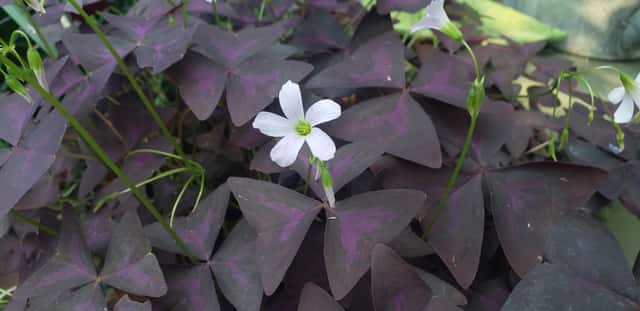
Oxalis regnellii, commonly known as false shamrock or purple shamrock, is a perennial bulbous plant native to South America — particularly Brazil, Bolivia, Argentina, and Paraguay. A member of the Oxalidaceae family, it is beloved for its striking trifoliate leaves, which range from rich green to deep purple, and its delicate white or pale pink five-petaled flowers that bloom from spring through autumn. One of its most charming traits is photonasty: the leaves fold closed at night and in low light, reopening with morning brightness through turgor pressure changes. The plant grows from small corms and may enter a brief dormancy period after flowering or during hot summer months.
How to Propagate False Shamrock?
Corm Division
Use clean tools to avoid disease transmission. New growth can be slow to emerge — avoid overwatering while waiting.
- 1 Remove the plant from its pot during dormancy or early spring
- 2 Gently separate the small offset corms from the main cluster
- 3 Plant each corm individually in well-draining potting mix about 1 inch deep
- 4 Water lightly and place in bright indirect light — new shoots appear in 2–4 weeks
Materials needed:
How Big Does False Shamrock Grow?
TLDR: False Shamrock can reach up to 30cm tall with Medium growth rate.
Max height
30cm
Spread
60cm
Growth rate
Medium
Foliage
Semi-evergreen
Warning: Toxic Plant
This plant can be toxic if ingested. Keep out of reach of:
Plant Uses
Ornamental
Great for decoration
Is your plant showing symptoms?
Click on the symptom to discover possible causes:
What Diseases Commonly Affect False Shamrock?
TLDR: False Shamrock is susceptible to 8 known diseases. Monitor regularly for early detection.
Root Rot
Root rot is a serious fungal disease that affects the root system of plants, causing them to decay and die. It is primarily caused by overwatering, poor drainage, or soil-borne fungi such as Pythium, Phytophthora, Rhizoctonia, and Fusarium. The disease thrives in waterlogged conditions where roots are deprived of oxygen, making them susceptible to fungal infection.
Powdery Mildew
Powdery mildew is a common fungal disease caused by various fungi species including Erysiphe, Podosphaera, Oïdium, and Leveillula. It affects over 10,000 plant species worldwide. The disease thrives in warm, dry climates with high humidity and appears as a distinctive white powdery coating on plant surfaces.
Spider Mites
Spider mites are tiny arachnids (less than 1/20 inch long) related to spiders and ticks that feed on plant sap. They thrive in hot, dry conditions and can cause significant damage to ornamental and vegetable plants. During severe infestations, crop losses can reach 14% or higher as these pests disrupt vital plant processes including photosynthesis, carbon dioxide absorption, and transpiration.
Aphids
Aphids are small, soft-bodied, pear-shaped insects (1/16 to 1/8 inch long) that feed by sucking nutrient-rich sap from plants. They reproduce rapidly and can quickly weaken plants, causing distorted growth and transmitting plant viruses. Aphids come in various colors including green, black, red, yellow, brown, and gray. They secrete honeydew, a sticky substance that attracts ants and encourages sooty mold growth.
Meaning & Symbolism
In both South American and Irish-inspired folklore, the three-leaflet shamrock symbolizes luck, love, and good fortune. Oxalis regnellii is a popular gift plant believed to bring happiness and prosperity into the home.
Fun Facts
Oxalis regnellii leaves open and close in response to light in a behaviour called photonasty — controlled by changes in water pressure inside specialised cells at the leaf base.
Despite the name "shamrock," this plant is not a true shamrock (Trifolium) but belongs to the entirely separate Oxalidaceae family.
Native to subtropical South America, it can survive mild frosts outdoors in USDA zones 8a–11 and is grown worldwide as a houseplant.
After heavy flowering or heat stress, the plant may shed all its leaves and enter dormancy — this is a healthy survival mechanism, not death.
Frequently asked questions
How often should I water false shamrock?
Is Oxalis regnellii toxic to cats and dogs?
Why are my false shamrock leaves closed?
What do I do when false shamrock goes dormant?
How do I propagate false shamrock?
Compare with similar plants
| Attribute | Difficulty | Light | Watering | Pet Safe |
|---|---|---|---|---|
| Field Maple | Easy | Bright indirect | 14d | ✓ |
| Silver Birch | Easy | Direct sun | 14d | ✓ |
| Common Blanketflower | Easy | Direct sun | 10d | ✓ |
| Cushion Bush | Easy | Direct sun | 14d | ✓ |





