Asteraceae
False Yellowhead: Aromatic Plant
Dittrichia viscosa
A hardy and very easy-to-grow plant, false yellowhead requires very little care once established: full sun, well-drained soil (even poor and dry), and rare watering limited to periods of prolonged drought. It tolerates Mediterranean summer heat and moderate winter cold well but is sensitive to waterlogging. Annual pruning after flowering helps maintain a compact shape.
Every 14 days
Direct sun
-5° - 45°C
20% - 60%
Categories
What is False Yellowhead?
False Yellowhead (Dittrichia viscosa) is a easy-care plant from the Asteraceae family. Dittrichia viscosa (syn. Inula viscosa), commonly known as false yellowhead or sticky fleabane, is a perennial evergreen shrub in the Asteraceae family, widespread throughout the Mediterranean basin. It typically grows along roadsides, wasteland, riverbeds, and degraded areas up to 1500 m in altitud...
False Yellowhead grows up to 1.5m, watering every 14 days, -5°C – 45°C, 20–60% humidity. It is not suitable for indoor environments and safe for pets.
Unlike many tropical plants, False Yellowhead tolerates watering mistakes. Best for beginners. Unlike many popular species, False Yellowhead is safe to keep around pets.
How to Care for False Yellowhead?
TLDR: False Yellowhead needs Direct sun, watering every 14 days, and temperatures between -5-45°C with 20-60% humidity.
How Often Should You Water False Yellowhead?
Water sparingly: this plant is well-adapted to Mediterranean drought. Allow the soil to dry out completely between waterings and further reduce water intake in winter when the plant is dormant. Excess water is more harmful than thirst.
How Much Light Does False Yellowhead Need?
Prefers full sun positions, with at least 6-8 hours of direct light per day. It does not tolerate shade or partial shade, conditions in which growth is stunted and flowering is sparse.
What Is the Best Soil for False Yellowhead?
Adapts to practically any type of soil, even poor, stony, or sandy, as long as it is well-drained. A pH from sub-acidic to sub-alkaline (about 5.5-8.5) is well tolerated. Avoid substrates that retain too much moisture to prevent root rot.
What Pot Should You Use for False Yellowhead?
If grown in a pot, prefer unglazed terracotta containers, which promote transpiration and rapid drying of the substrate, with large drainage holes and a layer of expanded clay or gravel at the bottom to avoid water stagnation.
What Is False Yellowhead and Where Does It Come From?
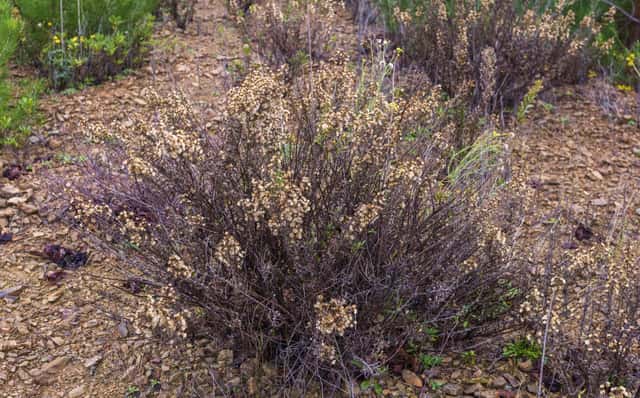
Dittrichia viscosa (syn. Inula viscosa), commonly known as false yellowhead or sticky fleabane, is a perennial evergreen shrub in the Asteraceae family, widespread throughout the Mediterranean basin. It typically grows along roadsides, wasteland, riverbeds, and degraded areas up to 1500 m in altitude, colonizing even the poorest and stoniest soils. It has a bushy habit with erect and highly branched stems, woody at the base, which can reach 50-150 cm in height. The leaves are elongated, pointed, with serrated margins and covered with glandular hairs that release a sticky resin with a resinous and balsamic scent, from which the name 'viscosa' derives. In autumn, it produces numerous yellow flower heads that provide an important source of pollen and nectar for bees and pollinating insects when most other blooms have ended.
How to Propagate False Yellowhead?
Sowing
Seeds germinate best with indirect light and mild temperatures; avoid waterlogging in the seedbed.
- 1 Sow in spring in a seedbed or cold frame, covering the seeds with a thin layer of substrate.
- 2 Keep the substrate slightly moist until germination.
- 3 Transplant seedlings into individual pots as soon as they are manageable.
- 4 Plant out in the ground after the last frost.
Materials needed:
Stem cutting
Avoid waterlogging which promotes rot; rooting is slower compared to sowing.
- 1 Take 10-15 cm cuttings from healthy, semi-woody stems without flowers.
- 2 Remove leaves from the lower half of the cutting.
- 3 Dip the base in rooting hormone.
- 4 Plant in well-draining substrate and keep slightly moist.
- 5 Place in a bright spot but not in direct full sun until rooted.
Materials needed:
Clump division
Easier operation on well-developed plants; avoid dividing in mid-summer.
- 1 In spring or autumn, carefully dig up a mature clump.
- 2 Divide the root ball into sections, ensuring each has healthy roots.
- 3 Plant the new sections immediately in well-drained soil.
- 4 Water moderately until established.
Materials needed:
How Big Does False Yellowhead Grow?
TLDR: False Yellowhead can reach up to 1.5m tall with Fast growth rate.
Max height
1.5m
Growth rate
Fast
Foliage
Evergreen
Warning: Toxic Plant
This plant can be toxic if ingested. Keep out of reach of:
Plant Uses
Medicinal
Medicinal properties
Aromatic
Pleasant fragrance
Ornamental
Great for decoration
Medicinal Uses
- Astringent use in traditional folk medicine
- Soothing topical application on bee, wasp, and jellyfish stings
Is your plant showing symptoms?
Click on the symptom to discover possible causes:
What Diseases Commonly Affect False Yellowhead?
TLDR: False Yellowhead is susceptible to 6 known diseases. Monitor regularly for early detection.
Powdery Mildew
Powdery mildew is a common fungal disease caused by various fungi species including Erysiphe, Podosphaera, Oïdium, and Leveillula. It affects over 10,000 plant species worldwide. The disease thrives in warm, dry climates with high humidity and appears as a distinctive white powdery coating on plant surfaces.
Rust
Rust is a common fungal disease caused by fungi in the order Pucciniales that affects a wide variety of plants. The disease gets its name from the characteristic orange, yellow, or reddish-brown pustules that appear on leaves, resembling metal rust. This obligate fungal parasite requires living plants to survive and can cause significant economic losses in agricultural crops.
Aphids
Aphids are small, soft-bodied, pear-shaped insects (1/16 to 1/8 inch long) that feed by sucking nutrient-rich sap from plants. They reproduce rapidly and can quickly weaken plants, causing distorted growth and transmitting plant viruses. Aphids come in various colors including green, black, red, yellow, brown, and gray. They secrete honeydew, a sticky substance that attracts ants and encourages sooty mold growth.
Spider Mites
Spider mites are tiny arachnids (less than 1/20 inch long) related to spiders and ticks that feed on plant sap. They thrive in hot, dry conditions and can cause significant damage to ornamental and vegetable plants. During severe infestations, crop losses can reach 14% or higher as these pests disrupt vital plant processes including photosynthesis, carbon dioxide absorption, and transpiration.
Meaning & Symbolism
A pioneer plant par excellence, false yellowhead is among the first species to colonize burned, abandoned, or degraded land. For this reason, in Mediterranean folk tradition, it is associated with the idea of resilience, adaptation, and the rebirth of nature even in the most difficult contexts.
Compare with similar plants
| Attribute | Difficulty | Light | Watering | Pet Safe |
|---|---|---|---|---|
| Field Maple | Easy | Bright indirect | 14d | ✓ |
| Silver Birch | Easy | Direct sun | 14d | ✓ |
| Common Blanketflower | Easy | Direct sun | 10d | ✓ |
| Cushion Bush | Easy | Direct sun | 14d | ✓ |





