Caprifoliaceae
Field Scabious: Medicinal Uses & Care Tips
Knautia arvensis
An undemanding sun-loving perennial suitable for natural and butterfly gardens. It thrives in well-draining, rather poor and calcareous soils in full sun to light partial shade. Once established, it tolerates drought and requires no fertilization or special care; occasional removal of spent flower stalks is sufficient to prolong flowering.
Every 10 days
Bright indirect
-30° - 35°C
40% - 70%
Categories
What is Field Scabious?
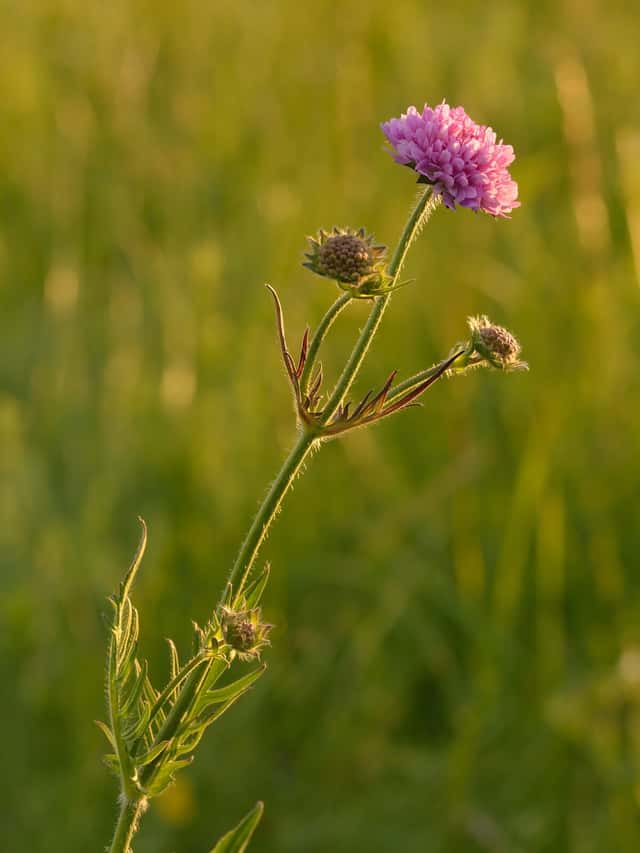
Field Scabious (Knautia arvensis) is a easy-care plant from the Caprifoliaceae family. Field Scabious is a perennial meadow herb from the honeysuckle family (Caprifoliaceae), growing to a height of 30 to 150 cm. Its upright, slightly grooved stem bears grey-green, dull leaves with lyre-shaped to pinnately lobed blades. From May to September, blue to pinkish-purple flowers appear, clus...
Field Scabious grows up to 1.2m, spread of 40cm, watering every 10 days, -30°C – 35°C, 40–70% humidity. It is not suitable for indoor environments and safe for pets.
Unlike many tropical plants, Field Scabious tolerates watering mistakes. Best for beginners. Unlike many popular species, Field Scabious is safe to keep around pets.
How to Care for Field Scabious?
TLDR: Field Scabious needs Bright indirect, watering every 10 days, and temperatures between -30-35°C with 40-70% humidity.
How Often Should You Water Field Scabious?
After planting, water regularly until the plant establishes itself. Thereafter, Field Scabious tolerates drought well, and watering is only necessary during prolonged dry spells – overwatering, on the other hand, harms it and increases the risk of root rot.
How Much Light Does Field Scabious Need?
It flowers best in full sun but can tolerate light partial shade. In shade, it tends to be sparser and flowers less profusely.
What Is the Best Soil for Field Scabious?
It prefers well-draining, drier, and calcareous (alkaline to neutral) soils – it can also tolerate poorer sandy or clayey substrates, provided they drain well. Heavy, constantly moist soils are not suitable for it.
What Pot Should You Use for Field Scabious?
It thrives best directly in the open ground of a flower bed or a wildflower meadow. If grown in a container, choose a wider and deeper pot with excellent drainage holes and a well-draining substrate, as the plant has a long taproot.
What Is Field Scabious and Where Does It Come From?
Field Scabious is a perennial meadow herb from the honeysuckle family (Caprifoliaceae), growing to a height of 30 to 150 cm. Its upright, slightly grooved stem bears grey-green, dull leaves with lyre-shaped to pinnately lobed blades. From May to September, blue to pinkish-purple flowers appear, clustered into conspicuous, approximately 4 cm large flower heads. It grows in meadows, field margins, and light woodlands, where it prefers drier, calcareous soils from lowlands to mountainous regions. It is an important honey plant and a host plant for many species of butterflies and beetles.
How to Propagate Field Scabious?
Seed Sowing
Germination can be uneven; do not pull out seedlings prematurely, as germination can take several months.
- 1 Sow seeds directly in their permanent location in autumn, or in spring after cold stratification.
- 2 For spring sowing, store seeds in a cool place (refrigerator) at 2–5 °C for approximately 60 days.
- 3 Sow shallowly, covering lightly with substrate, as seeds need light to germinate.
- 4 Keep the substrate moderately moist until seedlings emerge.
- 5 After emergence, thin seedlings to a distance of approximately 30–40 cm.
Materials needed:
Clump Division
Field Scabious has a long taproot and tolerates division less well than many other perennials, so only perform it on older, well-established clumps.
- 1 In spring, carefully lift an older, established clump from the ground.
- 2 Divide the root ball into sections, each with healthy roots and at least one growth point.
- 3 Immediately replant in a new location with sunny exposure and well-draining soil.
- 4 After planting, water regularly until the plant establishes itself.
Materials needed:
How Big Does Field Scabious Grow?
TLDR: Field Scabious can reach up to 1.2m tall with Medium growth rate.
Max height
1.2m
Spread
40cm
Growth rate
Medium
Foliage
Deciduous
Plant Uses
Ornamental
Great for decoration
Medicinal
Medicinal properties
Medicinal Uses
- Traditionally used as a mild astringent and diuretic.
- Used internally as a blood-purifying herb, externally for cuts, burns, and bruises.
- Applied for eczema and other skin conditions, including relieving itching.
- Also used in homeopathy.
Is your plant showing symptoms?
Click on the symptom to discover possible causes:
What Diseases Commonly Affect Field Scabious?
TLDR: Field Scabious is susceptible to 4 known diseases. Monitor regularly for early detection.
Powdery Mildew
Powdery mildew is a common fungal disease caused by various fungi species including Erysiphe, Podosphaera, Oïdium, and Leveillula. It affects over 10,000 plant species worldwide. The disease thrives in warm, dry climates with high humidity and appears as a distinctive white powdery coating on plant surfaces.
Rust
Rust is a common fungal disease caused by fungi in the order Pucciniales that affects a wide variety of plants. The disease gets its name from the characteristic orange, yellow, or reddish-brown pustules that appear on leaves, resembling metal rust. This obligate fungal parasite requires living plants to survive and can cause significant economic losses in agricultural crops.
Aphids
Aphids are small, soft-bodied, pear-shaped insects (1/16 to 1/8 inch long) that feed by sucking nutrient-rich sap from plants. They reproduce rapidly and can quickly weaken plants, causing distorted growth and transmitting plant viruses. Aphids come in various colors including green, black, red, yellow, brown, and gray. They secrete honeydew, a sticky substance that attracts ants and encourages sooty mold growth.
Root Rot
Root rot is a serious fungal disease that affects the root system of plants, causing them to decay and die. It is primarily caused by overwatering, poor drainage, or soil-borne fungi such as Pythium, Phytophthora, Rhizoctonia, and Fusarium. The disease thrives in waterlogged conditions where roots are deprived of oxygen, making them susceptible to fungal infection.
Meaning & Symbolism
In folk tradition, Field Scabious is associated with wild meadows, resilience, and the abundance of nature – its ancient medicinal use for skin ailments also gave the plant its name. It is also a symbol of pollinator support, as it is one of the most important honey-producing herbs of our meadows.
Compare with similar plants
| Attribute | Difficulty | Light | Watering | Pet Safe |
|---|---|---|---|---|
| Field Maple | Easy | Bright indirect | 14d | ✓ |
| Silver Birch | Easy | Direct sun | 14d | ✓ |
| Common Blanketflower | Easy | Direct sun | 10d | ✓ |
| Cushion Bush | Easy | Direct sun | 14d | ✓ |





