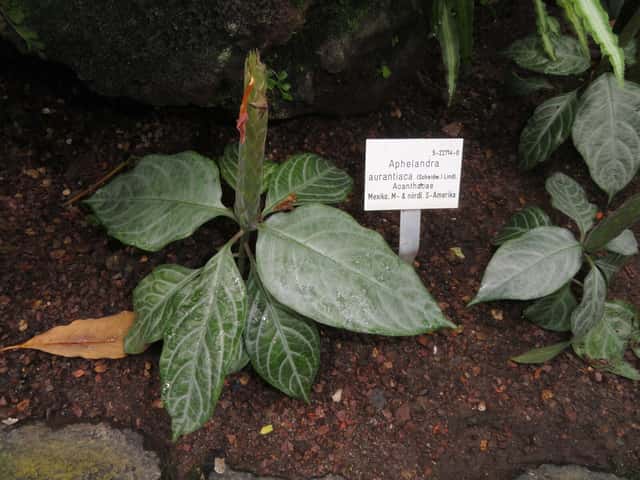
Acanthaceae
Fiery spike: Pet-Safe Plant
Aphelandra aurantiaca
Prefers bright indirect light, consistently moist but well-drained soil, high humidity, and warm temperatures above 15°C. Sensitive to waterlogging and dry air.
Every 5 days
Partial shade
15° - 27°C
60% - 80%
Categories
What is Fiery spike?
Fiery spike (Aphelandra aurantiaca) is a medium-care plant from the Acanthaceae family. A tropical evergreen shrub in the Acanthaceae family, native to a range spanning Mexico to Brazil and Bolivia, growing in partial shade along riverbanks, forest edges and paths between 100 and 1800 m elevation. Reaches 50 cm to 1 m tall, with large opposite leaves (10-30 cm) marked by prominent vein...
Fiery spike grows up to 1.0m, spread of 50cm, watering every 5 days, 15°C – 27°C, 60–80% humidity. It is suitable for indoor environments and safe for pets.
Unlike many popular species, Fiery spike is safe to keep around pets. Without adequate drainage, root rot can develop within 10 days.
How to Care for Fiery spike?
TLDR: Fiery spike needs Partial shade, watering every 5 days, and temperatures between 15-27°C with 60-80% humidity.
How Often Should You Water Fiery spike?
Water when the top third of the soil feels dry, keeping it consistently moist but never soggy; use room-temperature, lime-free water.
How Much Light Does Fiery spike Need?
Place in bright, indirect light near a window; avoid direct midday sun, which scorches the leaves.
What Is the Best Soil for Fiery spike?
Use a rich, well-draining potting mix, blending houseplant soil with sand or perlite for extra drainage.
What Pot Should You Use for Fiery spike?
A pot with ample drainage holes, ideally porous terracotta, to prevent excess moisture around the roots.
Care Schedule
Fertilize
Every 30 days
Misting
Every 3 days
Rotate
Every 14 days
Repot
Every 730 days
What Is Fiery spike and Where Does It Come From?
A tropical evergreen shrub in the Acanthaceae family, native to a range spanning Mexico to Brazil and Bolivia, growing in partial shade along riverbanks, forest edges and paths between 100 and 1800 m elevation. Reaches 50 cm to 1 m tall, with large opposite leaves (10-30 cm) marked by prominent veining. Produces showy terminal spikes of orange-red bracts with yellow flowers, attractive to hummingbirds.
How to Propagate Fiery spike?
Stem tip cutting
Keeping the substrate lightly moist and temperature above 20°C speeds up rooting.
- 1 Cut a ~10 cm stem segment just below a leaf node using sterilized scissors
- 2 Remove the lower leaves, leaving 2-3 leaves at the top
- 3 Place the cutting in water or directly into a light, well-draining mix (houseplant soil with sand)
- 4 Keep in a warm spot with indirect light and high humidity (use a plastic bag or a pebble tray)
- 5 Transplant into a permanent pot once firm roots have developed
Materials needed:
How Big Does Fiery spike Grow?
TLDR: Fiery spike can reach up to 1.0m tall with Medium growth rate.
Max height
1.0m
Spread
50cm
Growth rate
Medium
Foliage
Evergreen
Plant Uses
Ornamental
Great for decoration
Medicinal Uses
- Traditional folk use in Panama for menstrual bleeding/menorrhagia
Is your plant showing symptoms?
Click on the symptom to discover possible causes:
What Diseases Commonly Affect Fiery spike?
TLDR: Fiery spike is susceptible to 6 known diseases. Monitor regularly for early detection.
Root Rot
Root rot is a serious fungal disease that affects the root system of plants, causing them to decay and die. It is primarily caused by overwatering, poor drainage, or soil-borne fungi such as Pythium, Phytophthora, Rhizoctonia, and Fusarium. The disease thrives in waterlogged conditions where roots are deprived of oxygen, making them susceptible to fungal infection.
Leaf Spot
Leaf spot is a common fungal disease caused by various pathogens including Alternaria, Ascochyta, Colletotrichum, Septoria, and Venturia. It primarily affects leaves, causing discolored spots that can lead to premature leaf drop if left untreated.
Grey Mould
Spider Mites
Spider mites are tiny arachnids (less than 1/20 inch long) related to spiders and ticks that feed on plant sap. They thrive in hot, dry conditions and can cause significant damage to ornamental and vegetable plants. During severe infestations, crop losses can reach 14% or higher as these pests disrupt vital plant processes including photosynthesis, carbon dioxide absorption, and transpiration.
Meaning & Symbolism
Prized for its tropical vigor and exotic beauty, valued as a striking ornamental for shaded gardens and interiors.
Compare with similar plants
| Attribute | Difficulty | Light | Watering | Pet Safe |
|---|---|---|---|---|
| Dark Fieldcap | Medium | Low light | 2d | ⚠️ |
| Azalea | Medium | Partial shade | 3d | ⚠️ |
| Muriel's Bamboo | Medium | Partial shade | 3d | ✓ |
| Bougainvillea | Medium | Direct sun | 7d | ⚠️ |




