Poaceae
Giant reed: Fast Growing
Arundo donax
Plant in a sunny, wind-protected spot in nutrient-rich, moisture-retentive soil; it tolerates most soil types and pH levels. It grows fastest with abundant water during the growing season, though established plants can withstand drought. Cut stems back to the ground in late winter or early spring before new shoots appear. It spreads vigorously via rhizomes: plant with a root barrier and do not plant near waterbanks or natural habitats. It has no serious pests or diseases.
Every 7 days
Bright indirect
° - °C
% - %
Categories
What is Giant reed?
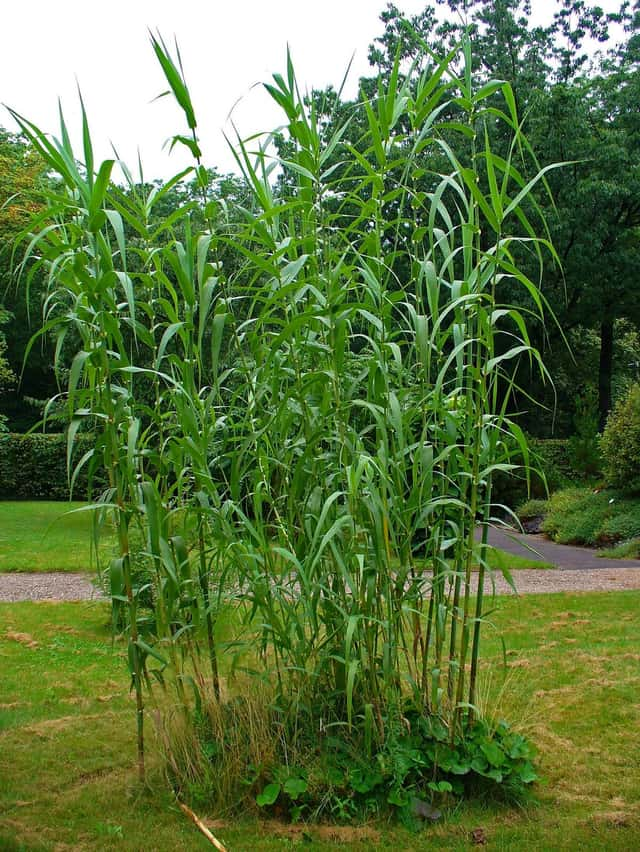
Giant reed (Arundo donax) is a easy-care plant from the Poaceae family. The giant reed (Arundo donax) is a large perennial grass belonging to the Poaceae family. It resembles common reed but grows much taller: typically 6–16 feet (2–5 m), and in favorable conditions, even 20–33 feet (6–10 m). From its thick, creeping rhizomes, hollow, hard, almost woody stems 2–3 cm thi...
Giant reed grows up to 6.0m, spread of 200cm, watering every 7 days. It is not suitable for indoor environments and safe for pets.
Unlike many tropical plants, Giant reed tolerates watering mistakes. Best for beginners. Unlike many popular species, Giant reed is safe to keep around pets.
How to Care for Giant reed?
TLDR: Giant reed needs Bright indirect, watering every 7 days, and temperatures between 15-30°C with 40-70% humidity.
How Often Should You Water Giant reed?
Keep the soil consistently moist from spring to autumn; water thoroughly once a week during dry summers. Established clumps can tolerate short droughts but will grow slower without water. Plants in containers require more frequent watering.
How Much Light Does Giant reed Need?
It develops best and grows tallest in full sun; it can tolerate partial shade, but will be less vigorous there.
What Is the Best Soil for Giant reed?
Prefers nutrient-rich, moisture-retentive loamy soil, but also thrives in sandy, clayey, and calcareous soils with acidic, neutral, or alkaline pH. It tolerates wet, even occasionally waterlogged soil well.
What Pot Should You Use for Giant reed?
Can only be kept in very large (at least 60–80 liter), heavy containers with drainage holes, using nutrient-rich, moisture-retentive soil. The container also serves to curb the spread of rhizomes; in the garden, use a root barrier buried at least 60 cm deep.
What Is Giant reed and Where Does It Come From?
The giant reed (Arundo donax) is a large perennial grass belonging to the Poaceae family. It resembles common reed but grows much taller: typically 6–16 feet (2–5 m), and in favorable conditions, even 20–33 feet (6–10 m). From its thick, creeping rhizomes, hollow, hard, almost woody stems 2–3 cm thick emerge, bearing bluish-green, drooping leaves 30–60 cm long and 2–8 cm wide. With adequate moisture, it can grow up to 5 cm per day in summer. In September–October, it produces half-meter long panicle inflorescences that are initially reddish-brown and later turn silvery. It is common mainly along the Mediterranean, on the moist banks of watercourses and lagoons. It is planted for windbreaks, hedges, and soil protection; its stems are used to make reeds for oboes, bassoons, clarinets, and saxophones. It spreads aggressively via rhizomes and is an invasive species in many warm regions.
How to Propagate Giant reed?
Division (Rhizome)
- The rhizome starts well once the soil has warmed up to at least 7–8 °C.
- 1 Lifting
In spring, when shoots appear, dig up a piece from an older clump.
- 2 Cutting
Cut the rhizome into pieces that have at least one or two buds or shoot primordia.
- 3 Planting
Plant the pieces 10–15 cm deep in nutrient-rich, moist soil, and keep moist until they sprout.
Materials needed:
Stem cutting
- Do not discard cut stem pieces in moist areas or water: they can root and propagate on their own.
- 1 Cutting
Cut pieces from fresh, green stems containing at least two nodes.
- 2 Rooting
Lay the pieces horizontally in moist soil or place them in water; roots and shoots will develop from the nodes.
- 3 Transplanting
Plant the rooted shoots in their final location or in a container.
Materials needed:
How Big Does Giant reed Grow?
TLDR: Giant reed can reach up to 6.0m tall with Fast growth rate.
Max height
6.0m
Spread
2.0m
Growth rate
Fast
Foliage
Deciduous
Plant Uses
Ornamental
Great for decoration
Is your plant showing symptoms?
Click on the symptom to discover possible causes:
Compare with similar plants
| Attribute | Difficulty | Light | Watering | Pet Safe |
|---|---|---|---|---|
| Field Maple | Easy | Bright indirect | 14d | ✓ |
| Muriel's Bamboo | Medium | Partial shade | 3d | ✓ |
| Iberian Houseleek | Easy | Direct sun | 14d | ✓ |
| Silver Birch | Easy | Direct sun | 14d | ✓ |





