Asteraceae
Globe thistle: Aromatic Plant
Echinops sphaerocephalus
An easy-to-care-for and highly drought-tolerant perennial that thrives best in full sun and poor, well-drained, preferably calcareous soil. It requires minimal maintenance once established but is sensitive to waterlogged soil, which can cause root rot.
Every 10 days
Direct sun
-30° - 35°C
30% - 70%
Categories
What is Globe thistle?
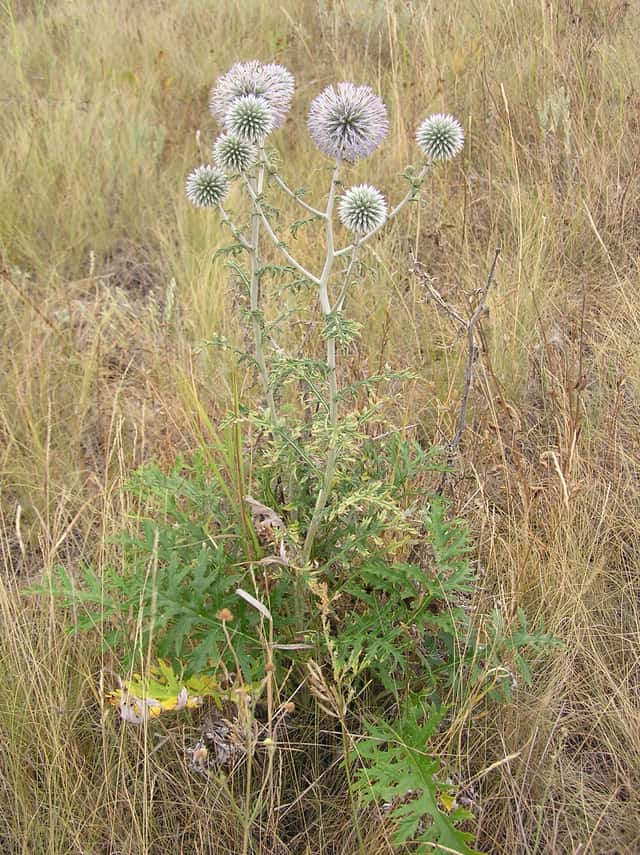
Globe thistle (Echinops sphaerocephalus) is a easy-care plant from the Asteraceae family. Globe thistle is a large, robust perennial in the Asteraceae family that can reach up to 2 meters in height. It bears spherical, silvery-blue to whitish flower heads on stiff stems and blooms in July–August. The leaves are deeply lobed and prickly with a grayish-green upper side and a felted, lighte...
Globe thistle grows up to 2.0m, spread of 80cm, watering every 10 days, -30°C – 35°C, 30–70% humidity. It is not suitable for indoor environments and safe for pets.
Unlike many tropical plants, Globe thistle tolerates watering mistakes. Best for beginners. Unlike many popular species, Globe thistle is safe to keep around pets.
How to Care for Globe thistle?
TLDR: Globe thistle needs Direct sun, watering every 10 days, and temperatures between -30-35°C with 30-70% humidity.
How Often Should You Water Globe thistle?
Water regularly during the first year to help the plant establish a deep root system. After that, globe thistle can manage without extra watering even during long dry periods—avoid overwatering, as the risk of root rot increases in damp soil.
How Much Light Does Globe thistle Need?
Place in full sun, at least 6 hours of direct sunlight per day, for a compact growth habit, sturdy stems, and the most intense blue colors on the flower heads.
What Is the Best Soil for Globe thistle?
Thrives best in poor to average, well-drained soil, preferably alkaline (pH approx. 6–8). Avoid heavy, water-retaining clay soil where the roots risk sitting in wet conditions.
What Pot Should You Use for Globe thistle?
Preferably planted directly in the ground due to its deep taproot, which does not tolerate transplanting well. If grown in a pot, a deep container with excellent drainage is required.
Care Schedule
Fertilize
Every 180 days
What Is Globe thistle and Where Does It Come From?
Globe thistle is a large, robust perennial in the Asteraceae family that can reach up to 2 meters in height. It bears spherical, silvery-blue to whitish flower heads on stiff stems and blooms in July–August. The leaves are deeply lobed and prickly with a grayish-green upper side and a felted, lighter underside. The species is very drought-tolerant, thrives in poor, well-drained soil, and is highly favored by bees, bumblebees, and butterflies.
How to Propagate Globe thistle?
Seed Sowing
- Seeds can also be sown directly in place in the fall for natural cold stratification.
- Seed-grown plants usually bloom only after 2-3 years.
- 1 Sowing
Sow seeds shallowly (approx. 0.5 cm deep) in well-drained soil during early spring.
- 2 Germination
Keep the soil slightly moist but not wet until sprouts appear.
- 3 Transplanting
Transplant to a permanent location once the risk of frost has passed and the plants have several true leaves.
Materials needed:
Division
- Be very careful with the taproot—it is sensitive to disturbance, and division is most successful in early spring before the shoots have grown significantly.
- 1 Digging up
Carefully dig up an established plant in early spring, just as new shoots begin to appear.
- 2 Division
Divide the root ball with a sharp spade so that each section has at least 2-3 shoots and a portion of the taproot.
- 3 Replanting
Replant the sections immediately in their new locations and water thoroughly.
Materials needed:
How Big Does Globe thistle Grow?
TLDR: Globe thistle can reach up to 2.0m tall with Medium growth rate.
Max height
2.0m
Spread
80cm
Growth rate
Medium
Foliage
Deciduous
Plant Uses
Ornamental
Great for decoration
Aromatic
Pleasant fragrance
Medicinal
Medicinal properties
Medicinal Uses
- Historically used in traditional medicine for inflammation and respiratory issues (root extract)
- The roots contain bioactive compounds (including thiophenes) that have been studied for antimicrobial properties
Is your plant showing symptoms?
Click on the symptom to discover possible causes:
What Diseases Commonly Affect Globe thistle?
TLDR: Globe thistle is susceptible to 4 known diseases. Monitor regularly for early detection.
Powdery Mildew
Powdery mildew is a common fungal disease caused by various fungi species including Erysiphe, Podosphaera, Oïdium, and Leveillula. It affects over 10,000 plant species worldwide. The disease thrives in warm, dry climates with high humidity and appears as a distinctive white powdery coating on plant surfaces.
Root Rot
Root rot is a serious fungal disease that affects the root system of plants, causing them to decay and die. It is primarily caused by overwatering, poor drainage, or soil-borne fungi such as Pythium, Phytophthora, Rhizoctonia, and Fusarium. The disease thrives in waterlogged conditions where roots are deprived of oxygen, making them susceptible to fungal infection.
Aphids
Aphids are small, soft-bodied, pear-shaped insects (1/16 to 1/8 inch long) that feed by sucking nutrient-rich sap from plants. They reproduce rapidly and can quickly weaken plants, causing distorted growth and transmitting plant viruses. Aphids come in various colors including green, black, red, yellow, brown, and gray. They secrete honeydew, a sticky substance that attracts ants and encourages sooty mold growth.
Slugs and Snails
Slugs and snails are mollusks that feed on plant tissue, causing irregular holes in leaves and damage to young seedlings. They are most active at night and in moist conditions, leaving characteristic silvery slime trails. These pests can quickly devastate gardens, especially during wet seasons.
Meaning & Symbolism
Represents endurance and protection due to its prickly leaves and robust, drought-tolerant nature.
Compare with similar plants
| Attribute | Difficulty | Light | Watering | Pet Safe |
|---|---|---|---|---|
| Field Maple | Easy | Bright indirect | 14d | ✓ |
| Silver Birch | Easy | Direct sun | 14d | ✓ |
| Common Blanketflower | Easy | Direct sun | 10d | ✓ |
| Cushion Bush | Easy | Direct sun | 14d | ✓ |
Choose & Compare
Sources & References
- Great Globe-Thistle Care Guide - Plantiary
- Great Globe-Thistle - Walnut Lane Gardens
- Glandular Globe-thistle Plant Care - PlantIn
- Globe Thistle: How to Plant, Grow, and Care For Echinops
- Bolltistel - Allt om Biodling (pollinator value, sv)
- The Genus Echinops: Phytochemistry and Biological Activities





