Oleaceae
Goshiki False Holly: Aromatic Plant
Osmanthus heterophyllus 'Goshiki'
A hardy and easy-to-grow plant, it prefers a sunny or partially shaded position, well-drained soil ranging from slightly acidic to neutral, and is quite drought-tolerant once established. It does not face significant pest or disease issues when grown in appropriate conditions.
Every 10 days
Bright indirect
-18° - 35°C
% - %
Categories
What is Goshiki False Holly?
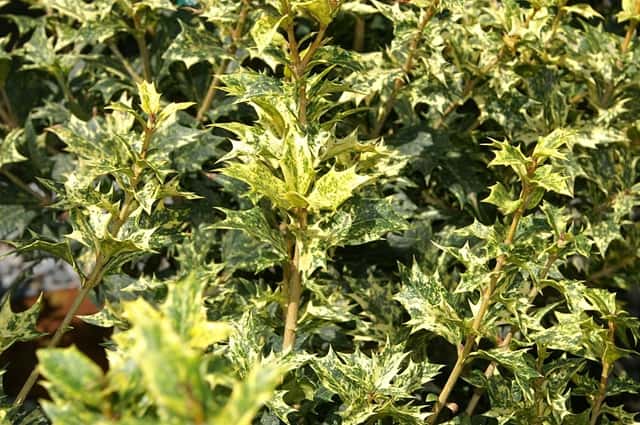
Goshiki False Holly (Osmanthus heterophyllus 'Goshiki') is a easy-care plant from the Oleaceae family. Osmanthus heterophyllus 'Goshiki' is an evergreen shrub in the Oleaceae family, native to Japan and Taiwan. The cultivar 'Goshiki' (literally meaning "five colors" in Japanese) is distinguished by its variegated foliage: the leathery, spiny leaves, similar to those of holly, emerge in shades of bron...
Goshiki False Holly grows up to 1.8m, spread of 150cm, watering every 10 days, -18°C – 35°C. It is not suitable for indoor environments and safe for pets.
Unlike many tropical plants, Goshiki False Holly tolerates watering mistakes. Best for beginners. Unlike many popular species, Goshiki False Holly is safe to keep around pets.
How to Care for Goshiki False Holly?
TLDR: Goshiki False Holly needs Bright indirect, watering every 10 days, and temperatures between -18-35°C with 40-70% humidity.
How Often Should You Water Goshiki False Holly?
Water regularly during the first year to encourage establishment, keeping the soil moist but never waterlogged. Once established, the plant is quite drought-tolerant: allow the top few inches of soil to dry out between waterings and avoid standing water, which can lead to root rot.
How Much Light Does Goshiki False Holly Need?
It grows well in both full sun and partial shade; increased sun exposure intensifies the variegation of the foliage. In very hot summer climates, some afternoon shade is recommended to prevent leaf scorch.
What Is the Best Soil for Goshiki False Holly?
Prefers well-drained soils, from sandy to loamy, with a pH ranging from slightly acidic to neutral (4.5-7.5). However, it adapts to various soil types, including clay, as long as there is no water stagnation.
What Pot Should You Use for Goshiki False Holly?
If grown in a pot, choose a large and deep container made of terracotta or porous material with plenty of drainage holes; repot every 2-3 years using a well-draining substrate enriched with organic matter.
Care Schedule
Fertilize
Every 180 days
Repot
Every 730 days
What Is Goshiki False Holly and Where Does It Come From?
Osmanthus heterophyllus 'Goshiki' is an evergreen shrub in the Oleaceae family, native to Japan and Taiwan. The cultivar 'Goshiki' (literally meaning "five colors" in Japanese) is distinguished by its variegated foliage: the leathery, spiny leaves, similar to those of holly, emerge in shades of bronze-pink before maturing into green mottled with cream, yellow, and pink. In autumn, it produces small white flowers that are discreet but highly fragrant, often hidden among the leaves. Slow-growing with a compact habit, it is prized as a specimen plant, in informal hedges, or in mixed borders.
How Big Does Goshiki False Holly Grow?
TLDR: Goshiki False Holly can reach up to 1.8m tall with Slow growth rate.
Max height
1.8m
Spread
1.5m
Growth rate
Slow
Foliage
Evergreen
Plant Uses
Ornamental
Great for decoration
Aromatic
Pleasant fragrance
Is your plant showing symptoms?
Click on the symptom to discover possible causes:
What Diseases Commonly Affect Goshiki False Holly?
TLDR: Goshiki False Holly is susceptible to 9 known diseases. Monitor regularly for early detection.
Scale Insects
Scale insects are small sap-sucking pests that appear as brown, shell-like bumps on plant stems and leaves. There are over 25 species, divided into armored (hard) and unarmored (soft) scales. They feed by piercing plant tissue and extracting sap, which weakens the plant and can lead to yellowing, stunted growth, and even death if left untreated. They also excrete honeydew, which attracts ants and promotes sooty mold growth.
Aphids
Aphids are small, soft-bodied, pear-shaped insects (1/16 to 1/8 inch long) that feed by sucking nutrient-rich sap from plants. They reproduce rapidly and can quickly weaken plants, causing distorted growth and transmitting plant viruses. Aphids come in various colors including green, black, red, yellow, brown, and gray. They secrete honeydew, a sticky substance that attracts ants and encourages sooty mold growth.
Spider Mites
Spider mites are tiny arachnids (less than 1/20 inch long) related to spiders and ticks that feed on plant sap. They thrive in hot, dry conditions and can cause significant damage to ornamental and vegetable plants. During severe infestations, crop losses can reach 14% or higher as these pests disrupt vital plant processes including photosynthesis, carbon dioxide absorption, and transpiration.
Mealybugs
Mealybugs are small, soft-bodied insects covered with a white, waxy, cottony material. They are common pests of houseplants and outdoor plants in mild climates. These sap-sucking insects feed on plant tissue, causing damage, stunted growth, and can lead to plant death if left untreated. They produce sticky honeydew which attracts sooty mold.
Meaning & Symbolism
In Japanese tradition, the Osmanthus represents silent nobility and lasting love: the discreet but intensely fragrant blooming symbolizes beauty that reveals itself with patience, while the holly-like foliage evokes protection and resilience.
Compare with similar plants
| Attribute | Difficulty | Light | Watering | Pet Safe |
|---|---|---|---|---|
| Field Maple | Easy | Bright indirect | 14d | ✓ |
| Silver Birch | Easy | Direct sun | 14d | ✓ |
| Common Blanketflower | Easy | Direct sun | 10d | ✓ |
| Cushion Bush | Easy | Direct sun | 14d | ✓ |
Choose & Compare
Sources & References
- Osmanthus heterophyllus - NC State Extension Gardener Plant Toolbox
- Osmanthus heterophyllus Goshiki - Oregon State University Landscape Plants
- Osmanthus heterophyllus - Missouri Botanical Garden Plant Finder
- Identify & Treat Holly Osmanthus Shrub Diseases
- Treat & Identify Holly Osmanthus Shrub Pests
- Osmanthus heterophyllus Goshiki False Holly - Backyard Gardener
- How to Grow and Care for Osmanthus - BBC Gardeners World
- Osmanthus heterophyllus - Wikipedia





