Papaveraceae
Greater celandine: Medicinal Uses & Care Tips
Chelidonium majus
Greater celandine is an undemanding, fast-growing herb better suited for natural garden corners than for pots. It tolerates poor and stony soil, preferring partial shade, though it can handle sun in cooler climates. The soil should be kept moderately moist but never waterlogged – excess moisture causes root rot. The plant self-seeds prolifically, quickly establishing itself in the garden and potentially becoming a weed. Caution is necessary when handling it – the toxic sap irritates the skin and eyes.
Every 7 days
Partial shade
° - °C
% - %
Categories
What is Greater celandine?
Greater celandine (Chelidonium majus) is a easy-care plant from the Papaveraceae family. Greater celandine (Chelidonium majus) is a perennial herb in the poppy family (Papaveraceae), native to Europe and western Asia, and now widespread in North America where it is considered invasive. It grows to a height of approximately 30–120 cm, featuring grayish-green pinnately divided leaves and...
Greater celandine grows up to 1.2m, spread of 30cm, watering every 7 days. It is not suitable for indoor environments and not safe for pets.
Unlike many tropical plants, Greater celandine tolerates watering mistakes. Best for beginners. Without precautions, ingestion can cause irritation in pets. Keep out of reach of cats and dogs.
How to Care for Greater celandine?
TLDR: Greater celandine needs Partial shade, watering every 7 days, and temperatures between 15-30°C with 40-70% humidity.
How Often Should You Water Greater celandine?
Water moderately only when the top layer of soil is dry – celandine tolerates short droughts better than waterlogged soil. Permanently wet or flooded substrate leads to root rot.
How Much Light Does Greater celandine Need?
It thrives best in partial shade to full shade, for example, under tree canopies or near fences. In cooler regions, it can tolerate direct sun, but in warmer climates, direct sun dries out and weakens the plant.
What Is the Best Soil for Greater celandine?
It is not demanding regarding soil – it grows even in poor, stony, or loamy soil. Ideal is well-draining, moderately fertile soil with a slightly acidic to slightly alkaline pH (approx. 6.0–7.5) that does not retain water.
What Pot Should You Use for Greater celandine?
Celandine is not commonly grown indoors or in pots – it thrives best directly in the ground in shady garden corners. If you still wish to grow it in a container, choose a wider pot with a good drainage hole and permeable substrate to prevent root waterlogging.
What Is Greater celandine and Where Does It Come From?
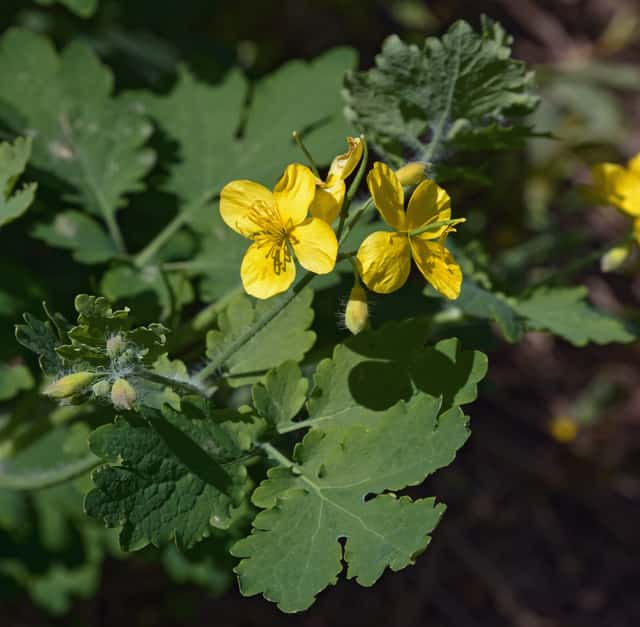
Greater celandine (Chelidonium majus) is a perennial herb in the poppy family (Papaveraceae), native to Europe and western Asia, and now widespread in North America where it is considered invasive. It grows to a height of approximately 30–120 cm, featuring grayish-green pinnately divided leaves and small four-petaled yellow flowers that bloom from May to September. When injured, every part of the plant exudes a characteristic orange-yellow toxic sap containing isoquinoline alkaloids (such as chelidonine, sanguinarine, berberine, and coptisine). It grows on waste ground, near fences, in forest undergrowth, and in shady areas near human settlements. Both the Latin and common names refer to swallows (Greek: chelidón) – according to tradition, the plant blooms from their arrival until their departure.
How to Propagate Greater celandine?
How Big Does Greater celandine Grow?
TLDR: Greater celandine can reach up to 1.2m tall with Fast growth rate.
Max height
1.2m
Spread
30cm
Growth rate
Fast
Foliage
Deciduous
Warning: Toxic Plant
This plant can be toxic if ingested. Keep out of reach of:
Plant Uses
Medicinal
Medicinal properties
Ornamental
Great for decoration
Medicinal Uses
- Traditionally (unverified), the yellow-orange sap was used in folk medicine to remove warts by direct application to the skin.
- In folk medicine, it was traditionally used for skin problems (eczema, irritation) – this is an unverified use without support from clinical studies.
- Historically, it was also used for liver and gallbladder issues; however, modern studies have shown a risk of liver damage (hepatotoxicity) with internal use, so this application is not recommended.
Is your plant showing symptoms?
Click on the symptom to discover possible causes:
What Diseases Commonly Affect Greater celandine?
TLDR: Greater celandine is susceptible to 2 known diseases. Monitor regularly for early detection.
Root Rot
Root rot is a serious fungal disease that affects the root system of plants, causing them to decay and die. It is primarily caused by overwatering, poor drainage, or soil-borne fungi such as Pythium, Phytophthora, Rhizoctonia, and Fusarium. The disease thrives in waterlogged conditions where roots are deprived of oxygen, making them susceptible to fungal infection.
Aphids
Aphids are small, soft-bodied, pear-shaped insects (1/16 to 1/8 inch long) that feed by sucking nutrient-rich sap from plants. They reproduce rapidly and can quickly weaken plants, causing distorted growth and transmitting plant viruses. Aphids come in various colors including green, black, red, yellow, brown, and gray. They secrete honeydew, a sticky substance that attracts ants and encourages sooty mold growth.
Meaning & Symbolism
The plant's name (Greek: chelidón – swallow) relates to an ancient legend where swallows used the sap of this herb to heal the eyes of their young. In folk tradition, greater celandine thus symbolizes the arrival of swallows, renewal, and the healing power of nature, while also serving as a reminder that what heals can also harm in careless hands – as the entire plant is toxic.
Compare with similar plants
| Attribute | Difficulty | Light | Watering | Pet Safe |
|---|---|---|---|---|
| Field Maple | Easy | Bright indirect | 14d | ✓ |
| Silver Birch | Easy | Direct sun | 14d | ✓ |
| Common Blanketflower | Easy | Direct sun | 10d | ✓ |
| Cushion Bush | Easy | Direct sun | 14d | ✓ |





