Cactaceae
Greenflower Nipple Cactus (Cochemiea barbata): Care Guide
Cochemiea barbata
Grow it like other small hooked-spine Mammillaria-type cacti: plenty of direct sun, a gritty mineral mix and water only when the soil has dried out completely. Keep it almost dry and cool in winter.
Every 14 days
Bright indirect
° - °C
% - %
Categories
What is Greenflower nipple cactus?
Greenflower nipple cactus (Cochemiea barbata) is a medium-care plant from the Cactaceae family. Cochemiea barbata, long known as Mammillaria barbata, is a small cactus from the mountains of Arizona, New Mexico, Chihuahua, Sonora and Durango, where it grows on rocky slopes, canyons and valleys in semidesert grassland and pine-oak woodland at about 1,100-2,000 m. Its flattened to short-cylindric...
Greenflower nipple cactus grows up to watering every 14 days. It is suitable for indoor environments and safe for pets.
Unlike many popular species, Greenflower nipple cactus is safe to keep around pets. Without adequate drainage, root rot can develop within 28 days.
How to Care for Greenflower nipple cactus?
TLDR: Greenflower nipple cactus needs Bright indirect, watering every 14 days, and temperatures between 15-30°C with 40-70% humidity.
How Often Should You Water Greenflower nipple cactus?
From spring to early autumn, water thoroughly and wait until the mix is completely dry before watering again. In winter keep it almost dry; wet, cold soil quickly rots the roots.
How Much Light Does Greenflower nipple cactus Need?
Give it bright light with several hours of direct sun daily. Indoors, a sunny south- or west-facing windowsill is best; acclimate gradually to avoid scorching.
What Is the Best Soil for Greenflower nipple cactus?
Use a fast-draining cactus mix with 50-70% mineral grit such as pumice, perlite or coarse sand.
What Pot Should You Use for Greenflower nipple cactus?
A small terracotta pot with drainage holes, only slightly larger than the plant.
What Is Greenflower nipple cactus and Where Does It Come From?
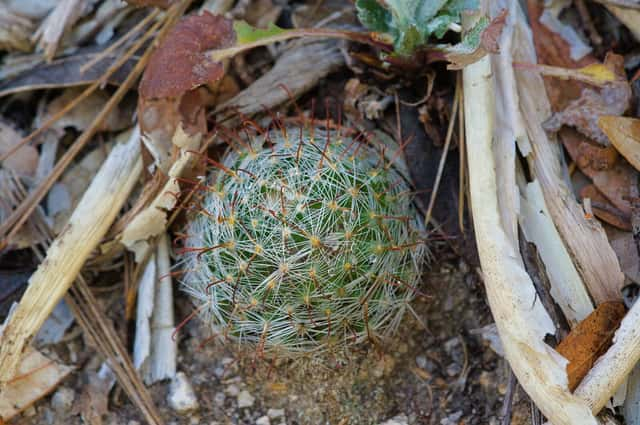
Cochemiea barbata, long known as Mammillaria barbata, is a small cactus from the mountains of Arizona, New Mexico, Chihuahua, Sonora and Durango, where it grows on rocky slopes, canyons and valleys in semidesert grassland and pine-oak woodland at about 1,100-2,000 m. Its flattened to short-cylindrical heads are only 3-4 cm across and may stay solitary or form dense cushions. Each areole carries 1-4 stiff brown to orange-brown central spines, one or two of them strongly hooked, surrounded by 16-60 fine, hairy, whitish radial spines. Its 1.5-3 cm flowers vary remarkably in colour, from greenish and white to pink, yellowish or orange, and the outer petals are fringed - the "beard" that gives the species its name.
How to Propagate Greenflower nipple cactus?
Offsets
Handle with tweezers or folded paper: the hooked spines snag easily. Never water a fresh cut before it has callused.
- 1 Choose an offset at least 1 cm across on a clumping plant
- 2 Cut or twist it off cleanly with a sterile blade
- 3 Let the cut dry for several days in a shaded, airy spot
- 4 Set it on dry cactus mix without burying it
- 5 Start light watering once roots have formed
Materials needed:
Seed
Seedlings are tiny and slow; do not let them dry out completely during the first months.
- 1 Sow seeds on the surface of moist, fine mineral mix
- 2 Cover the tray to keep humidity high
- 3 Keep warm with bright, indirect light
- 4 Ventilate gradually after germination
- 5 Pot up seedlings once they are large enough to handle
Materials needed:
How Big Does Greenflower nipple cactus Grow?
TLDR: Greenflower nipple cactus can reach up to ?cm tall with Slow growth rate.
Growth rate
Slow
Foliage
Evergreen
Plant Uses
Ornamental
Great for decoration
Is your plant showing symptoms?
Click on the symptom to discover possible causes:
What Diseases Commonly Affect Greenflower nipple cactus?
TLDR: Greenflower nipple cactus is susceptible to 5 known diseases. Monitor regularly for early detection.
Root Rot
Root rot is a serious fungal disease that affects the root system of plants, causing them to decay and die. It is primarily caused by overwatering, poor drainage, or soil-borne fungi such as Pythium, Phytophthora, Rhizoctonia, and Fusarium. The disease thrives in waterlogged conditions where roots are deprived of oxygen, making them susceptible to fungal infection.
Overwatering
Overwatering occurs when plants receive too much water, depriving roots of oxygen and causing root rot. This environmental stress is one of the most common causes of houseplant death, as waterlogged soil prevents roots from breathing and functioning properly.
Mealybugs
Mealybugs are small, soft-bodied insects covered with a white, waxy, cottony material. They are common pests of houseplants and outdoor plants in mild climates. These sap-sucking insects feed on plant tissue, causing damage, stunted growth, and can lead to plant death if left untreated. They produce sticky honeydew which attracts sooty mold.
Spider Mites
Spider mites are tiny arachnids (less than 1/20 inch long) related to spiders and ticks that feed on plant sap. They thrive in hot, dry conditions and can cause significant damage to ornamental and vegetable plants. During severe infestations, crop losses can reach 14% or higher as these pests disrupt vital plant processes including photosynthesis, carbon dioxide absorption, and transpiration.
Fun Facts
"Barbata" means "bearded" in Latin, after the fringed outer petals of the flower.
It was described by George Engelmann in 1848 from plants collected during expeditions in northern Mexico.
Its flower color varies so much between populations that several forms were once described as separate species.
Frequently asked questions
How often should I water Cochemiea barbata?
Is Cochemiea barbata the same as Mammillaria barbata?
Why does it have hooked spines?
What color are its flowers?
Compare with similar plants
| Attribute | Difficulty | Light | Watering | Pet Safe |
|---|---|---|---|---|
| Dark Fieldcap | Medium | Low light | 2d | ⚠️ |
| Azalea | Medium | Partial shade | 3d | ⚠️ |
| Muriel's Bamboo | Medium | Partial shade | 3d | ✓ |
| Bougainvillea | Medium | Direct sun | 7d | ⚠️ |




