Phytolaccaceae
Guinea Hen Weed: Aromatic Plant
Petiveria alliacea
An easy-to-grow plant, it tolerates partial shade to full sun. It requires regular watering in well-drained, organic-rich soil, maintaining constant moisture without waterlogging. It thrives best between 20 and 30 °C; protect it from intense cold.
Every 3 days
Bright indirect
15° - 30°C
50% - %
Categories
What is Guinea Hen Weed?
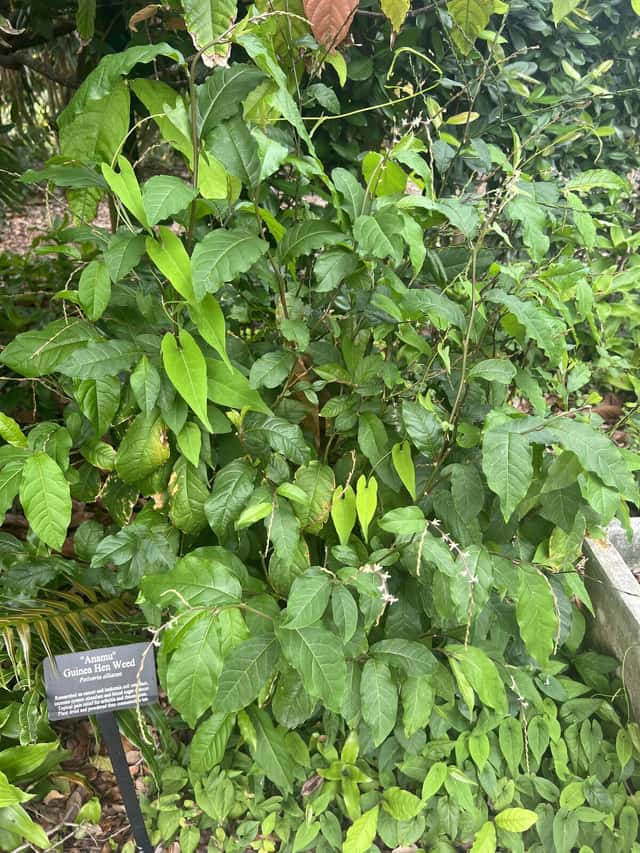
Guinea Hen Weed (Petiveria alliacea) is a easy-care plant from the Phytolaccaceae family. Guinea Hen Weed (Petiveria alliacea) is a perennial tropical subshrub, 20 to 100 cm tall, with aromatic roots and leaves that emit a strong garlic odor when crushed. Its delicate white inflorescences appear in spikes, mainly from November to March. It is a hardy plant, well-adapted to Brazilian trop...
Guinea Hen Weed grows up to 1.0m, spread of 30cm, watering every 3 days, 15°C – 30°C. It is suitable for indoor environments and not safe for pets.
Unlike many tropical plants, Guinea Hen Weed tolerates watering mistakes. Best for beginners. Without precautions, ingestion can cause irritation in pets. Keep out of reach of cats and dogs. Without adequate drainage, root rot can develop within 7 days.
How to Care for Guinea Hen Weed?
TLDR: Guinea Hen Weed needs Bright indirect, watering every 3 days, and temperatures between 15-30°C with 50-70% humidity.
How Often Should You Water Guinea Hen Weed?
Keep the soil lightly moist, but never waterlogged. Increase watering frequency in hot, dry summers; space out waterings more in winter. Excess moisture promotes root rot.
How Much Light Does Guinea Hen Weed Need?
Thrives in partial shade but tolerates full sun, especially if kept moist. In very hot regions, protect it from strong midday sun to prevent leaf burn.
What Is the Best Soil for Guinea Hen Weed?
Use fertile, well-drained soil, preferably sandy-loam rich in organic matter, with a pH between 5.5 and 7.5. Incorporate organic compost annually to maintain nutrients and soil structure.
What Pot Should You Use for Guinea Hen Weed?
Grow in a terracotta or ceramic pot at least 25 cm deep with drainage holes. Terracotta promotes root aeration. In garden beds, enrich the soil with organic compost every year.
Care Schedule
Fertilize
Every 60 days
Misting
Every 3 days
Rotate
Every 7 days
Repot
Every 365 days
What Is Guinea Hen Weed and Where Does It Come From?
Guinea Hen Weed (Petiveria alliacea) is a perennial tropical subshrub, 20 to 100 cm tall, with aromatic roots and leaves that emit a strong garlic odor when crushed. Its delicate white inflorescences appear in spikes, mainly from November to March. It is a hardy plant, well-adapted to Brazilian tropical and subtropical climates, and has been incorporated into the medicinal and spiritual heritage of Afro-Brazilian traditions for centuries.
How to Propagate Guinea Hen Weed?
Stem cutting
Cuttings are the fastest and most reliable method for Guinea Hen Weed.
- 1 Harvest apical branches 15 to 20 cm long in early spring or summer
- 2 Remove lower leaves, leaving 2 to 3 leaves at the top
- 3 Bury the base in moist, well-drained substrate
- 4 Maintain high humidity and indirect light until rooted
Materials needed:
Seed
Germination can be variable; cuttings are preferable for faster results.
- 1 Sow in moist, light substrate
- 2 Maintain at 20-25 °C with indirect light
- 3 Transplant seedlings when they are large enough to handle
Materials needed:
How Big Does Guinea Hen Weed Grow?
TLDR: Guinea Hen Weed can reach up to 1.0m tall with Fast growth rate.
Max height
1.0m
Spread
30cm
Growth rate
Fast
Foliage
Evergreen
Warning: Toxic Plant
This plant can be toxic if ingested. Keep out of reach of:
Plant Uses
Ornamental
Great for decoration
Medicinal
Medicinal properties
Aromatic
Pleasant fragrance
Medicinal Uses
- Traditional use for fever, headaches, and inflammation, in the form of a tea made from leaves or roots.
- Topical applications of fresh juice or decoction on wounds, skin irritations, and joint pains (arthritis, rheumatism).
- Anti-inflammatory, antimicrobial, and analgesic properties observed in laboratory studies.
- WARNING: popular use, does not replace medical advice. Contains potentially toxic compounds — avoid internal use during pregnancy and in children, and consult a healthcare professional.
Is your plant showing symptoms?
Click on the symptom to discover possible causes:
What Diseases Commonly Affect Guinea Hen Weed?
TLDR: Guinea Hen Weed is susceptible to 4 known diseases. Monitor regularly for early detection.
Root Rot
Root rot is a serious fungal disease that affects the root system of plants, causing them to decay and die. It is primarily caused by overwatering, poor drainage, or soil-borne fungi such as Pythium, Phytophthora, Rhizoctonia, and Fusarium. The disease thrives in waterlogged conditions where roots are deprived of oxygen, making them susceptible to fungal infection.
Anthracnose
Anthracnose is a fungal disease caused by fungi in the genus Colletotrichum that affects many plants, including vegetables, fruits, and trees. The disease thrives in cool, wet conditions, causing dark, sunken lesions on leaves, stems, flowers, and fruits.
Aphids
Aphids are small, soft-bodied, pear-shaped insects (1/16 to 1/8 inch long) that feed by sucking nutrient-rich sap from plants. They reproduce rapidly and can quickly weaken plants, causing distorted growth and transmitting plant viruses. Aphids come in various colors including green, black, red, yellow, brown, and gray. They secrete honeydew, a sticky substance that attracts ants and encourages sooty mold growth.
Spider Mites
Spider mites are tiny arachnids (less than 1/20 inch long) related to spiders and ticks that feed on plant sap. They thrive in hot, dry conditions and can cause significant damage to ornamental and vegetable plants. During severe infestations, crop losses can reach 14% or higher as these pests disrupt vital plant processes including photosynthesis, carbon dioxide absorption, and transpiration.
Meaning & Symbolism
A plant deeply rooted in Afro-Brazilian tradition and African-matrix spiritualities. Historically used in rituals of protection and spiritual cleansing — hence the name "amansa-senhor" (lord-tamer). Its aromatic roots were burned as protective incense, and the leaves were used in baths and smudging. It represents resilience, purification, and ancestral connection.
Compare with similar plants
| Attribute | Difficulty | Light | Watering | Pet Safe |
|---|---|---|---|---|
| Field Maple | Easy | Bright indirect | 14d | ✓ |
| Silver Birch | Easy | Direct sun | 14d | ✓ |
| Common Blanketflower | Easy | Direct sun | 10d | ✓ |
| Cushion Bush | Easy | Direct sun | 14d | ✓ |





