Cactaceae
Haage's Pincushion Cactus (Mammillaria haageana)
Mammillaria haageana
An easy, drought-tolerant cactus that wants bright direct sun, gritty fast-draining soil, and infrequent, deep watering. Let the soil dry out completely between waterings and cut back watering almost entirely in winter.
Every 14 days
Direct sun
-4° - 35°C
20% - 40%
Categories
What is Haage's Pincushion Cactus?
Haage's Pincushion Cactus (Mammillaria haageana) is a easy-care plant from the Cactaceae family. Mammillaria haageana is a small, spine-covered cactus native to the highlands of central and southern Mexico, where it grows wild among oak forests, pine woodlands, and volcanic lava flows at elevations between 450 and 2,600 meters. Its stem is globular when young and becomes more cylindrical with a...
Haage's Pincushion Cactus grows up to 15cm, spread of 10cm, watering every 14 days, -4°C – 35°C, 20–40% humidity. It is suitable for indoor environments and safe for pets.
Unlike many tropical plants, Haage's Pincushion Cactus tolerates watering mistakes. Best for beginners. Unlike many popular species, Haage's Pincushion Cactus is safe to keep around pets. Without adequate drainage, root rot can develop within 28 days.
How to Care for Haage's Pincushion Cactus?
TLDR: Haage's Pincushion Cactus needs Direct sun, watering every 14 days, and temperatures between -4-35°C with 20-40% humidity.
How Often Should You Water Haage's Pincushion Cactus?
Water deeply only when the soil is completely dry, roughly every 10-14 days in spring and summer. In fall and winter, reduce to once every 3-4 weeks or less - overwatering is the most common cause of death in this species.
How Much Light Does Haage's Pincushion Cactus Need?
Give it as much bright, direct sunlight as possible - a south-facing windowsill or full sun outdoors is ideal. Insufficient light causes weak, elongated (etiolated) growth and poor flowering.
What Is the Best Soil for Haage's Pincushion Cactus?
Use a mineral-heavy cactus mix with 70-80% coarse sand, pumice, or perlite. The soil must drain within seconds of watering - standard potting soil retains far too much moisture for this species.
What Pot Should You Use for Haage's Pincushion Cactus?
Unglazed terracotta with a drainage hole - the porous material helps excess moisture evaporate and protects against root rot.
What Is Haage's Pincushion Cactus and Where Does It Come From?
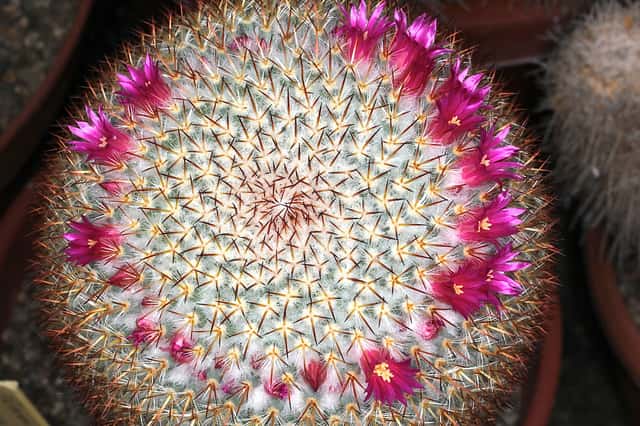
Mammillaria haageana is a small, spine-covered cactus native to the highlands of central and southern Mexico, where it grows wild among oak forests, pine woodlands, and volcanic lava flows at elevations between 450 and 2,600 meters. Its stem is globular when young and becomes more cylindrical with age, reaching up to 15 cm tall and 3-10 cm in diameter, often forming dense clusters as it produces offsets around its base. The stem is covered in small, cone-shaped tubercles called mammillae (the trait that gives the genus its name), each topped with an areole bearing 8 to 30 fine white radial spines and a handful of darker central spines that fade from black or reddish-brown to grey with age. In late winter and early spring the plant rewards patient growers with a crown of funnel-shaped flowers in shades of deep magenta-pink to pale pink, each only 8-20 mm across but often appearing in a ring around the growing tip. Slow-growing and undemanding, it is a favorite among beginner cactus collectors for its compact size and reliable, colorful blooms.
How to Propagate Haage's Pincushion Cactus?
Offset Division
Always use sterilized tools to prevent infection, and never water immediately after cutting - wait for the callus to fully form.
- 1 Wait until offsets (pups) are at least 2-3 cm wide and have developed their own areoles.
- 2 Use a clean, sharp knife to detach the offset close to the base of the parent plant.
- 3 Let the cut surface callus over in a dry, shaded spot for 3-7 days.
- 4 Place the callused offset on top of well-draining cactus soil without burying the base.
- 5 Mist lightly once roots begin to form, then water sparingly as with an established plant.
Materials needed:
Seed Propagation
Growth from seed is very slow for this species, often taking years to reach a mature flowering size, so offsets are the preferred method when available.
- 1 Sow fresh seeds on the surface of a sterile, well-draining cactus mix.
- 2 Cover the tray with plastic wrap or glass to maintain humidity.
- 3 Keep at 21-27C with bright, indirect light until germination, which can take 1-4 weeks.
- 4 Gradually reduce humidity over several months as seedlings develop.
- 5 Transplant seedlings once they are large enough to handle safely.
Materials needed:
How Big Does Haage's Pincushion Cactus Grow?
TLDR: Haage's Pincushion Cactus can reach up to 15cm tall with Slow growth rate.
Max height
15cm
Spread
10cm
Growth rate
Slow
Foliage
Evergreen
Plant Uses
Ornamental
Great for decoration
Is your plant showing symptoms?
Click on the symptom to discover possible causes:
What Diseases Commonly Affect Haage's Pincushion Cactus?
TLDR: Haage's Pincushion Cactus is susceptible to 6 known diseases. Monitor regularly for early detection.
Root Rot
Root rot is a serious fungal disease that affects the root system of plants, causing them to decay and die. It is primarily caused by overwatering, poor drainage, or soil-borne fungi such as Pythium, Phytophthora, Rhizoctonia, and Fusarium. The disease thrives in waterlogged conditions where roots are deprived of oxygen, making them susceptible to fungal infection.
Mealybugs
Mealybugs are small, soft-bodied insects covered with a white, waxy, cottony material. They are common pests of houseplants and outdoor plants in mild climates. These sap-sucking insects feed on plant tissue, causing damage, stunted growth, and can lead to plant death if left untreated. They produce sticky honeydew which attracts sooty mold.
Scale Insects
Scale insects are small sap-sucking pests that appear as brown, shell-like bumps on plant stems and leaves. There are over 25 species, divided into armored (hard) and unarmored (soft) scales. They feed by piercing plant tissue and extracting sap, which weakens the plant and can lead to yellowing, stunted growth, and even death if left untreated. They also excrete honeydew, which attracts ants and promotes sooty mold growth.
Spider Mites
Spider mites are tiny arachnids (less than 1/20 inch long) related to spiders and ticks that feed on plant sap. They thrive in hot, dry conditions and can cause significant damage to ornamental and vegetable plants. During severe infestations, crop losses can reach 14% or higher as these pests disrupt vital plant processes including photosynthesis, carbon dioxide absorption, and transpiration.
Meaning & Symbolism
Like many cacti, it is often associated with resilience, endurance, and the ability to thrive in adversity - a small plant that flowers reliably even in the harshest, driest conditions.
Fun Facts
The genus name Mammillaria comes from the Latin "mammilla" (nipple), referring to the small tubercles covering the stem instead of ribs.
This species is also known by its Mexican common name "biznaguita," a diminutive of "biznaga," used for small barrel-shaped cacti.
It can survive brief cold snaps down to about -4C (25F), making it hardier than many other Mammillaria species.
Frequently asked questions
How often should I water Mammillaria haageana?
Is Mammillaria haageana toxic to cats or dogs?
Why isn't my Mammillaria haageana flowering?
How do I propagate Mammillaria haageana?
Compare with similar plants
| Attribute | Difficulty | Light | Watering | Pet Safe |
|---|---|---|---|---|
| Field Maple | Easy | Bright indirect | 14d | ✓ |
| Silver Birch | Easy | Direct sun | 14d | ✓ |
| Common Blanketflower | Easy | Direct sun | 10d | ✓ |
| Cushion Bush | Easy | Direct sun | 14d | ✓ |





