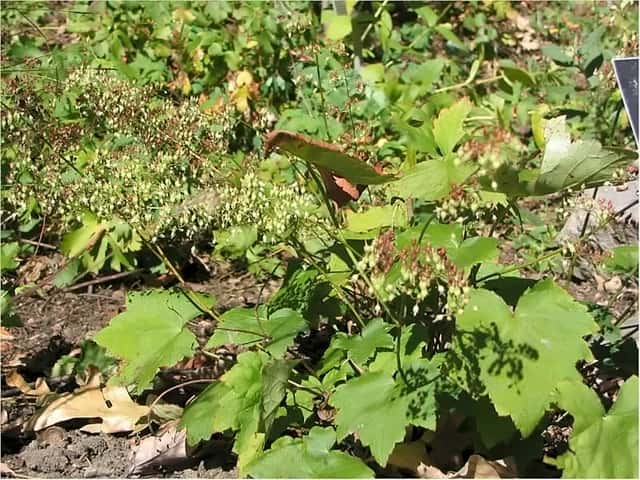
Saxifragaceae
Hairy Alumroot: Ground Cover Plant
Heuchera villosa
Grow in part shade with consistently moist, well-drained, humus-rich soil. Water when the top inch of soil dries out, avoid wetting the foliage, and feed lightly during the growing season. Divide congested clumps every 3-4 years in spring to keep plants vigorous.
Every 5 days
Partial shade
-20° - 29°C
40% - 70%
Categories
What is Hairy Alumroot?
Hairy Alumroot (Heuchera villosa) is a easy-care plant from the Saxifragaceae family. Heuchera villosa, commonly called hairy alumroot, is a clump-forming woodland perennial native to the Appalachian region of the eastern United States, from New York south to Georgia and west to Missouri. It forms low mounds of softly hairy, maple-like leaves and sends up airy spikes of tiny white to...
Hairy Alumroot grows up to 90cm, spread of 60cm, watering every 5 days, -20°C – 29°C, 40–70% humidity. It is not suitable for indoor environments and safe for pets.
Unlike many tropical plants, Hairy Alumroot tolerates watering mistakes. Best for beginners. Unlike many popular species, Hairy Alumroot is safe to keep around pets.
How to Care for Hairy Alumroot?
TLDR: Hairy Alumroot needs Partial shade, watering every 5 days, and temperatures between -20-29°C with 40-70% humidity.
How Often Should You Water Hairy Alumroot?
Keep the soil evenly moist but never soggy; water at the base to keep the fuzzy leaves dry and reduce the risk of fungal disease.
How Much Light Does Hairy Alumroot Need?
Best in partial to dappled shade; morning sun with afternoon shade is ideal in hot climates, though it tolerates more sun in cooler regions.
What Is the Best Soil for Hairy Alumroot?
Plant in well-draining, organically rich soil with a slightly acidic to neutral pH (about 6.0-7.5); good drainage is essential to prevent crown and root rot.
What Pot Should You Use for Hairy Alumroot?
Use a wide, shallow terracotta or ceramic pot with ample drainage holes to keep the shallow root system from sitting in water.
Care Schedule
Fertilize
Every 60 days
Repot
Every 900 days
What Is Hairy Alumroot and Where Does It Come From?
Heuchera villosa, commonly called hairy alumroot, is a clump-forming woodland perennial native to the Appalachian region of the eastern United States, from New York south to Georgia and west to Missouri. It forms low mounds of softly hairy, maple-like leaves and sends up airy spikes of tiny white to pink bell-shaped flowers from midsummer into fall. Prized for its outstanding heat and humidity tolerance compared to other coral bells, it thrives in shaded rock gardens, woodland borders, and containers.
How to Propagate Hairy Alumroot?
Clump Division
Divide every 3-4 years in early spring as new growth emerges, before flowering; discard old woody centers and replant only vigorous outer sections.
- 1 Water the plant well the day before dividing.
- 2 Dig up the entire clump, lifting the root ball carefully with a garden fork.
- 3 Use a sharp knife or spade to split the clump into sections, each with several leaves and healthy roots.
- 4 Discard any woody, unproductive centers.
- 5 Replant divisions immediately at the same depth they were growing, spacing 30-45 cm apart.
- 6 Water thoroughly and keep soil consistently moist until new growth appears.
Materials needed:
How Big Does Hairy Alumroot Grow?
TLDR: Hairy Alumroot can reach up to 90cm tall with Medium growth rate.
Max height
90cm
Spread
60cm
Growth rate
Medium
Foliage
Semi-evergreen
Plant Uses
Ornamental
Great for decoration
Ground Cover
Soil coverage
Is your plant showing symptoms?
Click on the symptom to discover possible causes:
What Diseases Commonly Affect Hairy Alumroot?
TLDR: Hairy Alumroot is susceptible to 6 known diseases. Monitor regularly for early detection.
Root Rot
Root rot is a serious fungal disease that affects the root system of plants, causing them to decay and die. It is primarily caused by overwatering, poor drainage, or soil-borne fungi such as Pythium, Phytophthora, Rhizoctonia, and Fusarium. The disease thrives in waterlogged conditions where roots are deprived of oxygen, making them susceptible to fungal infection.
Rust
Rust is a common fungal disease caused by fungi in the order Pucciniales that affects a wide variety of plants. The disease gets its name from the characteristic orange, yellow, or reddish-brown pustules that appear on leaves, resembling metal rust. This obligate fungal parasite requires living plants to survive and can cause significant economic losses in agricultural crops.
Powdery Mildew
Powdery mildew is a common fungal disease caused by various fungi species including Erysiphe, Podosphaera, Oïdium, and Leveillula. It affects over 10,000 plant species worldwide. The disease thrives in warm, dry climates with high humidity and appears as a distinctive white powdery coating on plant surfaces.
Leaf Spot
Leaf spot is a common fungal disease caused by various pathogens including Alternaria, Ascochyta, Colletotrichum, Septoria, and Venturia. It primarily affects leaves, causing discolored spots that can lead to premature leaf drop if left untreated.
Meaning & Symbolism
Delicate beauty and quiet resilience: airy bell-shaped blooms on slender stems paired with tough, textured evergreen foliage symbolize grace balanced with inner strength.
Compare with similar plants
| Attribute | Difficulty | Light | Watering | Pet Safe |
|---|---|---|---|---|
| Field Maple | Easy | Bright indirect | 14d | ✓ |
| Silver Birch | Easy | Direct sun | 14d | ✓ |
| Common Blanketflower | Easy | Direct sun | 10d | ✓ |
| Cushion Bush | Easy | Direct sun | 14d | ✓ |





