Brassicaceae
Hairy Bittercress (Cardamine hirsuta)
Cardamine hirsuta
Hairy bittercress needs almost no care to thrive: give it moist soil and partial shade to full sun, and it will grow rapidly and self-seed on its own. Because it completes its life cycle in about 5-7 weeks, gardeners who want to keep it as an edible ground cover should let a few plants set seed, while those who want to control it should remove plants before the seed pods ripen and shatter.
Every 5 days
Partial shade
5° - 27°C
40% - 70%
Categories
What is Hairy Bittercress?
Hairy Bittercress (Cardamine hirsuta) is a easy-care plant from the Brassicaceae family. Cardamine hirsuta, commonly known as hairy bittercress, is a small, fast-growing annual (occasionally biennial) herb in the mustard family (Brassicaceae). Native to Europe, Asia and parts of Africa, it now grows almost worldwide as a common garden weed, favoring moist, disturbed soil in beds, contai...
Hairy Bittercress grows up to 20cm, spread of 15cm, watering every 5 days, 5°C – 27°C, 40–70% humidity. It is not suitable for indoor environments and safe for pets.
Unlike many tropical plants, Hairy Bittercress tolerates watering mistakes. Best for beginners. Unlike many popular species, Hairy Bittercress is safe to keep around pets.
How to Care for Hairy Bittercress?
TLDR: Hairy Bittercress needs Partial shade, watering every 5 days, and temperatures between 5-27°C with 40-70% humidity.
How Often Should You Water Hairy Bittercress?
Keep the soil evenly moist, especially during germination and early growth; water every 4-6 days if there is no rainfall. It tolerates brief dry spells once established but grows lusher and more tender with consistent moisture.
How Much Light Does Hairy Bittercress Need?
Grows best in partial shade to full sun. In hot climates, afternoon shade keeps the leaves tender and prevents the plant from bolting to seed too quickly.
What Is the Best Soil for Hairy Bittercress?
Not fussy about soil type - thrives in sandy, loamy or clay soil as long as it is kept moist and has decent organic content. Tolerates a wide pH range from acidic to alkaline.
What Pot Should You Use for Hairy Bittercress?
Any shallow, well-draining container works well since this is a small, short-lived annual; a wide, shallow pot or window box suits its low rosette habit and makes harvesting easy.
What Is Hairy Bittercress and Where Does It Come From?
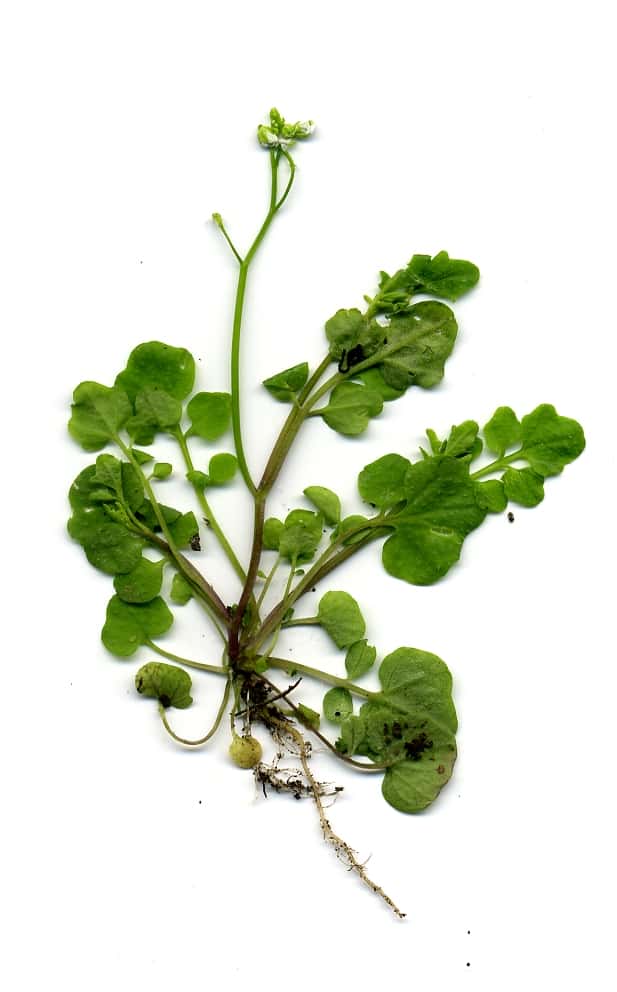
Cardamine hirsuta, commonly known as hairy bittercress, is a small, fast-growing annual (occasionally biennial) herb in the mustard family (Brassicaceae). Native to Europe, Asia and parts of Africa, it now grows almost worldwide as a common garden weed, favoring moist, disturbed soil in beds, containers and pavement cracks. It forms a low rosette of pinnately compound leaves and sends up slender flowering stems topped with tiny four-petaled white flowers. Its slender seed pods (siliques) ripen explosively, catapulting seeds several feet to spread the plant quickly. Despite its weedy reputation, the young leaves are edible and prized for a peppery, cress-like flavor similar to watercress or arugula.
How to Propagate Hairy Bittercress?
Seed sowing
Hairy bittercress self-seeds readily and its seed pods explode when ripe, flinging seeds up to a meter away, so harvest pods before they dry if you want to control spread.
- 1 Scatter fresh seeds onto moist, loose soil in a partly shaded spot
- 2 Press seeds lightly into the soil surface without burying them deeply
- 3 Keep the soil consistently moist until seedlings emerge
- 4 Thin seedlings if overcrowded once true leaves appear
Materials needed:
How Big Does Hairy Bittercress Grow?
TLDR: Hairy Bittercress can reach up to 20cm tall with Fast growth rate.
Max height
20cm
Spread
15cm
Growth rate
Fast
Foliage
Deciduous
Plant Uses
Edible
Can be consumed
Ground Cover
Soil coverage
Culinary Uses
- Fresh leaves added to salads for a peppery, watercress-like kick
- Used as a garnish on soups and sandwiches
- Young leaves cooked lightly as a potherb, similar to spinach
- Flowers used as an edible garnish
Is your plant showing symptoms?
Click on the symptom to discover possible causes:
What Diseases Commonly Affect Hairy Bittercress?
TLDR: Hairy Bittercress is susceptible to 3 known diseases. Monitor regularly for early detection.
Powdery Mildew
Powdery mildew is a common fungal disease caused by various fungi species including Erysiphe, Podosphaera, Oïdium, and Leveillula. It affects over 10,000 plant species worldwide. The disease thrives in warm, dry climates with high humidity and appears as a distinctive white powdery coating on plant surfaces.
Downy Mildew
Downy mildew is a fungal-like disease caused by oomycetes (water molds) that thrives in cool, wet conditions. It affects a wide range of plants, causing yellowing leaves with fuzzy white-gray growth underneath, leading to defoliation and reduced yields if left untreated.
Aphids
Aphids are small, soft-bodied, pear-shaped insects (1/16 to 1/8 inch long) that feed by sucking nutrient-rich sap from plants. They reproduce rapidly and can quickly weaken plants, causing distorted growth and transmitting plant viruses. Aphids come in various colors including green, black, red, yellow, brown, and gray. They secrete honeydew, a sticky substance that attracts ants and encourages sooty mold growth.
Fun Facts
Its seed pods can catapult seeds more than a meter away when touched, earning it nicknames like 'shot weed' and 'flick weed.'
A single plant can complete its entire life cycle, from germination to seed, in as little as 5 to 7 weeks.
The tender leaves taste similar to watercress and are a favorite foraged green among wild-food enthusiasts.
It serves as a host plant for spring azure and falcate orange-tip butterfly caterpillars.
Frequently asked questions
Is hairy bittercress edible?
Is Cardamine hirsuta toxic to pets?
Why does hairy bittercress spread so fast?
How do I get rid of hairy bittercress in my garden?
Does hairy bittercress need fertilizer?
Compare with similar plants
| Attribute | Difficulty | Light | Watering | Pet Safe |
|---|---|---|---|---|
| Field Maple | Easy | Bright indirect | 14d | ✓ |
| Silver Birch | Easy | Direct sun | 14d | ✓ |
| Common Blanketflower | Easy | Direct sun | 10d | ✓ |
| Cushion Bush | Easy | Direct sun | 14d | ✓ |





