Asteraceae
Catsear: Ground Cover Plant
Hypochaeris radicata
It is a very low-maintenance plant, ideal for wild gardens or areas with poor soil. It prefers full sun but tolerates partial shade, moderate watering with drought tolerance thanks to its deep taproot, and requires no fertilization or special care. Avoid waterlogging, which can cause root rot.
Every 12 days
Direct sun
-5° - 32°C
40% - 70%
Categories
What is Catsear?
Catsear (Hypochaeris radicata) is a easy-care plant from the Asteraceae family. Catsear (Hypochaeris radicata) is a perennial herbaceous plant in the Asteraceae family, native to Europe and now naturalized in the Americas, Australia, and New Zealand. It forms a basal rosette of rough, hairy, lobed leaves, from which leafless branched stems emerge, ending in golden-yellow flower...
Catsear grows up to 60cm, spread of 30cm, watering every 12 days, -5°C – 32°C, 40–70% humidity. It is not suitable for indoor environments and safe for pets.
Unlike many tropical plants, Catsear tolerates watering mistakes. Best for beginners. Unlike many popular species, Catsear is safe to keep around pets.
How to Care for Catsear?
TLDR: Catsear needs Direct sun, watering every 12 days, and temperatures between -5-32°C with 40-70% humidity.
How Often Should You Water Catsear?
Water moderately, allowing the substrate to dry partially between waterings; it withstands short periods of drought well due to its deep root, but does not tolerate waterlogging.
How Much Light Does Catsear Need?
Grows best in full sun (at least 6 hours daily), although it adapts well to partial shade in very hot climates.
What Is the Best Soil for Catsear?
Prefers well-drained soils, from slightly acidic to neutral, and tolerates sandy or nutrient-poor soils; avoid waterlogged or overly fertile substrates.
What Pot Should You Use for Catsear?
If grown in a pot, use a wide and shallow container with good drainage (unglazed terracotta is ideal) to mimic its rosette habit and taproot; add gravel to the bottom to prevent waterlogging.
What Is Catsear and Where Does It Come From?
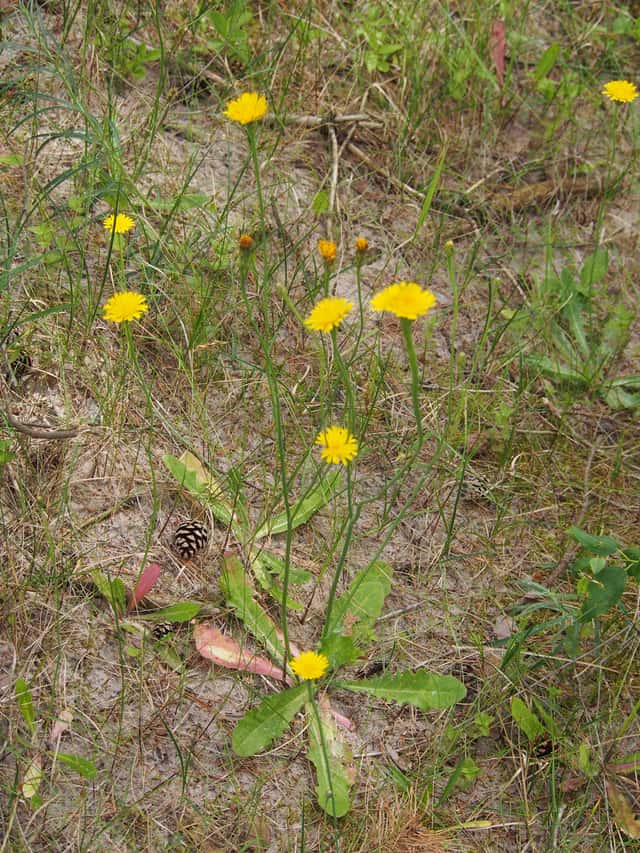
Catsear (Hypochaeris radicata) is a perennial herbaceous plant in the Asteraceae family, native to Europe and now naturalized in the Americas, Australia, and New Zealand. It forms a basal rosette of rough, hairy, lobed leaves, from which leafless branched stems emerge, ending in golden-yellow flower heads very similar to those of the dandelion. The entire plant exudes a milky latex when cut. It is extremely hardy, tolerating poor and compacted soils, and commonly grows spontaneously in lawns, roadsides, and vacant lots.
How to Propagate Catsear?
Sowing by seed
Germinates easily even in poor soils; does not require stratification or special treatments.
- 1 Collect mature seeds from dry flower heads (with their feathery pappus, like a dandelion)
- 2 Scatter seeds over well-drained soil, pressing lightly without covering them too much
- 3 Keep the substrate uniformly moist until germination
- 4 Thin out seedlings leaving about 20-30 cm of spacing once established
Materials needed:
Basal rosette division
The deep taproot makes division more delicate than sowing; work carefully to avoid damaging it.
- 1 Carefully dig up a rosette with part of the taproot
- 2 Divide the rosette ensuring each section retains roots
- 3 Transplant immediately into well-drained soil
- 4 Water well after transplanting to encourage rooting
Materials needed:
How Big Does Catsear Grow?
TLDR: Catsear can reach up to 60cm tall with Medium growth rate.
Max height
60cm
Spread
30cm
Growth rate
Medium
Foliage
Semi-evergreen
Plant Uses
Edible
Can be consumed
Medicinal
Medicinal properties
Ground Cover
Soil coverage
Medicinal Uses
- Anti-inflammatory and diuretic in folk medicine
- Topical use as a vulnerary and anti-dermatotic (wounds and skin conditions)
- Traditionally used for dyspepsia, mild constipation, and kidney problems
- Antioxidant and antibacterial properties attributed to leaves and roots
Culinary Uses
- Young tender leaves raw in salads, seasoned with salt, oil, and vinegar
- Leaves steamed or sautéed as a wild vegetable in stews and soups
- Roasted and ground root as a coffee substitute
- Historically used as fodder for pigs (hence its common name in several languages)
Is your plant showing symptoms?
Click on the symptom to discover possible causes:
What Diseases Commonly Affect Catsear?
TLDR: Catsear is susceptible to 6 known diseases. Monitor regularly for early detection.
Aphids
Aphids are small, soft-bodied, pear-shaped insects (1/16 to 1/8 inch long) that feed by sucking nutrient-rich sap from plants. They reproduce rapidly and can quickly weaken plants, causing distorted growth and transmitting plant viruses. Aphids come in various colors including green, black, red, yellow, brown, and gray. They secrete honeydew, a sticky substance that attracts ants and encourages sooty mold growth.
Caterpillars
Caterpillars are the larval stage of moths and butterflies that feed voraciously on plant foliage, stems, flowers, and fruits. Common species include cabbage loopers, tomato hornworms, armyworms, and cutworms. These pests can cause extensive damage by consuming large amounts of plant tissue in a short time. They vary in size from small (1/4 inch) to large (5 inches), with colors ranging from green to brown, often featuring stripes or spots. Caterpillars are highly mobile and can quickly spread throughout gardens, making them one of the most destructive common pests.
Slugs and Snails
Slugs and snails are mollusks that feed on plant tissue, causing irregular holes in leaves and damage to young seedlings. They are most active at night and in moist conditions, leaving characteristic silvery slime trails. These pests can quickly devastate gardens, especially during wet seasons.
Powdery Mildew
Powdery mildew is a common fungal disease caused by various fungi species including Erysiphe, Podosphaera, Oïdium, and Leveillula. It affects over 10,000 plant species worldwide. The disease thrives in warm, dry climates with high humidity and appears as a distinctive white powdery coating on plant surfaces.
Meaning & Symbolism
Like the dandelion, it symbolizes resilience, humility, and the ability to bloom even in the most difficult terrains.
Compare with similar plants
| Attribute | Difficulty | Light | Watering | Pet Safe |
|---|---|---|---|---|
| Field Maple | Easy | Bright indirect | 14d | ✓ |
| Silver Birch | Easy | Direct sun | 14d | ✓ |
| Common Blanketflower | Easy | Direct sun | 10d | ✓ |
| Cushion Bush | Easy | Direct sun | 14d | ✓ |





