Asteraceae
Hairy Inula: Full Sun Plant
Inula hirta
Hairy Inula is extremely easy to care for and robust once established in its location. It requires very little attention: occasional watering during long dry spells, pruning of faded stems in the fall, and a nutrient-poor, well-drained soil. Fertilization is generally not necessary, as the species is adapted to lean sites.
Every 12 days
Direct sun
-20° - 35°C
% - %
Categories
What is Hairy Inula?
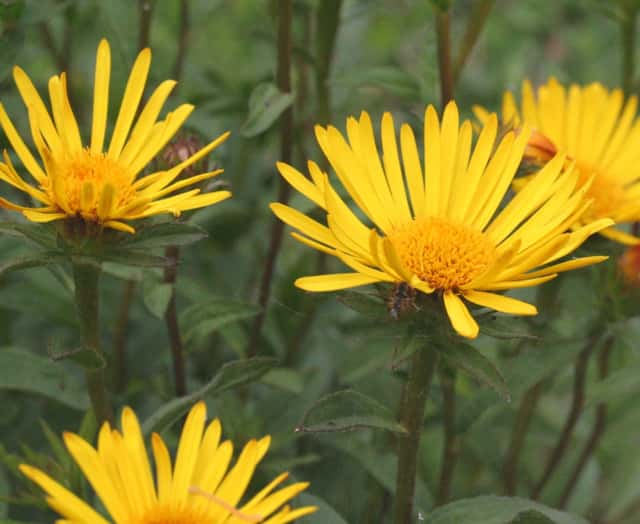
Hairy Inula (Inula hirta) is a easy-care plant from the Asteraceae family. Hairy Inula (Inula hirta) is a perennial herbaceous plant in the daisy family (Asteraceae) that reaches heights of 15 to 50 cm. The leaves and stems are conspicuously hairy, and the narrow-elliptical leaves are arranged alternately. From June to August, bright golden-yellow flower heads appear. The...
Hairy Inula grows up to 50cm, spread of 40cm, watering every 12 days, -20°C – 35°C. It is not suitable for indoor environments and safe for pets.
Unlike many tropical plants, Hairy Inula tolerates watering mistakes. Best for beginners. Unlike many popular species, Hairy Inula is safe to keep around pets.
How to Care for Hairy Inula?
TLDR: Hairy Inula needs Direct sun, watering every 12 days, and temperatures between -20-35°C with 40-70% humidity.
How Often Should You Water Hairy Inula?
Water sparingly and allow the soil to dry out between waterings—Hairy Inula is adapted to dry, lean locations and does not tolerate waterlogging well.
How Much Light Does Hairy Inula Need?
Choose a sunny to semi-shaded location with ideally several hours of direct sun daily, preferably near open woodland edges.
What Is the Best Soil for Hairy Inula?
Use a well-drained, calcareous to nutrient-poor soil; heavy, waterlogged clay soils should be avoided.
What Pot Should You Use for Hairy Inula?
This species thrives best in open ground; for container cultivation, choose a wide, shallow pot with a very well-drained, mineral substrate and generous drainage holes.
What Is Hairy Inula and Where Does It Come From?
Hairy Inula (Inula hirta) is a perennial herbaceous plant in the daisy family (Asteraceae) that reaches heights of 15 to 50 cm. The leaves and stems are conspicuously hairy, and the narrow-elliptical leaves are arranged alternately. From June to August, bright golden-yellow flower heads appear. The species grows in clumps with short rhizomes on nutrient-poor dry and semi-dry grasslands, preferring locations near open oak or pine forests on calcareous soils. Its distribution range extends from Central Asia and Siberia through Southeast Europe to Central Europe, where it is rare and protected at its western range limit. As a valuable bee pasture, it is visited by numerous species of wild bees and butterflies.
How to Propagate Hairy Inula?
How Big Does Hairy Inula Grow?
TLDR: Hairy Inula can reach up to 50cm tall with Medium growth rate.
Max height
50cm
Spread
40cm
Growth rate
Medium
Foliage
Deciduous
Plant Uses
Ornamental
Great for decoration
Is your plant showing symptoms?
Click on the symptom to discover possible causes:
What Diseases Commonly Affect Hairy Inula?
TLDR: Hairy Inula is susceptible to 2 known diseases. Monitor regularly for early detection.
Powdery Mildew
Powdery mildew is a common fungal disease caused by various fungi species including Erysiphe, Podosphaera, Oïdium, and Leveillula. It affects over 10,000 plant species worldwide. The disease thrives in warm, dry climates with high humidity and appears as a distinctive white powdery coating on plant surfaces.
Aphids
Aphids are small, soft-bodied, pear-shaped insects (1/16 to 1/8 inch long) that feed by sucking nutrient-rich sap from plants. They reproduce rapidly and can quickly weaken plants, causing distorted growth and transmitting plant viruses. Aphids come in various colors including green, black, red, yellow, brown, and gray. They secrete honeydew, a sticky substance that attracts ants and encourages sooty mold growth.
Meaning & Symbolism
As a modest dry-grassland perennial, Hairy Inula symbolizes resilience and ecological value—it is one of the important bee and butterfly pastures of lean meadow landscapes.
Compare with similar plants
| Attribute | Difficulty | Light | Watering | Pet Safe |
|---|---|---|---|---|
| Field Maple | Easy | Bright indirect | 14d | ✓ |
| Silver Birch | Easy | Direct sun | 14d | ✓ |
| Common Blanketflower | Easy | Direct sun | 10d | ✓ |
| Cushion Bush | Easy | Direct sun | 14d | ✓ |





