Cactaceae
Rhipsalis pilocarpa (Hairy-Stemmed Rhipsalis)
Rhipsalis pilocarpa
Grow in bright, indirect light with partial shade, a light, airy orchid-style mix, and frequent light watering that keeps the substrate lightly moist. Higher humidity than typical for cacti is appreciated. Slow-growing and low-maintenance once its shade and moisture needs are met.
Every 7 days
Partial shade
15° - 29°C
50% - 70%
Categories
What is Hairy-stemmed Rhipsalis?
Hairy-stemmed Rhipsalis (Rhipsalis pilocarpa) is a easy-care plant from the Cactaceae family. Rhipsalis pilocarpa, commonly called the hairy-stemmed rhipsalis, is an epiphytic cactus endemic to Brazil's Atlantic Forest, native to the states of Espírito Santo, Minas Gerais, Rio de Janeiro, São Paulo, and Paraná. In the wild it grows harmlessly on tree trunks and branches, absorbing moisture a...
Hairy-stemmed Rhipsalis grows up to 50cm, spread of 50cm, watering every 7 days, 15°C – 29°C, 50–70% humidity. It is suitable for indoor environments and safe for pets.
Unlike many tropical plants, Hairy-stemmed Rhipsalis tolerates watering mistakes. Best for beginners. Unlike many popular species, Hairy-stemmed Rhipsalis is safe to keep around pets. Without adequate drainage, root rot can develop within 14 days.
How to Care for Hairy-stemmed Rhipsalis?
TLDR: Hairy-stemmed Rhipsalis needs Partial shade, watering every 7 days, and temperatures between 15-29°C with 50-70% humidity.
How Often Should You Water Hairy-stemmed Rhipsalis?
Water lightly every 5-7 days, keeping the substrate consistently barely moist but never soggy. Reduce frequency in winter.
How Much Light Does Hairy-stemmed Rhipsalis Need?
Provide bright, filtered light or partial shade, as found under a forest canopy. Avoid direct sun, which can scorch the stems.
What Is the Best Soil for Hairy-stemmed Rhipsalis?
Use an airy, orchid-style mix of pine bark, charcoal, and coconut fiber, with a little sphagnum moss to hold humidity.
What Pot Should You Use for Hairy-stemmed Rhipsalis?
Hanging baskets or terracotta pots with good drainage, which showcase the plant's trailing growth habit.
Care Schedule
Fertilize
Every 30 days
Misting
Every 3 days
What Is Hairy-stemmed Rhipsalis and Where Does It Come From?
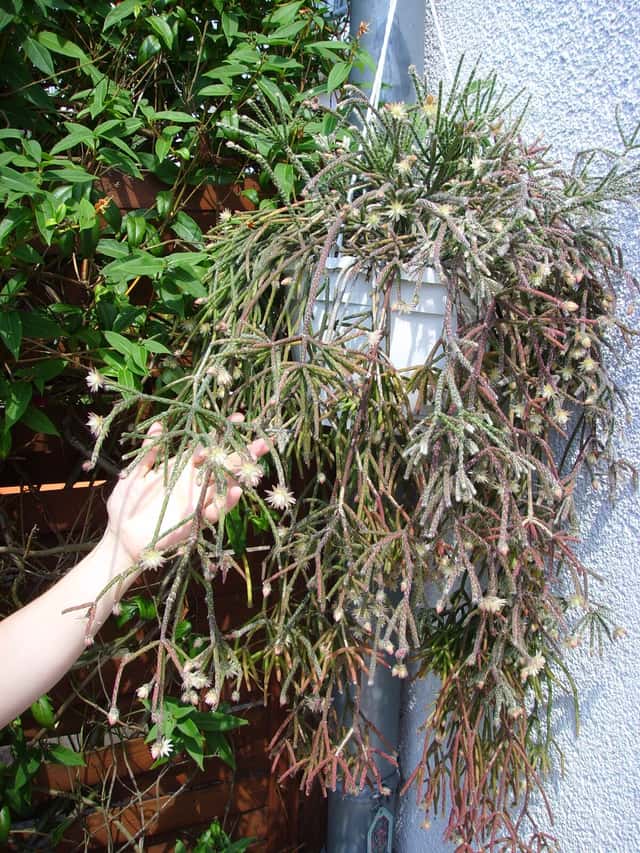
Rhipsalis pilocarpa, commonly called the hairy-stemmed rhipsalis, is an epiphytic cactus endemic to Brazil's Atlantic Forest, native to the states of Espírito Santo, Minas Gerais, Rio de Janeiro, São Paulo, and Paraná. In the wild it grows harmlessly on tree trunks and branches, absorbing moisture and nutrients from humid forest air and organic debris rather than from soil. Its slender cylindrical stems, reaching up to 50 cm long, start upright and become pendant as they mature, covered in small gray-to-white bristles that give the plant a soft, fuzzy texture. Fragrant white flowers 2.5 to 4 cm wide appear from fall into early winter, followed by bristly, wine-red spherical fruits about 12 mm across. Unlike desert cacti, this forest species thrives in filtered light and higher humidity, reflecting its origins beneath the rainforest canopy.
How to Propagate Hairy-stemmed Rhipsalis?
Stem cutting
Avoid overwatering right after planting; wait for signs of rooting before resuming normal watering.
- 1 Cut a healthy 8-15 cm stem segment with clean scissors
- 2 Let the cutting dry in a shaded, ventilated spot for 2-3 days until the cut callouses
- 3 Plant the cutting in a light, airy orchid-style mix
- 4 Keep the substrate lightly moist in filtered light until roots form
Materials needed:
How Big Does Hairy-stemmed Rhipsalis Grow?
TLDR: Hairy-stemmed Rhipsalis can reach up to 50cm tall with Slow growth rate.
Max height
50cm
Spread
50cm
Growth rate
Slow
Foliage
Evergreen
Plant Uses
Ornamental
Great for decoration
Is your plant showing symptoms?
Click on the symptom to discover possible causes:
What Diseases Commonly Affect Hairy-stemmed Rhipsalis?
TLDR: Hairy-stemmed Rhipsalis is susceptible to 6 known diseases. Monitor regularly for early detection.
Root Rot
Root rot is a serious fungal disease that affects the root system of plants, causing them to decay and die. It is primarily caused by overwatering, poor drainage, or soil-borne fungi such as Pythium, Phytophthora, Rhizoctonia, and Fusarium. The disease thrives in waterlogged conditions where roots are deprived of oxygen, making them susceptible to fungal infection.
Mealybugs
Mealybugs are small, soft-bodied insects covered with a white, waxy, cottony material. They are common pests of houseplants and outdoor plants in mild climates. These sap-sucking insects feed on plant tissue, causing damage, stunted growth, and can lead to plant death if left untreated. They produce sticky honeydew which attracts sooty mold.
Spider Mites
Spider mites are tiny arachnids (less than 1/20 inch long) related to spiders and ticks that feed on plant sap. They thrive in hot, dry conditions and can cause significant damage to ornamental and vegetable plants. During severe infestations, crop losses can reach 14% or higher as these pests disrupt vital plant processes including photosynthesis, carbon dioxide absorption, and transpiration.
Scale Insects
Scale insects are small sap-sucking pests that appear as brown, shell-like bumps on plant stems and leaves. There are over 25 species, divided into armored (hard) and unarmored (soft) scales. They feed by piercing plant tissue and extracting sap, which weakens the plant and can lead to yellowing, stunted growth, and even death if left untreated. They also excrete honeydew, which attracts ants and promotes sooty mold growth.
Fun Facts
Unlike most cacti, it grows naturally hanging from Atlantic Forest trees without harming its host.
Its species name 'pilocarpa' means 'hairy fruit,' referring to the bristly fruits.
It is classified as Vulnerable by the IUCN due to Atlantic Forest habitat loss.
It received the Royal Horticultural Society's Award of Garden Merit.
Frequently asked questions
Does Rhipsalis pilocarpa need direct sunlight?
How often should I water Rhipsalis pilocarpa?
Is Rhipsalis pilocarpa toxic to cats and dogs?
How do you propagate Rhipsalis pilocarpa?
Compare with similar plants
| Attribute | Difficulty | Light | Watering | Pet Safe |
|---|---|---|---|---|
| Field Maple | Easy | Bright indirect | 14d | ✓ |
| Silver Birch | Easy | Direct sun | 14d | ✓ |
| Common Blanketflower | Easy | Direct sun | 10d | ✓ |
| Cushion Bush | Easy | Direct sun | 14d | ✓ |
Choose & Compare
Sources & References
- Rhipsalis pilocarpa - Wikipedia
- Rhipsalis pilocarpa (Hairy Stemmed Rhipsalis) - World of Succulents
- Rhipsalis Pilocarpa Care - Plantophiles
- Rhipsalis Pilocarpa: Cacto Para Ambientes Sombreados - Terragam
- Mistletoe Cactus - ASPCA Toxic and Non-Toxic Plants
- Todo sobre el Rhipsalis pilocarpa - Cactus y Suculentas
- Hairy Stemmed Rhipsalis Plant Care - Plantiary
- Rhipsalis Pilocarpa: The Fuzzy-Stemmed Hanging Cactus





