Euphorbiaceae
Hardy Manihot: Fast Growing
Manihot grahamii
Hardy Manihot is an undemanding, fast-growing plant suitable for sunny to partially shaded locations with well-draining soil. Once established, it tolerates heat and drought very well; the main risk is waterlogging of the substrate, which leads to root rot. In cooler regions, the aerial parts die back in winter, but the plant will regrow from the root system if protected with mulch.
Every 7 days
Bright indirect
-5° - 38°C
% - %
Categories
What is Hardy Manihot?
Hardy Manihot (Manihot grahamii) is a easy-care plant from the Euphorbiaceae family. Hardy Manihot is a fast-growing shrub to small tree from the spurge family (Euphorbiaceae), native to southern Brazil, Uruguay, Paraguay, and Argentina. It is closely related to the edible cassava (Manihot esculenta), from which it differs primarily by its significantly higher cold tolerance. It fea...
Hardy Manihot grows up to 6.0m, spread of 200cm, watering every 7 days, -5°C – 38°C. It is not suitable for indoor environments and not safe for pets.
Unlike many tropical plants, Hardy Manihot tolerates watering mistakes. Best for beginners. Without precautions, ingestion can cause irritation in pets. Keep out of reach of cats and dogs.
How to Care for Hardy Manihot?
TLDR: Hardy Manihot needs Bright indirect, watering every 7 days, and temperatures between -5-38°C with 40-70% humidity.
How Often Should You Water Hardy Manihot?
Water regularly until the plant is established, then limit watering only to dry periods—overwatering is more dangerous than short-term drought. During the winter season, when the plant's growth slows down or it has lost its leaves, significantly reduce watering.
How Much Light Does Hardy Manihot Need?
It grows best in full sun but also tolerates partial shade. Indoors or in a greenhouse, it requires as much light as possible, ideally with a southern or western exposure.
What Is the Best Soil for Hardy Manihot?
Prefers nutritious, well-draining soil (loamy, possibly with an admixture of sand or perlite). It tolerates a wide range of pH from slightly acidic to alkaline; the main requirement is the rapid drainage of excess water.
What Pot Should You Use for Hardy Manihot?
For container growing, choose a terracotta or other breathable pot with sufficient drainage holes—porous material helps the substrate dry out faster and reduces the risk of overwatering and root rot.
Care Schedule
Fertilize
Every 60 days
What Is Hardy Manihot and Where Does It Come From?
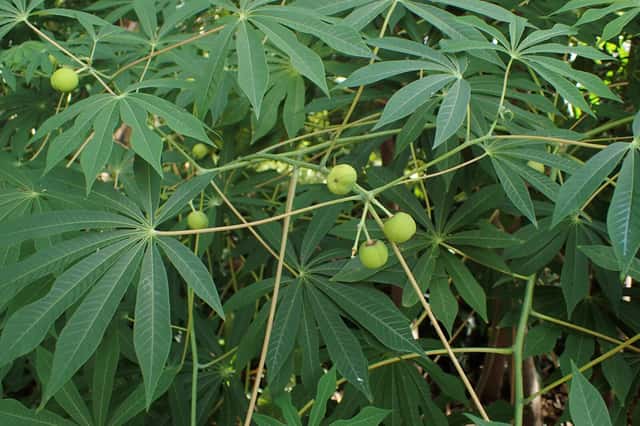
Hardy Manihot is a fast-growing shrub to small tree from the spurge family (Euphorbiaceae), native to southern Brazil, Uruguay, Paraguay, and Argentina. It is closely related to the edible cassava (Manihot esculenta), from which it differs primarily by its significantly higher cold tolerance. It features striking palmately lobed, deeply divided leaves and produces corymbs of waxy, reddish-streaked light green bell-shaped flowers in summer. In milder climates, it may die back to the ground in winter but quickly resprouts from its hardy root system in spring.
How to Propagate Hardy Manihot?
Softwood cuttings
The milky sap can irritate the skin; use gloves when cutting. Overwatering the cutting at this stage often leads to rot.
- 1 Cut a 10-15 cm long softwood (non-woody) shoot from a healthy plant.
- 2 Let the cut dry for a few hours so the milky sap stops flowing.
- 3 Insert the cutting into a well-draining substrate (e.g., sand with peat or perlite).
- 4 Keep the substrate slightly moist and place the plant in a warm, bright spot with indirect sunlight until it roots.
Materials needed:
Seed sowing
Germination is uneven, so sow multiple seeds at once. Seedlings grow quickly and will strengthen within a single season during warm and sunny weather.
- 1 Lightly scarify the seeds or soak them in lukewarm water for 24 hours before sowing to improve germination.
- 2 Sow in a light, well-draining substrate and cover only shallowly.
- 3 Keep the substrate evenly moist and warm (around 20-25 °C) until germination.
- 4 After germination, transplant the seedlings into individual pots as soon as they develop their first true leaves.
Materials needed:
How Big Does Hardy Manihot Grow?
TLDR: Hardy Manihot can reach up to 6.0m tall with Fast growth rate.
Max height
6.0m
Spread
2.0m
Growth rate
Fast
Foliage
Deciduous
Warning: Toxic Plant
This plant can be toxic if ingested. Keep out of reach of:
Plant Uses
Ornamental
Great for decoration
Is your plant showing symptoms?
Click on the symptom to discover possible causes:
What Diseases Commonly Affect Hardy Manihot?
TLDR: Hardy Manihot is susceptible to 4 known diseases. Monitor regularly for early detection.
Root Rot
Root rot is a serious fungal disease that affects the root system of plants, causing them to decay and die. It is primarily caused by overwatering, poor drainage, or soil-borne fungi such as Pythium, Phytophthora, Rhizoctonia, and Fusarium. The disease thrives in waterlogged conditions where roots are deprived of oxygen, making them susceptible to fungal infection.
Whiteflies
Whiteflies are small, soft-bodied, winged insects closely related to aphids and mealybugs. They are moth-like in appearance, about 1/16 inch long, triangular in shape, and gray-white in color. These sap-sucking pests feed on plant tissue, causing yellowing, stunted growth, and wilting. They also excrete honeydew, which attracts ants and promotes sooty mold growth. Whiteflies can transmit serious plant viruses.
Aphids
Aphids are small, soft-bodied, pear-shaped insects (1/16 to 1/8 inch long) that feed by sucking nutrient-rich sap from plants. They reproduce rapidly and can quickly weaken plants, causing distorted growth and transmitting plant viruses. Aphids come in various colors including green, black, red, yellow, brown, and gray. They secrete honeydew, a sticky substance that attracts ants and encourages sooty mold growth.
Spider Mites
Spider mites are tiny arachnids (less than 1/20 inch long) related to spiders and ticks that feed on plant sap. They thrive in hot, dry conditions and can cause significant damage to ornamental and vegetable plants. During severe infestations, crop losses can reach 14% or higher as these pests disrupt vital plant processes including photosynthesis, carbon dioxide absorption, and transpiration.
Compare with similar plants
| Attribute | Difficulty | Light | Watering | Pet Safe |
|---|---|---|---|---|
| Field Maple | Easy | Bright indirect | 14d | ✓ |
| Silver Birch | Easy | Direct sun | 14d | ✓ |
| Common Blanketflower | Easy | Direct sun | 10d | ✓ |
| Cushion Bush | Easy | Direct sun | 14d | ✓ |
Choose & Compare
Sources & References
- Manihot grahamii - Missouri Botanical Garden Plant Finder
- Manihot grahamii - RHS
- Manihot grahamii - Wikipedia
- Manihot grahamii | Hardy Tapioca - Plant Delights Nursery
- Manihot Species, Hardy Tapioca - Dave's Garden
- Hardy Tapioca (Manihot grahamii) - Garden.org
- Is Cassava (Manihot) Toxic to Cats? - Growli (ASPCA data)





