Amaranthaceae
Atriplex prostrata (Hastate Orache) Care Guide
Atriplex prostrata
An extremely tough, low-maintenance annual that thrives in full sun on poor, salty or sandy soil with minimal watering. It grows quickly from seed each spring, flowers inconspicuously in summer and fall, then dies back - simply let it self-seed for next year.
Every 10 days
Bright indirect
-5° - 35°C
30% - 70%
Categories
What is Hastate Orache?
Hastate Orache (Atriplex prostrata) is a easy-care plant from the Amaranthaceae family. Atriplex prostrata, known as hastate orache or spear-leaved orache, is an annual halophytic herb in the Amaranthaceae family. Native to Europe, Macaronesia, North Africa and western Asia, it now grows across temperate regions worldwide in salt marshes, coastal beaches and disturbed saline ground. It...
Hastate Orache grows up to 1.0m, spread of 60cm, watering every 10 days, -5°C – 35°C, 30–70% humidity. It is not suitable for indoor environments and safe for pets.
Unlike many tropical plants, Hastate Orache tolerates watering mistakes. Best for beginners. Unlike many popular species, Hastate Orache is safe to keep around pets.
How to Care for Hastate Orache?
TLDR: Hastate Orache needs Bright indirect, watering every 10 days, and temperatures between -5-35°C with 30-70% humidity.
How Often Should You Water Hastate Orache?
Water sparingly and let the soil dry out between waterings. This halophyte is drought-tolerant once established and rarely needs supplemental irrigation outdoors.
How Much Light Does Hastate Orache Need?
Give it full sun for the sturdiest growth and best autumn leaf color, though it tolerates light shade.
What Is the Best Soil for Hastate Orache?
Prefers moist to well-drained, neutral to slightly alkaline sandy or loamy soil; tolerates salty and nutrient-poor ground better than most plants.
What Pot Should You Use for Hastate Orache?
Rarely grown in pots; if containerized, use a wide, shallow, well-draining pot with sandy potting mix.
What Is Hastate Orache and Where Does It Come From?
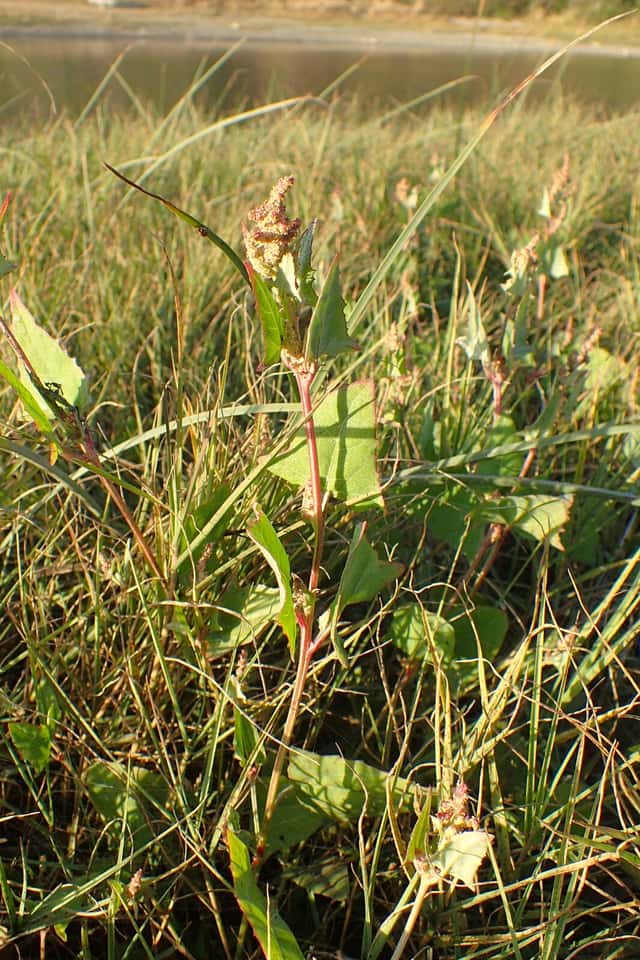
Atriplex prostrata, known as hastate orache or spear-leaved orache, is an annual halophytic herb in the Amaranthaceae family. Native to Europe, Macaronesia, North Africa and western Asia, it now grows across temperate regions worldwide in salt marshes, coastal beaches and disturbed saline ground. It forms sprawling to upright stems reaching up to 1 m, with distinctive hastate (spear- or arrowhead-shaped) leaves covered in tiny salt-excreting bladder hairs that let it thrive in brackish soils.
How to Propagate Hastate Orache?
Seed sowing
Seeds need light to germinate, so avoid covering them with soil; the plant self-seeds readily in favorable spots.
- 1 Collect ripe seed clusters in autumn
- 2 Sow directly into sandy or disturbed soil in spring, pressing lightly onto the surface
- 3 Keep soil lightly moist until germination
- 4 Thin seedlings once several centimeters tall
Materials needed:
How Big Does Hastate Orache Grow?
TLDR: Hastate Orache can reach up to 1.0m tall with Fast growth rate.
Max height
1.0m
Spread
60cm
Growth rate
Fast
Foliage
Deciduous
Plant Uses
Edible
Can be consumed
Culinary Uses
- Young leaves eaten raw in salads or cooked like spinach
- Salty leaves used as a seasoning or salt substitute
- Seeds can be ground into flour
Is your plant showing symptoms?
Click on the symptom to discover possible causes:
What Diseases Commonly Affect Hastate Orache?
TLDR: Hastate Orache is susceptible to 4 known diseases. Monitor regularly for early detection.
Aphids
Aphids are small, soft-bodied, pear-shaped insects (1/16 to 1/8 inch long) that feed by sucking nutrient-rich sap from plants. They reproduce rapidly and can quickly weaken plants, causing distorted growth and transmitting plant viruses. Aphids come in various colors including green, black, red, yellow, brown, and gray. They secrete honeydew, a sticky substance that attracts ants and encourages sooty mold growth.
Leafminers
Leafminers are the larvae of various insects including flies, moths, sawflies, and beetles that tunnel between leaf surfaces, creating distinctive serpentine trails or blotchy patches. While primarily cosmetic, severe infestations can weaken plants by reducing photosynthesis capacity and making them susceptible to secondary infections.
Downy Mildew
Downy mildew is a fungal-like disease caused by oomycetes (water molds) that thrives in cool, wet conditions. It affects a wide range of plants, causing yellowing leaves with fuzzy white-gray growth underneath, leading to defoliation and reduced yields if left untreated.
Flea beetle damage
Flea beetles are small, jumping insects that feed on the leaves of many vegetable crops. They chew numerous small, circular holes, creating a characteristic 'shothole' appearance. While established plants can often tolerate the damage, young seedlings are highly susceptible and can be stunted or killed if the infestation is severe.
Meaning & Symbolism
As a hardy coastal pioneer, it is sometimes associated with resilience and adaptability in harsh environments.
Fun Facts
Its hastate (arrowhead-shaped) leaves give the plant its common name hastate orache.
Tiny bladder hairs on the leaves and stems excrete excess salt, letting it grow in brackish, saline soil.
Young leaves taste like a salty, nutty spinach and have long been foraged as a wild vegetable.
It self-seeds readily and can complete its life cycle from seed to seed in a single growing season.
Frequently asked questions
Is Atriplex prostrata edible?
How much water does hastate orache need?
Where does hastate orache grow best?
Is Atriplex prostrata toxic to pets?
Compare with similar plants
| Attribute | Difficulty | Light | Watering | Pet Safe |
|---|---|---|---|---|
| Field Maple | Easy | Bright indirect | 14d | ✓ |
| Silver Birch | Easy | Direct sun | 14d | ✓ |
| Common Blanketflower | Easy | Direct sun | 10d | ✓ |
| Cushion Bush | Easy | Direct sun | 14d | ✓ |
Choose & Compare
Sources & References
- Atriplex prostrata - Wikipedia
- Atriplex prostrata (hastate-leaved orache) - Go Botany
- Atriplex prostrata Boucher ex DC. (Spear-leaved Orache) - BSBI
- Atriplex prostrata Boucher ex DC. - Plants of the World Online, Kew
- Fat Hen (not native) - Nature Collective
- Atriplex prostrata - Triangle Orache - Eat The Planet
- Garden orache (Atriplex hortensis) Care Guide: Pests, Diseases, Watering, Fertilizing and Toxicity
- Atriplex prostrata - NEMESIS species summary
- How To Grow Atriplex prostrata - EarthOne





