Pteridaceae
Heart Fern: Pet-Safe Plant
Hemionitis arifolia
Requires consistently moist but never waterlogged soil and air humidity above 60%. It prefers bright, indirect light without direct sun and stable temperatures between 60-80°F (16-27°C), away from drafts and drops below 59°F (15°C).
Every 3 days
Partial shade
16° - 27°C
60% - 90%
Categories
What is Heart Fern?
Heart Fern (Hemionitis arifolia) is a medium-care plant from the Pteridaceae family. Hemionitis arifolia, commonly known as the Heart Fern, is a small fern from the Pteridaceae family, native to the moist forests of South and Southeast Asia (ranging from India to China, Cambodia, and Taiwan). The plant reaches only 6-10 inches in height and produces two types of fronds set on dark,...
Heart Fern grows up to 25cm, spread of 20cm, watering every 3 days, 16°C – 27°C, 60–90% humidity. It is suitable for indoor environments and safe for pets.
Unlike many popular species, Heart Fern is safe to keep around pets. Without adequate drainage, root rot can develop within 7 days.
How to Care for Heart Fern?
TLDR: Heart Fern needs Partial shade, watering every 3 days, and temperatures between 16-27°C with 60-90% humidity.
How Often Should You Water Heart Fern?
Water when the top layer of the soil dries out slightly, usually 2-3 times a week. Use soft, filtered, or boiled water at room temperature and pour it directly onto the substrate rather than the leaves to reduce the risk of fungal diseases.
How Much Light Does Heart Fern Need?
Place the plant in a spot with bright, indirect light or partial shade—a north or east-facing window is ideal. Direct sunlight quickly causes burns on the delicate, heart-shaped leaves.
What Is the Best Soil for Heart Fern?
Use a well-draining, slightly acidic mix of peat and perlite that provides good water retention while allowing drainage; a drainage layer at the bottom of the pot should be at least 1 inch (3 cm) thick.
What Pot Should You Use for Heart Fern?
A plastic pot or glazed ceramic works well to retain moisture, always with drainage holes. Due to its high humidity requirements, the plant also thrives in a closed terrarium or 'forest in a jar'.
Care Schedule
Fertilize
Every 21 days
Misting
Every 1 days
Rotate
Every 14 days
Repot
Every 730 days
What Is Heart Fern and Where Does It Come From?
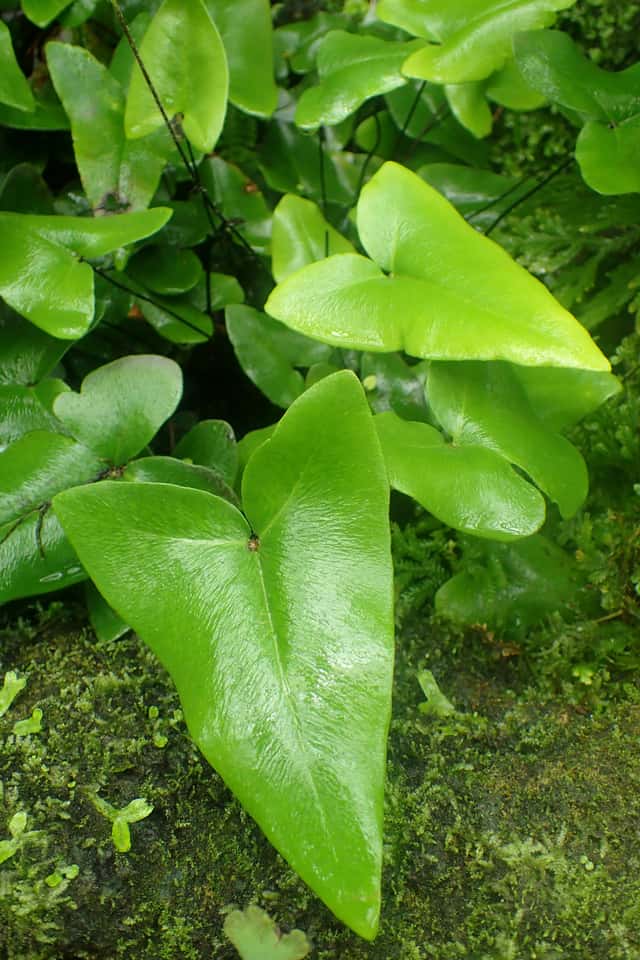
Hemionitis arifolia, commonly known as the Heart Fern, is a small fern from the Pteridaceae family, native to the moist forests of South and Southeast Asia (ranging from India to China, Cambodia, and Taiwan). The plant reaches only 6-10 inches in height and produces two types of fronds set on dark, almost black petioles: shorter, leathery heart-shaped sterile fronds and longer, arrow-shaped fertile fronds that rise above the clump. It is a slow grower and thrives best in conditions similar to a terrarium.
How to Propagate Heart Fern?
Division
- Keep the plant in very high humidity after division (e.g., under a cloche)
- Use clean tools
- 1 Removal from pot
Carefully remove the plant in March or April and clean the roots of excess soil.
- 2 Division
Gently separate the rhizomes, ensuring each section has leaves and a root system.
- 3 Planting
Plant the new divisions in fresh, moist substrate and keep them in very high humidity, such as under a humidity dome.
Materials needed:
Spore Sowing
- Maintain constant substrate moisture by misting
- Ensure sterile conditions to avoid mold
- 1 Spore collection
Collect mature, brown spores from the underside of the arrow-shaped fertile fronds.
- 2 Sowing
Sow the spores onto a sterile, moist peat substrate.
- 3 Incubation
Cover the container with plastic wrap and keep it in a warm, bright place (without direct sun) until prothalli appear.
Materials needed:
How Big Does Heart Fern Grow?
TLDR: Heart Fern can reach up to 25cm tall with Slow growth rate.
Max height
25cm
Spread
20cm
Growth rate
Slow
Foliage
Evergreen
Plant Uses
Ornamental
Great for decoration
Is your plant showing symptoms?
Click on the symptom to discover possible causes:
What Diseases Commonly Affect Heart Fern?
TLDR: Heart Fern is susceptible to 12 known diseases. Monitor regularly for early detection.
Root Rot
Root rot is a serious fungal disease that affects the root system of plants, causing them to decay and die. It is primarily caused by overwatering, poor drainage, or soil-borne fungi such as Pythium, Phytophthora, Rhizoctonia, and Fusarium. The disease thrives in waterlogged conditions where roots are deprived of oxygen, making them susceptible to fungal infection.
Leaf Spot
Leaf spot is a common fungal disease caused by various pathogens including Alternaria, Ascochyta, Colletotrichum, Septoria, and Venturia. It primarily affects leaves, causing discolored spots that can lead to premature leaf drop if left untreated.
Gray Mold (Botrytis Blight)
Gray mold, caused by the fungus Botrytis cinerea, is a widespread necrotrophic pathogen affecting over 1,400 plant species. It thrives in cool, humid conditions and attacks weakened or aging plant tissues, causing soft rot and characteristic gray fuzzy growth.
Rust
Rust is a common fungal disease caused by fungi in the order Pucciniales that affects a wide variety of plants. The disease gets its name from the characteristic orange, yellow, or reddish-brown pustules that appear on leaves, resembling metal rust. This obligate fungal parasite requires living plants to survive and can cause significant economic losses in agricultural crops.
Meaning & Symbolism
Due to the characteristic heart-like shape of its leaves, the plant is often associated with love, devotion, and domestic warmth.
Compare with similar plants
| Attribute | Difficulty | Light | Watering | Pet Safe |
|---|---|---|---|---|
| Dark Fieldcap | Medium | Low light | 2d | ⚠️ |
| Azalea | Medium | Partial shade | 3d | ⚠️ |
| Muriel's Bamboo | Medium | Partial shade | 3d | ✓ |
| Bougainvillea | Medium | Direct sun | 7d | ⚠️ |




