Apiaceae
Poison hemlock: Medicinal Uses & Care Tips
Conium maculatum
This plant is not recommended for intentional cultivation: it is an invasive weed of extreme toxicity. If it appears spontaneously in the garden, it is advised to identify it with certainty (purple-spotted stem, unpleasant odor when crushing leaves) and remove it using gloves rather than propagating it. When kept for botanical or educational purposes, it tolerates full sun or partial shade and prefers moist, nutrient-rich soils.
Every 7-10 days
Bright indirect
° - °C
% - %
Categories
What is Poison hemlock?
Poison hemlock (Conium maculatum) is a easy-care plant from the Apiaceae family. Poison hemlock (Conium maculatum) is a biennial herb in the Apiaceae family, native to Europe, North Africa, and temperate Asia, now naturalized as an invasive weed throughout much of the world. It is recognized by its hollow, ridged stems with purple spotting, its highly divided feathery leaves sim...
Poison hemlock grows up to 2.4m, spread of 100cm. It is not suitable for indoor environments and not safe for pets.
Unlike many tropical plants, Poison hemlock tolerates watering mistakes. Best for beginners. Without precautions, ingestion can cause irritation in pets. Keep out of reach of cats and dogs.
How to Care for Poison hemlock?
TLDR: Poison hemlock needs Bright indirect, watering every 7 days, and temperatures between 15-30°C with 40-70% humidity.
How Often Should You Water Poison hemlock?
Prefers constantly moist soils; in nature, it colonizes ditches, riverbanks, and waterlogged areas. It does not tolerate prolonged drought well.
How Much Light Does Poison hemlock Need?
Develops best in full sun, although it tolerates partial shade well, such as in clearings of riparian forests.
What Is the Best Soil for Poison hemlock?
Prefers loamy, moist, fertile soils rich in organic matter or nitrogen, although it tolerates sandy or clay soils; it adapts to a pH range from slightly acidic to slightly alkaline.
What Pot Should You Use for Poison hemlock?
Cultivation in pots or domestic gardens is not recommended, especially if children or pets are present, due to its extreme toxicity through contact and ingestion. If it must be handled for educational purposes, always use gloves and wash hands thoroughly afterward.
What Is Poison hemlock and Where Does It Come From?
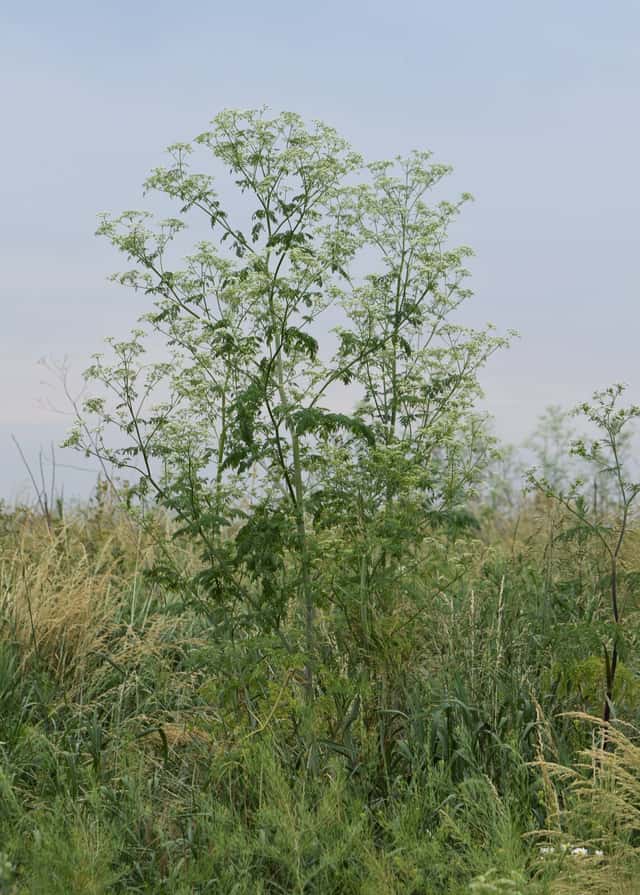
Poison hemlock (Conium maculatum) is a biennial herb in the Apiaceae family, native to Europe, North Africa, and temperate Asia, now naturalized as an invasive weed throughout much of the world. It is recognized by its hollow, ridged stems with purple spotting, its highly divided feathery leaves similar to parsley, and its small white flowers clustered in umbels. It is one of the most poisonous plants in temperate flora: all parts contain piperidine alkaloids (primarily coniine), responsible for fatal poisonings in humans and animals. It grows spontaneously in ditches, riverbanks, abandoned fields, and other moist, disturbed soils.
How to Propagate Poison hemlock?
Seed propagation
- All parts of the plant are extremely toxic: always use gloves and avoid contact with eyes and mucous membranes when handling seeds or seedlings.
- Intentional cultivation is not recommended; in the event of a spontaneous outbreak, it is preferable to control or eliminate it rather than propagate it.
- 1 Collect mature seeds from dry umbels in late summer
- 2 Sow directly in the permanent location (in situ), as it develops a taproot sensitive to transplanting
- 3 Seeds generally germinate in autumn, forming a basal rosette in the first year
- 4 In the second year, the plant flowers, fruits, and dies, as it follows a biennial cycle
Materials needed:
How Big Does Poison hemlock Grow?
TLDR: Poison hemlock can reach up to 2.4m tall with Fast growth rate.
Max height
2.4m
Spread
1.0m
Growth rate
Fast
Foliage
Deciduous
Warning: Toxic Plant
This plant can be toxic if ingested. Keep out of reach of:
Plant Uses
Medicinal
Medicinal properties
Medicinal Uses
- Historical use as an analgesic, antispasmodic, and sedative in ancient medicine, now practically abandoned due to its narrow safety margin
- Highly diluted homeopathic preparations traditionally used for tremors, dizziness, and insomnia
- Traditional external use in ointments, currently obsolete due to its toxicity
Culinary Uses
- None recommended: the entire plant is potentially fatal and is easily confused with parsley, fennel, or wild carrot, a frequent cause of accidental poisonings
Is your plant showing symptoms?
Click on the symptom to discover possible causes:
What Diseases Commonly Affect Poison hemlock?
TLDR: Poison hemlock is susceptible to 6 known diseases. Monitor regularly for early detection.
Powdery Mildew
Powdery mildew is a common fungal disease caused by various fungi species including Erysiphe, Podosphaera, Oïdium, and Leveillula. It affects over 10,000 plant species worldwide. The disease thrives in warm, dry climates with high humidity and appears as a distinctive white powdery coating on plant surfaces.
Aphids
Aphids are small, soft-bodied, pear-shaped insects (1/16 to 1/8 inch long) that feed by sucking nutrient-rich sap from plants. They reproduce rapidly and can quickly weaken plants, causing distorted growth and transmitting plant viruses. Aphids come in various colors including green, black, red, yellow, brown, and gray. They secrete honeydew, a sticky substance that attracts ants and encourages sooty mold growth.
Leafminers
Leafminers are the larvae of various insects including flies, moths, sawflies, and beetles that tunnel between leaf surfaces, creating distinctive serpentine trails or blotchy patches. While primarily cosmetic, severe infestations can weaken plants by reducing photosynthesis capacity and making them susceptible to secondary infections.
Rust
Rust is a common fungal disease caused by fungi in the order Pucciniales that affects a wide variety of plants. The disease gets its name from the characteristic orange, yellow, or reddish-brown pustules that appear on leaves, resembling metal rust. This obligate fungal parasite requires living plants to survive and can cause significant economic losses in agricultural crops.
Meaning & Symbolism
Famous for being the poison used to execute the Greek philosopher Socrates in 399 BC, hemlock has symbolized death, condemnation, and sacrifice for one's ideas since antiquity. In the Victorian language of flowers, it represented betrayal and the threat of death, and its purple stem spots fueled folk legends about a mark of a curse.
Compare with similar plants
| Attribute | Difficulty | Light | Watering | Pet Safe |
|---|---|---|---|---|
| Field Maple | Easy | Bright indirect | 14d | ✓ |
| Silver Birch | Easy | Direct sun | 14d | ✓ |
| Common Blanketflower | Easy | Direct sun | 10d | ✓ |
| Cushion Bush | Easy | Direct sun | 14d | ✓ |





