Malvaceae
Henry's lime: Aromatic Plant
Tilia henryana
A hardy and undemanding tree once established, but slow-growing and sensitive to drought: it requires deep, cool soil rich in organic matter. Prefers sunny to semi-shaded exposure, sheltered from cold winds in cool climates. Light structural pruning is sufficient; it tolerates heavy pruning well. Monitor for powdery mildew, canker, and root rot in overly wet soil.
Every 10 days
Bright indirect
-20° - 35°C
50% - 80%
Categories
What is Henry's lime?
Henry's lime (Tilia henryana) is a medium-care plant from the Malvaceae family. Henry's lime (Tilia henryana) is a deciduous tree native to the mountain forests of central China (Anhui, Hubei, Hunan, Shaanxi, Zhejiang...), introduced to the West by Ernest Wilson in 1901. More compact than the common lime, it reaches 30 to 50 ft in height in cultivation (up to 80 ft in its nativ...
Henry's lime grows up to 15.0m, spread of 1000cm, watering every 10 days, -20°C – 35°C, 50–80% humidity. It is not suitable for indoor environments and safe for pets.
Unlike many popular species, Henry's lime is safe to keep around pets.
How to Care for Henry's lime?
TLDR: Henry's lime needs Bright indirect, watering every 10 days, and temperatures between -20-35°C with 50-80% humidity.
How Often Should You Water Henry's lime?
Water copiously but infrequently to maintain cool soil without waterlogging; allow the surface to dry slightly between waterings and significantly reduce frequency in autumn and winter. A well-established tree tolerates temperate summers but suffers during prolonged drought.
How Much Light Does Henry's lime Need?
Prefers a sunny exposure but adapts well to partial shade, especially in regions with hot summers where some afternoon shade prevents foliage desiccation.
What Is the Best Soil for Henry's lime?
Thrives in deep, cool, humus-rich, and well-drained soils; avoids chalky soils but tolerates acidic soils well. Imperatively avoid waterlogged or, conversely, excessively dry soils.
What Pot Should You Use for Henry's lime?
Species to be reserved for open ground: its adult size and deep root system are not suitable for pot cultivation, even for temporary planting in containers before transplantation.
Care Schedule
Fertilize
Every 180 days
What Is Henry's lime and Where Does It Come From?
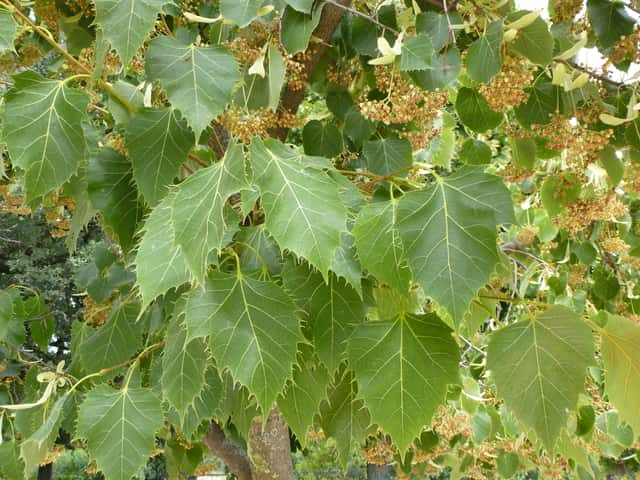
Henry's lime (Tilia henryana) is a deciduous tree native to the mountain forests of central China (Anhui, Hubei, Hunan, Shaanxi, Zhejiang...), introduced to the West by Ernest Wilson in 1901. More compact than the common lime, it reaches 30 to 50 ft in height in cultivation (up to 80 ft in its native habitat), with a rounded, spreading habit and pale gray bark that fissures with age. Its heart-shaped leaves, coppery when budding then glossy green, are distinguished by a ciliate margin of long silky bristles reminiscent of a carnivorous plant's eyelashes, before turning golden yellow in autumn. The late flowering (late August-September) produces abundant clusters of highly fragrant, nectar-rich creamy white flowers, among the last of the Tilia genus to open.
How to Propagate Henry's lime?
How Big Does Henry's lime Grow?
TLDR: Henry's lime can reach up to 15.0m tall with Slow growth rate.
Max height
15.0m
Spread
10.0m
Growth rate
Slow
Foliage
Deciduous
Plant Uses
Ornamental
Great for decoration
Medicinal
Medicinal properties
Aromatic
Pleasant fragrance
Edible
Can be consumed
Air Purifying
Improves air quality
Medicinal Uses
- Dried flowers in traditional calming, sedative, and mildly digestive infusions
- Used in herbal medicine to promote sleep and soothe nervousness
- Antispasmodic properties attributed to the flowers, as with other linden species (Tilia spp.)
Culinary Uses
- Dried flowers infused as linden tea
- Tender young leaves edible raw in salads
- Linden honey, highly prized, produced thanks to the late and abundant flowering
Is your plant showing symptoms?
Click on the symptom to discover possible causes:
What Diseases Commonly Affect Henry's lime?
TLDR: Henry's lime is susceptible to 6 known diseases. Monitor regularly for early detection.
Aphids
Aphids are small, soft-bodied, pear-shaped insects (1/16 to 1/8 inch long) that feed by sucking nutrient-rich sap from plants. They reproduce rapidly and can quickly weaken plants, causing distorted growth and transmitting plant viruses. Aphids come in various colors including green, black, red, yellow, brown, and gray. They secrete honeydew, a sticky substance that attracts ants and encourages sooty mold growth.
Powdery Mildew
Powdery mildew is a common fungal disease caused by various fungi species including Erysiphe, Podosphaera, Oïdium, and Leveillula. It affects over 10,000 plant species worldwide. The disease thrives in warm, dry climates with high humidity and appears as a distinctive white powdery coating on plant surfaces.
Phytophthora Root Rot
Disease caused by fungus-like organisms (oomycetes) that live in soil and can survive for years. It affects roots, stem, and crown of plants, being especially severe in waterlogged or poorly drained soils. It is the second most common cause of root rot in trees and shrubs.
Canker
Canker is a disease caused by various fungi and bacteria that create necrotic, sunken areas on bark of branches, stems, and trunks. Pathogens enter through wounds and natural openings, especially when plants are stressed. Canker can gradually weaken or kill branches by disrupting water and nutrient flow.
Meaning & Symbolism
In Europe, the linden tree is traditionally associated with peace, faithful friendship, and the protection of the home; it was planted in village squares as a tree of justice and gathering. France made it a national symbol in 1792, celebrating friendship and concord. As a highly sought-after honey species, Henry's lime perpetuates this symbolism until late summer, a period when few other lindens are still in bloom.
Compare with similar plants
| Attribute | Difficulty | Light | Watering | Pet Safe |
|---|---|---|---|---|
| Dark Fieldcap | Medium | Low light | 2d | ⚠️ |
| Azalea | Medium | Partial shade | 3d | ⚠️ |
| Muriel's Bamboo | Medium | Partial shade | 3d | ✓ |
| Bougainvillea | Medium | Direct sun | 7d | ⚠️ |




