Crassulaceae
Hobbit Jade - Crassula ovata Hobbit
Crassula ovata 'Hobbit'
Grow in abundant bright to direct light, water only once the soil is fully dry, and use a well-draining soil mix. It is a low-maintenance, drought-tolerant succulent that is very sensitive to overwatering.
Every 14 days
Bright indirect
10° - 27°C
20% - 40%
Categories
What is Hobbit Jade?
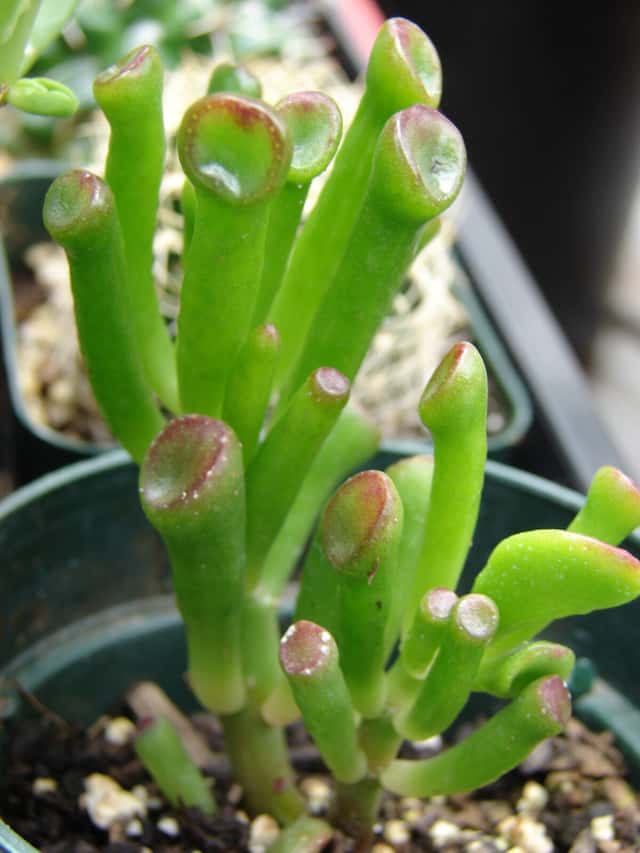
Hobbit Jade (Crassula ovata 'Hobbit') is a easy-care plant from the Crassulaceae family. Hobbit Jade is a cultivar of Crassula ovata distinguished by curled, tubular, finger- or trumpet-shaped leaves, unlike the flat oval leaves of the common jade plant. A perennial succulent descending from the South African parent species, it is a popular low-maintenance houseplant valued for its slow...
Hobbit Jade grows up to 90cm, spread of 60cm, watering every 14 days, 10°C – 27°C, 20–40% humidity. It is suitable for indoor environments and not safe for pets.
Unlike many tropical plants, Hobbit Jade tolerates watering mistakes. Best for beginners. Without precautions, ingestion can cause irritation in pets. Keep out of reach of cats and dogs. Without adequate drainage, root rot can develop within 28 days.
How to Care for Hobbit Jade?
TLDR: Hobbit Jade needs Bright indirect, watering every 14 days, and temperatures between 10-27°C with 20-40% humidity.
How Often Should You Water Hobbit Jade?
Use the "soak and dry" method: water thoroughly, then let the soil dry out completely before watering again, usually every 2 weeks.
How Much Light Does Hobbit Jade Need?
Prefers bright, direct sunlight for several hours a day; indoors, place it within a foot of a south-facing window.
What Is the Best Soil for Hobbit Jade?
Use a well-draining cactus/succulent soil mix (potting soil, coarse sand, and perlite).
What Pot Should You Use for Hobbit Jade?
Terracotta or ceramic pot with drainage holes, sized close to the root ball.
Care Schedule
Fertilize
Every 60 days
Repot
Every 900 days
What Is Hobbit Jade and Where Does It Come From?
Hobbit Jade is a cultivar of Crassula ovata distinguished by curled, tubular, finger- or trumpet-shaped leaves, unlike the flat oval leaves of the common jade plant. A perennial succulent descending from the South African parent species, it is a popular low-maintenance houseplant valued for its slow, compact growth. Leaf tips blush red under bright direct sun.
How to Propagate Hobbit Jade?
Stem Cutting
Avoid watering immediately after cutting to prevent rot; a rooting hormone can speed up the process.
- 1 Cut a healthy 5-10 cm stem section with a clean, sharp tool
- 2 Let the cutting callus (dry) for 2-3 days in a dry, airy spot
- 3 Plant the cutting in well-draining succulent soil
- 4 Water lightly only once rooting begins
Materials needed:
Leaf Cutting
Not every leaf will root; discard ones that rot rather than mummify.
- 1 Gently twist off a healthy, whole leaf at its base
- 2 Let the leaf callus for 2-3 days
- 3 Lay the leaf on top of well-draining soil without burying it
- 4 Mist lightly once the soil is dry, until roots and a new rosette appear
Materials needed:
How Big Does Hobbit Jade Grow?
TLDR: Hobbit Jade can reach up to 90cm tall with Slow growth rate.
Max height
90cm
Spread
60cm
Growth rate
Slow
Foliage
Evergreen
Warning: Toxic Plant
This plant can be toxic if ingested. Keep out of reach of:
Plant Uses
Ornamental
Great for decoration
Is your plant showing symptoms?
Click on the symptom to discover possible causes:
What Diseases Commonly Affect Hobbit Jade?
TLDR: Hobbit Jade is susceptible to 6 known diseases. Monitor regularly for early detection.
Mealybugs
Mealybugs are small, soft-bodied insects covered with a white, waxy, cottony material. They are common pests of houseplants and outdoor plants in mild climates. These sap-sucking insects feed on plant tissue, causing damage, stunted growth, and can lead to plant death if left untreated. They produce sticky honeydew which attracts sooty mold.
Spider Mites
Spider mites are tiny arachnids (less than 1/20 inch long) related to spiders and ticks that feed on plant sap. They thrive in hot, dry conditions and can cause significant damage to ornamental and vegetable plants. During severe infestations, crop losses can reach 14% or higher as these pests disrupt vital plant processes including photosynthesis, carbon dioxide absorption, and transpiration.
Aphids
Aphids are small, soft-bodied, pear-shaped insects (1/16 to 1/8 inch long) that feed by sucking nutrient-rich sap from plants. They reproduce rapidly and can quickly weaken plants, causing distorted growth and transmitting plant viruses. Aphids come in various colors including green, black, red, yellow, brown, and gray. They secrete honeydew, a sticky substance that attracts ants and encourages sooty mold growth.
Scale Insects
Scale insects are small sap-sucking pests that appear as brown, shell-like bumps on plant stems and leaves. There are over 25 species, divided into armored (hard) and unarmored (soft) scales. They feed by piercing plant tissue and extracting sap, which weakens the plant and can lead to yellowing, stunted growth, and even death if left untreated. They also excrete honeydew, which attracts ants and promotes sooty mold growth.
Meaning & Symbolism
Known as the "money plant" or "friendship plant," Hobbit Jade symbolizes prosperity, wealth, and good fortune in Feng Shui, with its coin-like leaves representing financial abundance.
Fun Facts
Hobbit Jade arose as a spontaneous mutation of Crassula ovata in California in the 1970s.
Its tubular leaves resemble fingers or trumpets, earning it the nickname "finger jade."
It is extremely drought-tolerant and can survive weeks without watering.
It can bloom in late winter/early spring with small white or pale pink star-shaped flowers.
Frequently asked questions
Is Hobbit Jade toxic to cats and dogs?
How often should I water my Hobbit Jade?
Why aren't my Hobbit Jade's leaf tips turning red?
What's the difference between Hobbit Jade and regular Jade Plant?
Compare with similar plants
| Attribute | Difficulty | Light | Watering | Pet Safe |
|---|---|---|---|---|
| Field Maple | Easy | Bright indirect | 14d | ✓ |
| Silver Birch | Easy | Direct sun | 14d | ✓ |
| Common Blanketflower | Easy | Direct sun | 10d | ✓ |
| Cushion Bush | Easy | Direct sun | 14d | ✓ |
Choose & Compare
Sources & References
- Hobbit Jade Care 101: Water, Light & Growing Tips - Greg
- Jade Plant Problems and Pests - Moody Blooms
- Toxic and Non-toxic Plants: Jade Plant - ASPCA
- Crassula ovata Hobbit - Succulents and Sunshine
- Crassula ovata Hobbit: A Comprehensive Grow and Care Guide - Desert Myths
- Learn About the Lucky Jade Plant: Meaning, Benefits, and Symbolism - Lively Root
- Crassula ovata - Wikipedia





