Fabaceae
Honey Mesquite: Edible Plant
Prosopis glandulosa
It is an extremely low-maintenance species once established: it requires full sun, well-drained soil, and practically no additional watering. It tolerates extreme heat, prolonged drought, and poor or saline soils, although during the first year, it is advisable to water it deeply every few weeks to encourage the development of its taproot.
Every 45 days
Direct sun
-20° - 45°C
10% - 40%
Categories
What is Honey Mesquite?
Honey Mesquite (Prosopis glandulosa) is a easy-care plant from the Fabaceae family. The honey mesquite (Prosopis glandulosa) is a deciduous tree or shrub in the legume family (Fabaceae), native to the arid and semi-arid regions of the Southwestern United States and Northern Mexico. It reaches between 4 and 9 meters in height, featuring a wide, spreading crown, a short trunk, and br...
Honey Mesquite grows up to 9.0m, spread of 1000cm, watering every 45 days, -20°C – 45°C, 10–40% humidity. It is not suitable for indoor environments and safe for pets.
Unlike many tropical plants, Honey Mesquite tolerates watering mistakes. Best for beginners. Unlike many popular species, Honey Mesquite is safe to keep around pets.
How to Care for Honey Mesquite?
TLDR: Honey Mesquite needs Direct sun, watering every 45 days, and temperatures between -20-45°C with 10-40% humidity.
How Often Should You Water Honey Mesquite?
Water deeply but infrequently. During the first year, water every 4-6 weeks during dry periods to stimulate deep root growth; once established, the mesquite survives on rainfall alone, and additional watering can promote root rot.
How Much Light Does Honey Mesquite Need?
It needs full direct sun throughout the day; in shade or partial shade, it grows weak, becomes leggy, and produces very few flowers.
What Is the Best Soil for Honey Mesquite?
Prefers sandy or loamy soils with very good drainage; it tolerates poor, alkaline, and even moderately saline soils, but waterlogging is its primary enemy.
What Pot Should You Use for Honey Mesquite?
It is not a suitable species for long-term container growth, as its taproot requires depth to develop. If grown young in a container, use a deep clay or terracotta pot with multiple drainage holes and a very porous substrate, and transplant it to its permanent location in the ground as soon as possible.
Care Schedule
Fertilize
Every 180 days
What Is Honey Mesquite and Where Does It Come From?
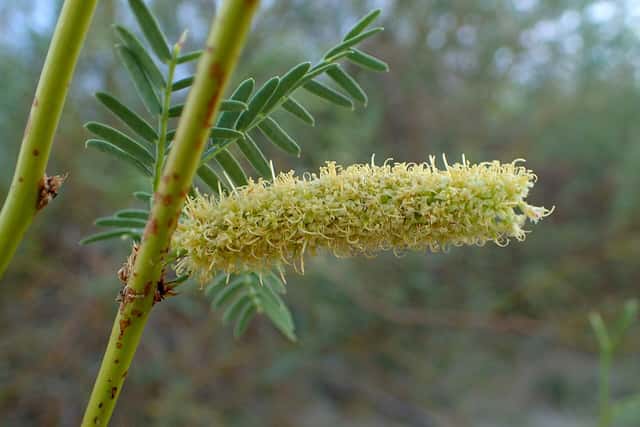
The honey mesquite (Prosopis glandulosa) is a deciduous tree or shrub in the legume family (Fabaceae), native to the arid and semi-arid regions of the Southwestern United States and Northern Mexico. It reaches between 4 and 9 meters in height, featuring a wide, spreading crown, a short trunk, and branches armed with thorns. In spring and summer, it produces dense clusters of highly fragrant greenish-yellow flowers, followed by elongated, flat pods that ripen in late summer. Thanks to its taproot, capable of reaching dozens of meters deep in search of water, and its ability to fix atmospheric nitrogen, it is an extremely drought-resistant species and fundamental to desert ecosystems.
How to Propagate Honey Mesquite?
Seed propagation (with scarification)
- Choose ripe, dry, brown pods to obtain viable seeds.
- Water sparingly after sowing; excess moisture promotes seed rot.
- 1 Scarification
Pour near-boiling water over the seeds and let them soak for 12 to 24 hours to soften the hard outer coat.
- 2 Verification
If the seeds do not swell, lightly file or nick the seed coat with sandpaper or a blade and soak them again for another 12 hours.
- 3 Sowing
Sow 1-2 cm deep in well-drained sandy substrate, using deep pots that accommodate the taproot.
- 4 Transplanting
Transplant to the permanent location as soon as the seedling is 20-30 cm tall, as mesquite develops deep roots quickly and does not tolerate late transplanting well.
Materials needed:
How Big Does Honey Mesquite Grow?
TLDR: Honey Mesquite can reach up to 9.0m tall with Medium growth rate.
Max height
9.0m
Spread
10.0m
Growth rate
Medium
Foliage
Deciduous
Plant Uses
Ornamental
Great for decoration
Edible
Can be consumed
Medicinal
Medicinal properties
Medicinal Uses
- Leaf infusions are traditionally used to treat fevers and digestive disorders.
- Gum diluted in water serves as an astringent for washing wounds and irritated eyes.
- Syrup made from the pods is used as an expectorant for coughs.
- The bark is used as an astringent and in rinses for sore throats.
- Chewed leaves have been traditionally used to relieve heartburn.
Culinary Uses
- Ripe pods are ground to obtain sweet flour, used in breads, tortillas, and atoles.
- Tender pods can be eaten raw or cooked, similar to green beans.
- Roasted and ground seeds are used to prepare fermented drinks such as pinole.
- Flowers are used to prepare infusions, and roasted inflorescences are eaten in the form of small balls.
- The gum or resin is chewed as a natural gum or used to make sweets.
Is your plant showing symptoms?
Click on the symptom to discover possible causes:
What Diseases Commonly Affect Honey Mesquite?
TLDR: Honey Mesquite is susceptible to 3 known diseases. Monitor regularly for early detection.
Mealybugs
Mealybugs are small, soft-bodied insects covered with a white, waxy, cottony material. They are common pests of houseplants and outdoor plants in mild climates. These sap-sucking insects feed on plant tissue, causing damage, stunted growth, and can lead to plant death if left untreated. They produce sticky honeydew which attracts sooty mold.
Scale Insects
Scale insects are small sap-sucking pests that appear as brown, shell-like bumps on plant stems and leaves. There are over 25 species, divided into armored (hard) and unarmored (soft) scales. They feed by piercing plant tissue and extracting sap, which weakens the plant and can lead to yellowing, stunted growth, and even death if left untreated. They also excrete honeydew, which attracts ants and promotes sooty mold growth.
Root Rot
Root rot is a serious fungal disease that affects the root system of plants, causing them to decay and die. It is primarily caused by overwatering, poor drainage, or soil-borne fungi such as Pythium, Phytophthora, Rhizoctonia, and Fusarium. The disease thrives in waterlogged conditions where roots are deprived of oxygen, making them susceptible to fungal infection.
Meaning & Symbolism
In the cultures of Northern Mexico and the Southwestern United States, it is known as the 'tree of life,' a symbol of resilience, abundance, and holistic utility: indigenous peoples traditionally use every part of the plant (wood, pods, flowers, bark, and roots).
Compare with similar plants
| Attribute | Difficulty | Light | Watering | Pet Safe |
|---|---|---|---|---|
| Field Maple | Easy | Bright indirect | 14d | ✓ |
| Silver Birch | Easy | Direct sun | 14d | ✓ |
| Common Blanketflower | Easy | Direct sun | 10d | ✓ |
| Cushion Bush | Easy | Direct sun | 14d | ✓ |





