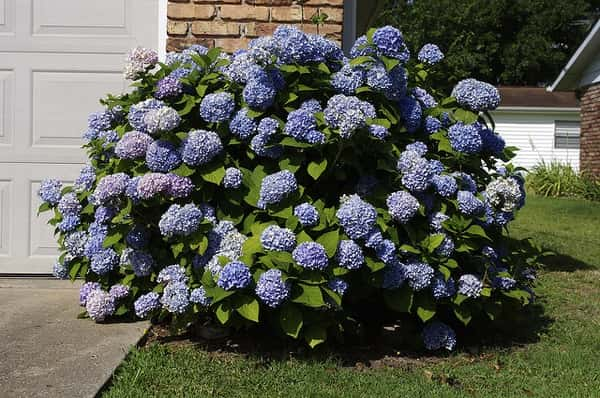
Hydrangeaceae
Hydrangeas: How to Care for the Hydrangea Genus
Hydrangea
Morning sun with afternoon shade, rich moist well-draining soil, frequent watering in hot weather and pruning suited to the species. In bigleaf hydrangeas, flower colour changes with soil pH.
Every 4 days
Partial shade
° - °C
% - %
Categories
What is Hydrangea?
Hydrangea (Hydrangea) is a medium-care plant from the Hydrangeaceae family. Hydrangea is a genus of roughly 70 to 100 species in the Hydrangeaceae family, native to Asia (especially China, Korea and Japan) and the Americas. Most are shrubs of 1-3 m, though some are small trees or climbers. Flowers come in rounded mopheads or cone-shaped panicles, with small fertile flowers...
Hydrangea grows up to 3.0m, watering every 4 days. It is not suitable for indoor environments and not safe for pets.
Without precautions, ingestion can cause irritation in pets. Keep out of reach of cats and dogs.
How to Care for Hydrangea?
TLDR: Hydrangea needs Partial shade, watering every 4 days, and temperatures between 15-30°C with 40-70% humidity.
How Often Should You Water Hydrangea?
Hydrangeas like consistently moist soil: water deeply two or three times a week in summer, in the morning and at the base, keeping the flowers dry. Leaves that wilt on a hot afternoon usually recover by evening.
How Much Light Does Hydrangea Need?
Morning sun and shade during the hottest hours is ideal. Panicle hydrangeas take more sun; bigleaf types scorch in strong afternoon sun.
What Is the Best Soil for Hydrangea?
Fertile, organic-rich, moist and well-draining soil. In H. macrophylla, acidic soil (below about pH 6) gives blue flowers and neutral to alkaline soil gives pink.
What Pot Should You Use for Hydrangea?
A large pot with drainage holes, at least 40 cm across, because hydrangeas dry out quickly in small containers.
Care Schedule
Fertilize
Every 30 days
Repot
Every 730 days
What Is Hydrangea and Where Does It Come From?
Hydrangea is a genus of roughly 70 to 100 species in the Hydrangeaceae family, native to Asia (especially China, Korea and Japan) and the Americas. Most are shrubs of 1-3 m, though some are small trees or climbers. Flowers come in rounded mopheads or cone-shaped panicles, with small fertile flowers in the centre and showy sterile flowers around them, from spring into autumn. The most widely grown species are bigleaf (H. macrophylla), panicle (H. paniculata) and smooth hydrangea (H. arborescens).
How to Propagate Hydrangea?
Softwood cutting
Use current-season shoots without flowers. Covering with a plastic bag helps hold humidity.
- 1 Cut a non-flowering new shoot 10-15 cm long with 2 or 3 pairs of leaves.
- 2 Remove the lower leaves and cut the upper ones in half.
- 3 Dip the base in rooting hormone and insert into moist mix.
- 4 Keep in shade with high humidity until rooted.
Materials needed:
Layering
Keep the buried section moist at all times.
- 1 Bend a low branch down to the ground.
- 2 Lightly wound the bark where it will be buried.
- 3 Bury that section and pin it with a stone or wire.
- 4 Sever from the parent once it has rooted.
Materials needed:
How Big Does Hydrangea Grow?
TLDR: Hydrangea can reach up to 3.0m tall with Fast growth rate.
Max height
3.0m
Growth rate
Fast
Foliage
Deciduous
Warning: Toxic Plant
This plant can be toxic if ingested. Keep out of reach of:
Plant Uses
Ornamental
Great for decoration
Is your plant showing symptoms?
Click on the symptom to discover possible causes:
What Diseases Commonly Affect Hydrangea?
TLDR: Hydrangea is susceptible to 12 known diseases. Monitor regularly for early detection.
Gray Mold (Botrytis Blight)
Gray mold, caused by the fungus Botrytis cinerea, is one of the most common fungal diseases in plants. It affects over 200 plant species, including ornamentals, vegetables, fruits, and houseplants. The disease thrives in cool, humid conditions with poor air circulation, causing grayish spots and soft rot on infected tissues.
Cercospora Leaf Spot
Cercospora leaf spot is a common fungal disease caused by Cercospora species that affects many plant types, particularly beets, roses, and leafy vegetables. The disease thrives in warm, humid conditions and can cause significant defoliation, reducing plant vigor and yield. It spreads rapidly through water splash, wind, and contaminated tools.
Powdery Mildew
Powdery mildew is a common fungal disease caused by various fungi species including Erysiphe, Podosphaera, Oïdium, and Leveillula. It affects over 10,000 plant species worldwide. The disease thrives in warm, dry climates with high humidity and appears as a distinctive white powdery coating on plant surfaces.
Anthracnose
Anthracnose is a fungal disease caused by fungi in the genus Colletotrichum that affects many plants, including vegetables, fruits, and trees. The disease thrives in cool, wet conditions, causing dark, sunken lesions on leaves, stems, flowers, and fruits.
Meaning & Symbolism
Associated with gratitude, heartfelt emotion and abundance; in Japan the hydrangea (ajisai) is the emblem of the rainy season.
Fun Facts
The name Hydrangea comes from the Greek hydor (water) and angeion (vessel), after the shape of its seed capsules.
Bigleaf hydrangea has more than 600 named cultivars.
In Japan, H. serrata leaves are used to make amacha, a sweet tea served in Buddhist ceremonies.
Frequently asked questions
How do I make my hydrangea blue?
When should I prune hydrangeas?
Are hydrangeas toxic to pets?
Why is my hydrangea not blooming?
Compare with similar plants
| Attribute | Difficulty | Light | Watering | Pet Safe |
|---|---|---|---|---|
| Dark Fieldcap | Medium | Low light | 2d | ⚠️ |
| Azalea | Medium | Partial shade | 3d | ⚠️ |
| Muriel's Bamboo | Medium | Partial shade | 3d | ✓ |
| Bougainvillea | Medium | Direct sun | 7d | ⚠️ |




