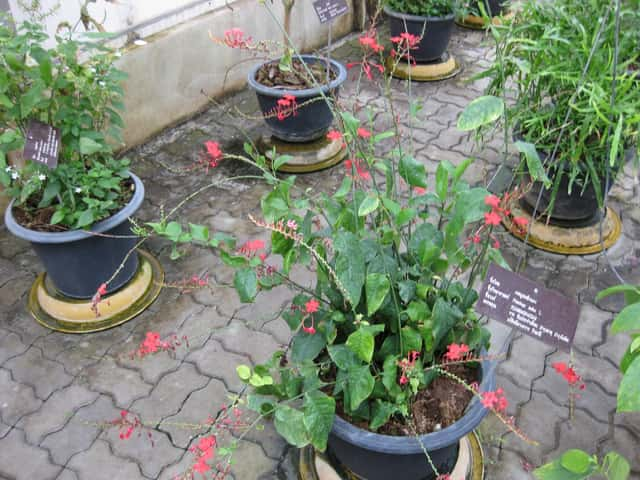
Plumbaginaceae
Indian Leadwort (Plumbago indica)
Plumbago indica
A tropical shrub for sun or bright part shade in well-drained soil. Water freely while growing and sparingly in winter. It does not tolerate temperatures below 7 °C.
Every 4 days
Bright indirect
7° - °C
% - %
Categories
What is Indian Leadwort?
Indian Leadwort (Plumbago indica) is a medium-care plant from the Plumbaginaceae family. Indian leadwort (Plumbago indica) is an evergreen shrub in the leadwort family (Plumbaginaceae), native to India, the Himalayas, Sri Lanka and Southeast Asia to southern China. It has slender, lax stems that tend to lean on other plants, and oval green leaves. It grows 1-1.5 m tall. In autumn and wi...
Indian Leadwort grows up to 1.5m, spread of 100cm, watering every 4 days. It is suitable for indoor environments and safe for pets.
Unlike many popular species, Indian Leadwort is safe to keep around pets. Without adequate drainage, root rot can develop within 8 days.
How to Care for Indian Leadwort?
TLDR: Indian Leadwort needs Bright indirect, watering every 4 days, and temperatures between 7-30°C with 40-70% humidity.
How Often Should You Water Indian Leadwort?
Water when the top of the soil starts to dry, generously during the growing season. In winter water sparingly and never leave it soggy.
How Much Light Does Indian Leadwort Need?
Full sun or very bright light; it also accepts part shade. Indoors, give it your brightest window.
What Is the Best Soil for Indian Leadwort?
Fertile, well-drained soil; acid, neutral or alkaline pH is fine. In pots, use a loam-based mix with compost.
What Pot Should You Use for Indian Leadwort?
A medium to large pot with drainage holes; in cool climates grow it in a pot so it can come indoors for winter.
Care Schedule
Fertilize
Every 30 days
What Is Indian Leadwort and Where Does It Come From?
Indian leadwort (Plumbago indica) is an evergreen shrub in the leadwort family (Plumbaginaceae), native to India, the Himalayas, Sri Lanka and Southeast Asia to southern China. It has slender, lax stems that tend to lean on other plants, and oval green leaves. It grows 1-1.5 m tall. In autumn and winter it carries clusters at the stem tips of five-petalled flowers about 2 cm across, in deep rose-pink to scarlet, which draw butterflies and hummingbirds. It is related to the blue Cape leadwort of gardens but is more compact and more sensitive to cold. The root has been used for centuries in Ayurvedic medicine and contains plumbagin, an irritant and toxic compound.
How to Propagate Indian Leadwort?
Stem cuttings
Wear gloves: the sap irritates skin. Semi-ripe cuttings root best with bottom heat.
- 1 Take softwood tips in late spring or semi-ripe stems in midsummer
- 2 Strip the lower leaves
- 3 Insert into a light, moist mix
- 4 Keep warm, ideally with bottom heat
Materials needed:
Seed
Keep the mix moist but not wet.
- 1 Sow in spring on moist mix
- 2 Keep at 13 to 18 °C
- 3 Pot on seedlings once they have a few leaves
Materials needed:
How Big Does Indian Leadwort Grow?
TLDR: Indian Leadwort can reach up to 1.5m tall with Medium growth rate.
Max height
1.5m
Spread
1.0m
Growth rate
Medium
Foliage
Evergreen
Warning: Toxic Plant
This plant can be toxic if ingested. Keep out of reach of:
Plant Uses
Ornamental
Great for decoration
Medicinal
Medicinal properties
Medicinal Uses
- Root used in traditional Ayurvedic medicine (red chitrak); it is toxic and contraindicated in pregnancy
Is your plant showing symptoms?
Click on the symptom to discover possible causes:
What Diseases Commonly Affect Indian Leadwort?
TLDR: Indian Leadwort is susceptible to 2 known diseases. Monitor regularly for early detection.
Spider Mites
Spider mites are tiny arachnids (less than 1/20 inch long) related to spiders and ticks that feed on plant sap. They thrive in hot, dry conditions and can cause significant damage to ornamental and vegetable plants. During severe infestations, crop losses can reach 14% or higher as these pests disrupt vital plant processes including photosynthesis, carbon dioxide absorption, and transpiration.
Whiteflies
Whiteflies are small, soft-bodied, winged insects closely related to aphids and mealybugs. They are moth-like in appearance, about 1/16 inch long, triangular in shape, and gray-white in color. These sap-sucking pests feed on plant tissue, causing yellowing, stunted growth, and wilting. They also excrete honeydew, which attracts ants and promotes sooty mold growth. Whiteflies can transmit serious plant viruses.
Fun Facts
One of its Sanskrit names evokes fire, after the colour of its flowers.
The name Plumbago comes from the Latin plumbum, 'lead'.
Unlike the sprawling blue Cape leadwort, this species stays compact and suits a pot.
Frequently asked questions
Is Indian leadwort toxic?
When does it flower?
Can it take cold?
Can it grow indoors?
What pests does it get?
Compare with similar plants
| Attribute | Difficulty | Light | Watering | Pet Safe |
|---|---|---|---|---|
| Dark Fieldcap | Medium | Low light | 2d | ⚠️ |
| Azalea | Medium | Partial shade | 3d | ⚠️ |
| Muriel's Bamboo | Medium | Partial shade | 3d | ✓ |
| Bougainvillea | Medium | Direct sun | 7d | ⚠️ |




