Phytolaccaceae
Phytolacca acinosa (Indian Pokeweed)
Phytolacca acinosa
Easy to grow in any reasonably fertile, moisture-retentive soil in full sun to part shade. Tolerant of a wide pH range and most soil textures. Dies back to the rootstock in winter and re-sprouts vigorously in spring. Keep away from children and pets due to toxic berries and roots.
Every 4 days
Bright indirect
-10° - 35°C
40% - 70%
Categories
What is Indian Pokeweed?
Indian Pokeweed (Phytolacca acinosa) is a easy-care plant from the Phytolaccaceae family. Phytolacca acinosa is a robust, fast-growing herbaceous perennial in the pokeweed family (Phytolaccaceae), native to temperate and tropical Asia (the Himalayas, China, Japan, Korea and Vietnam). It forms clumps of large ovate leaves on reddish-green stems, topped in summer by upright racemes of smal...
Indian Pokeweed grows up to 1.5m, spread of 100cm, watering every 4 days, -10°C – 35°C, 40–70% humidity. It is not suitable for indoor environments and not safe for pets.
Unlike many tropical plants, Indian Pokeweed tolerates watering mistakes. Best for beginners. Without precautions, ingestion can cause irritation in pets. Keep out of reach of cats and dogs.
How to Care for Indian Pokeweed?
TLDR: Indian Pokeweed needs Bright indirect, watering every 4 days, and temperatures between -10-35°C with 40-70% humidity.
How Often Should You Water Indian Pokeweed?
Keep soil evenly moist through the growing season; established plants tolerate brief dry spells but perform best without letting the soil fully dry out.
How Much Light Does Indian Pokeweed Need?
Grows best in full sun to light, dappled shade; too much shade reduces flowering and berry production.
What Is the Best Soil for Indian Pokeweed?
Adapts to sandy, loamy or clay soils as long as drainage is adequate; prefers fertile, humus-rich ground with mildly acid to mildly alkaline pH.
What Pot Should You Use for Indian Pokeweed?
Best grown directly in the garden border rather than in containers; if potted, use a large, deep pot with good drainage.
What Is Indian Pokeweed and Where Does It Come From?
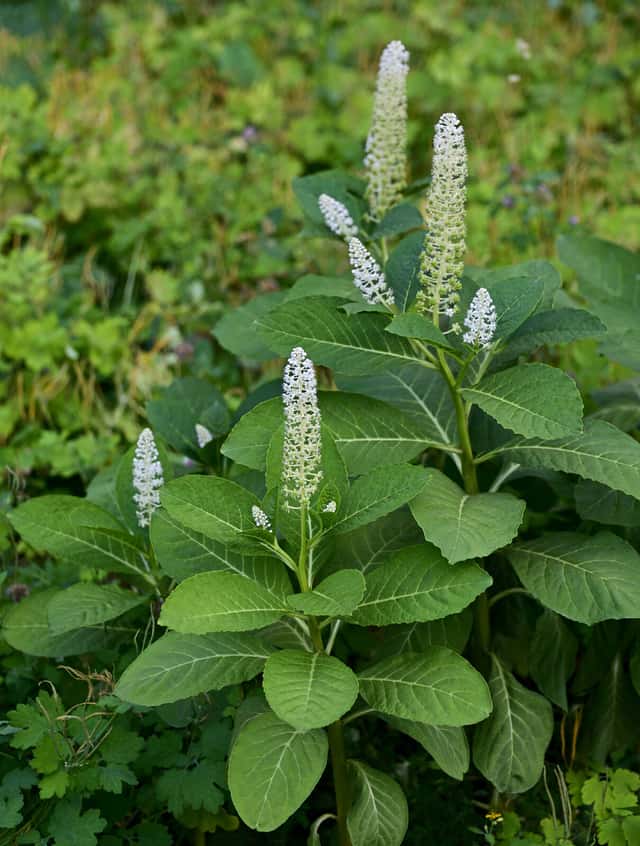
Phytolacca acinosa is a robust, fast-growing herbaceous perennial in the pokeweed family (Phytolaccaceae), native to temperate and tropical Asia (the Himalayas, China, Japan, Korea and Vietnam). It forms clumps of large ovate leaves on reddish-green stems, topped in summer by upright racemes of small white to greenish flowers that ripen into dark purple-black berries. Widely naturalized in parts of Europe and North America, it is grown ornamentally for its bold foliage and berry spikes, though every part of the plant is toxic if eaten raw.
How to Propagate Indian Pokeweed?
Seed sowing
Wear gloves when handling berries, as juice can stain and irritate skin.
- 1 Collect ripe berries and clean the seeds
- 2 Sow in a cold frame in autumn or spring
- 3 Keep substrate moist until germination
- 4 Transplant seedlings once large enough to handle
Materials needed:
Root division
Handle roots with gloves; sap can be irritating to skin.
- 1 Dig up an established clump in early spring or autumn
- 2 Divide the rootstock into sections with buds
- 3 Replant divisions immediately at the same depth
- 4 Water thoroughly after planting
Materials needed:
How Big Does Indian Pokeweed Grow?
TLDR: Indian Pokeweed can reach up to 1.5m tall with Fast growth rate.
Max height
1.5m
Spread
1.0m
Growth rate
Fast
Foliage
Deciduous
Warning: Toxic Plant
This plant can be toxic if ingested. Keep out of reach of:
Plant Uses
Edible
Can be consumed
Medicinal
Medicinal properties
Ornamental
Great for decoration
Medicinal Uses
- antiasthmatic
- antibacterial
- antifungal
- antitussive
- diuretic
- expectorant
Culinary Uses
- Young leaves cooked as a spinach substitute
- Young shoots cooked as an asparagus substitute
Is your plant showing symptoms?
Click on the symptom to discover possible causes:
What Diseases Commonly Affect Indian Pokeweed?
TLDR: Indian Pokeweed is susceptible to 4 known diseases. Monitor regularly for early detection.
Powdery Mildew
Powdery mildew is a common fungal disease caused by various fungi species including Erysiphe, Podosphaera, Oïdium, and Leveillula. It affects over 10,000 plant species worldwide. The disease thrives in warm, dry climates with high humidity and appears as a distinctive white powdery coating on plant surfaces.
Root Rot
Root rot is a serious fungal disease that affects the root system of plants, causing them to decay and die. It is primarily caused by overwatering, poor drainage, or soil-borne fungi such as Pythium, Phytophthora, Rhizoctonia, and Fusarium. The disease thrives in waterlogged conditions where roots are deprived of oxygen, making them susceptible to fungal infection.
Spider Mites
Spider mites are tiny arachnids (less than 1/20 inch long) related to spiders and ticks that feed on plant sap. They thrive in hot, dry conditions and can cause significant damage to ornamental and vegetable plants. During severe infestations, crop losses can reach 14% or higher as these pests disrupt vital plant processes including photosynthesis, carbon dioxide absorption, and transpiration.
Overwatering
Overwatering occurs when plants receive too much water, depriving roots of oxygen and causing root rot. This environmental stress is one of the most common causes of houseplant death, as waterlogged soil prevents roots from breathing and functioning properly.
Fun Facts
Its dark purple-black berries were historically used as a natural dye for food and textiles
Despite being toxic raw, its young shoots are eaten as a cooked delicacy in parts of Nepal and China
It is being studied for its ability to absorb heavy metals from contaminated soil
Frequently asked questions
Is Indian pokeweed toxic?
How much light does it need?
How often should I water it?
Does it come back every year?
Compare with similar plants
| Attribute | Difficulty | Light | Watering | Pet Safe |
|---|---|---|---|---|
| Field Maple | Easy | Bright indirect | 14d | ✓ |
| Silver Birch | Easy | Direct sun | 14d | ✓ |
| Common Blanketflower | Easy | Direct sun | 10d | ✓ |
| Cushion Bush | Easy | Direct sun | 14d | ✓ |





