Orchidaceae
Epidendrum jamiesonis (Jamieson's Epidendrum) Care Guide
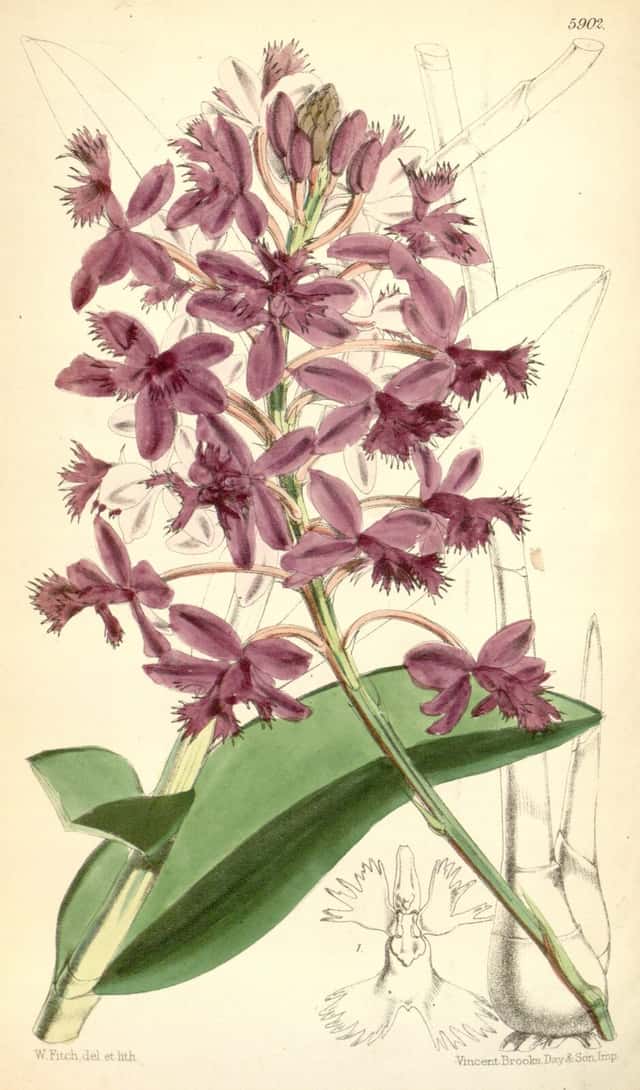
Epidendrum jamiesonis
A cool-to-cold growing highland orchid that thrives with cattleya-level bright light, constant moisture without waterlogging, and generous regular feeding. Best mounted on cork bark or tree-fern slabs, or grown in an open, fast-draining bark mix in a slatted basket.
Every 5 days
Bright indirect
10° - 24°C
60% - 80%
Categories
What is Jamieson's Epidendrum?
Jamieson's Epidendrum (Epidendrum jamiesonis) is a medium-care plant from the Orchidaceae family. Epidendrum jamiesonis is a large, reed-stemmed terrestrial-to-epiphytic orchid native to the cool cloud forests of Colombia and Ecuador, found on trees and slopes between 1,700 and 3,500 meters elevation. Its sturdy cane-like stems carry evergreen leaves and terminate in showy inflorescences packed...
Jamieson's Epidendrum grows up to 1.0m, spread of 60cm, watering every 5 days, 10°C – 24°C, 60–80% humidity. It is suitable for indoor environments and safe for pets.
Unlike many popular species, Jamieson's Epidendrum is safe to keep around pets. Without adequate drainage, root rot can develop within 10 days.
How to Care for Jamieson's Epidendrum?
TLDR: Jamieson's Epidendrum needs Bright indirect, watering every 5 days, and temperatures between 10-24°C with 60-80% humidity.
How Often Should You Water Jamieson's Epidendrum?
Keep the roots evenly moist year-round - water thoroughly until it drains freely, then allow the surface of the mix to approach dryness before watering again. Never let the plant sit in stagnant water.
How Much Light Does Jamieson's Epidendrum Need?
Provide bright, cattleya-strength light (about 2,500-3,500 foot-candles) with protection from direct midday sun. Insufficient light is the most common reason for poor flowering.
What Is the Best Soil for Jamieson's Epidendrum?
Use a well-draining, open bark-based mix (fine-to-medium fir bark with 15-20% coarse perlite) or mount on cork bark/tree-fern slab; good airflow around the roots is essential to prevent rot.
What Pot Should You Use for Jamieson's Epidendrum?
Slatted wooden orchid basket or mounted on cork bark/tree-fern slab for maximum root aeration.
Care Schedule
Fertilize
Every 14 days
Misting
Every 3 days
Rotate
Every 14 days
Repot
Every 730 days
What Is Jamieson's Epidendrum and Where Does It Come From?
Epidendrum jamiesonis is a large, reed-stemmed terrestrial-to-epiphytic orchid native to the cool cloud forests of Colombia and Ecuador, found on trees and slopes between 1,700 and 3,500 meters elevation. Its sturdy cane-like stems carry evergreen leaves and terminate in showy inflorescences packed with numerous small, star-shaped flowers roughly 2.5 cm across. Unlike many orchids tied to a single bloom season, it can flower at almost any time of year given consistent moisture and bright light. First described by Reichenbach in 1856 and named for the Scottish botanist William Jamieson, who collected extensively in Ecuador, the species is now considered vulnerable in the wild due to habitat loss, making cultivated specimens valuable for ex-situ conservation.
How to Propagate Jamieson's Epidendrum?
Clump Division
Only divide healthy, vigorously growing plants; avoid dividing stressed or recently repotted specimens.
- 1 Wait until the clump has at least 3-4 mature canes with healthy roots.
- 2 Using a sterile blade, cut the rhizome between pseudobulb groups, keeping 2-3 canes per division.
- 3 Dust cut surfaces with cinnamon or fungicide powder and let them callus for a few hours before potting.
- 4 Pot each division in fresh, well-draining bark mix or mount on cork bark.
Materials needed:
Keiki Removal
Keep newly separated keikis in higher humidity until established.
- 1 Look for small plantlets (keikis) forming along older, leafless canes.
- 2 Allow the keiki to develop several roots at least 3-5 cm long before removing it.
- 3 Cut the keiki away from the parent cane with a sterile blade, including its roots.
- 4 Pot the keiki in a small container with fine bark mix or mount it on a small piece of cork bark.
Materials needed:
How Big Does Jamieson's Epidendrum Grow?
TLDR: Jamieson's Epidendrum can reach up to 1.0m tall with Medium growth rate.
Max height
1.0m
Spread
60cm
Growth rate
Medium
Foliage
Evergreen
Warning: Toxic Plant
This plant can be toxic if ingested. Keep out of reach of:
Plant Uses
Ornamental
Great for decoration
Is your plant showing symptoms?
Click on the symptom to discover possible causes:
What Diseases Commonly Affect Jamieson's Epidendrum?
TLDR: Jamieson's Epidendrum is susceptible to 6 known diseases. Monitor regularly for early detection.
Scale Insects
Scale insects are small sap-sucking pests that appear as brown, shell-like bumps on plant stems and leaves. There are over 25 species, divided into armored (hard) and unarmored (soft) scales. They feed by piercing plant tissue and extracting sap, which weakens the plant and can lead to yellowing, stunted growth, and even death if left untreated. They also excrete honeydew, which attracts ants and promotes sooty mold growth.
Aphids
Aphids are small, soft-bodied, pear-shaped insects (1/16 to 1/8 inch long) that feed by sucking nutrient-rich sap from plants. They reproduce rapidly and can quickly weaken plants, causing distorted growth and transmitting plant viruses. Aphids come in various colors including green, black, red, yellow, brown, and gray. They secrete honeydew, a sticky substance that attracts ants and encourages sooty mold growth.
Mealybugs
Mealybugs are small, soft-bodied insects covered with a white, waxy, cottony material. They are common pests of houseplants and outdoor plants in mild climates. These sap-sucking insects feed on plant tissue, causing damage, stunted growth, and can lead to plant death if left untreated. They produce sticky honeydew which attracts sooty mold.
Spider Mites
Spider mites are tiny arachnids (less than 1/20 inch long) related to spiders and ticks that feed on plant sap. They thrive in hot, dry conditions and can cause significant damage to ornamental and vegetable plants. During severe infestations, crop losses can reach 14% or higher as these pests disrupt vital plant processes including photosynthesis, carbon dioxide absorption, and transpiration.
Meaning & Symbolism
As a highland cloud-forest orchid, it symbolizes resilience, endurance and quiet elegance under challenging conditions.
Fun Facts
It was first described by botanist Heinrich Gustav Reichenbach in 1856 and named in honor of Scottish botanist William Jamieson, an early plant collector in Ecuador.
Unlike most orchids that bloom on a fixed seasonal schedule, Epidendrum jamiesonis can flower at almost any time of year.
The species grows across an unusually wide elevation range in the Andes, from about 1,700 to 3,500 meters, and is now considered vulnerable due to habitat loss.
Frequently asked questions
Does Epidendrum jamiesonis need a rest period?
Why isn't my Epidendrum jamiesonis flowering?
Can I grow Epidendrum jamiesonis indoors?
What pests should I watch for?
Compare with similar plants
| Attribute | Difficulty | Light | Watering | Pet Safe |
|---|---|---|---|---|
| Dark Fieldcap | Medium | Low light | 2d | ⚠️ |
| Azalea | Medium | Partial shade | 3d | ⚠️ |
| Muriel's Bamboo | Medium | Partial shade | 3d | ✓ |
| Bougainvillea | Medium | Direct sun | 7d | ⚠️ |
Choose & Compare
Sources & References
- IOSPE Photos - Epidendrum jamiesonis
- Orchid Species: Epidendrum jamiesonis - American Orchid Society
- Cattleya Orchid Source: Epidendrum jamiesonis
- Reedstem Epidendrum Culture - American Orchid Society
- In vitro seed germination of endangered Ecuadorian orchids incl. Epidendrum jamiesonis - PCTOC
- Epidendrum jamiesonis Rchb.f. - Plants of the World Online, Kew