Poaceae
Japanese forest grass: Ground Cover Plant
Hakonechloa macra
Japanese forest grass is low-maintenance but requires a semi-shady to shady location – direct afternoon sun will scorch its leaves. The soil must be rich in humus, well-draining, and consistently moderately moist; it does not tolerate drought or waterlogging. It grows slowly, is frost-hardy to zone 5a, and only needs its dry stems cut back once in spring.
Every 4 days
Partial shade
-20° - 28°C
50% - 75%
Categories
What is Japanese forest grass?
Japanese forest grass (Hakonechloa macra) is a medium-care plant from the Poaceae family. Hakonechloa macra is the only species in the genus Hakonechloa, a perennial clumping grass native to the mountainous regions of the Japanese island of Honshu, where it grows on moist rocks and stabilized scree in wooded mountain gorges between 500 and 1500 m above sea level. It forms dense clumps wi...
Japanese forest grass grows up to 45cm, spread of 60cm, watering every 4 days, -20°C – 28°C, 50–75% humidity. It is not suitable for indoor environments and safe for pets.
Unlike many popular species, Japanese forest grass is safe to keep around pets.
How to Care for Japanese forest grass?
TLDR: Japanese forest grass needs Partial shade, watering every 4 days, and temperatures between -20-28°C with 50-75% humidity.
How Often Should You Water Japanese forest grass?
Water regularly to keep the soil consistently moderately moist, especially during hot and dry periods. Avoid overwatering and standing water around the roots – poor drainage easily leads to root and rhizome rot.
How Much Light Does Japanese forest grass Need?
It thrives best in partial to full shade; it can tolerate deep shade, but the leaf coloration will be less vibrant. Avoid direct afternoon sun, as it will scorch the leaves.
What Is the Best Soil for Japanese forest grass?
Plant in humus-rich, well-draining soil with a slightly acidic to neutral pH (5.5-7). It does not tolerate heavy clay or consistently waterlogged soil.
What Pot Should You Use for Japanese forest grass?
A wide, shallow container with drainage holes and an organic-rich substrate is suitable – it has been traditionally grown in pots in Japan for centuries. The material of the container is not critical; the main thing is to ensure proper drainage of excess water.
Care Schedule
Fertilize
Every 30 days
Repot
Every 1095 days
What Is Japanese forest grass and Where Does It Come From?
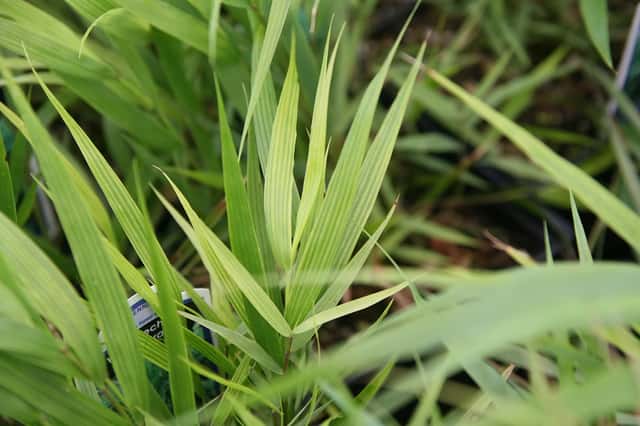
Hakonechloa macra is the only species in the genus Hakonechloa, a perennial clumping grass native to the mountainous regions of the Japanese island of Honshu, where it grows on moist rocks and stabilized scree in wooded mountain gorges between 500 and 1500 m above sea level. It forms dense clumps with short creeping rhizomes and thin, arching stems over 50 cm long. Narrow lanceolate leaves grow to about 25 cm in length and are complemented by inconspicuous greenish-yellow panicle inflorescences from summer to autumn. Thanks to its elegant, waterfall-like growth habit, it is one of the most popular ornamental grasses for shady gardens.
How to Propagate Japanese forest grass?
How Big Does Japanese forest grass Grow?
TLDR: Japanese forest grass can reach up to 45cm tall with Slow growth rate.
Max height
45cm
Spread
60cm
Growth rate
Slow
Foliage
Deciduous
Plant Uses
Ornamental
Great for decoration
Ground Cover
Soil coverage
Is your plant showing symptoms?
Click on the symptom to discover possible causes:
What Diseases Commonly Affect Japanese forest grass?
TLDR: Japanese forest grass is susceptible to 9 known diseases. Monitor regularly for early detection.
Leaf Spot
Leaf spot is a common fungal disease caused by various pathogens including Alternaria, Ascochyta, Colletotrichum, Septoria, and Venturia. It primarily affects leaves, causing discolored spots that can lead to premature leaf drop if left untreated.
Rust
Rust is a common fungal disease caused by fungi in the order Pucciniales that affects a wide variety of plants. The disease gets its name from the characteristic orange, yellow, or reddish-brown pustules that appear on leaves, resembling metal rust. This obligate fungal parasite requires living plants to survive and can cause significant economic losses in agricultural crops.
Root Rot
Root rot is a serious fungal disease that affects the root system of plants, causing them to decay and die. It is primarily caused by overwatering, poor drainage, or soil-borne fungi such as Pythium, Phytophthora, Rhizoctonia, and Fusarium. The disease thrives in waterlogged conditions where roots are deprived of oxygen, making them susceptible to fungal infection.
Crown Rot
Crown rot is a serious fungal disease that attacks the crown (base) of the plant where the stem meets the soil. It is caused by various fungal pathogens including Phytophthora, Fusarium, and Rhizoctonia. The disease thrives in waterlogged conditions and can quickly spread to kill the entire plant if not addressed promptly.
Meaning & Symbolism
Traditional cultural symbolism is not documented; in garden design, it is valued for its elegant, undulating appearance reminiscent of water or wind movement, which adds lightness to shady beds.
Compare with similar plants
| Attribute | Difficulty | Light | Watering | Pet Safe |
|---|---|---|---|---|
| Dark Fieldcap | Medium | Low light | 2d | ⚠️ |
| Azalea | Medium | Partial shade | 3d | ⚠️ |
| Muriel's Bamboo | Medium | Partial shade | 3d | ✓ |
| Bougainvillea | Medium | Direct sun | 7d | ⚠️ |
Choose & Compare
Sources & References
- Japanese Forest Grass Care & Growing Guide - Almanac.com
- Hakonechloa macra - NC State Extension Gardener Plant Toolbox
- Hakonechloa macra - Missouri Botanical Garden Plant Finder
- Pests and diseases of ornamental grasses and sedges - Greenhouse Management
- Hakonechloa macra (Munro) Honda - rakosovka japonska - BOTANY.cz




