Rutaceae
Japanese Skimmia: Perfect Plant for Beginners
Skimmia japonica
Japanese Skimmia thrives best in partial shade to deep shade with 4-6 hours of indirect light per day. The plant is sensitive to overwatering and requires well-draining, acidic soil (pH 4.8-6.0) rich in organic matter. Water approximately every 4 days to keep the soil moist without waterlogging. Suitable for USDA zones 7-8 and tolerates temperatures down to 0°F (-17.8°C).
Every 4 days
Partial shade
-17.8° - 21°C
30% - 50%
Categories
What is Japanese Skimmia?
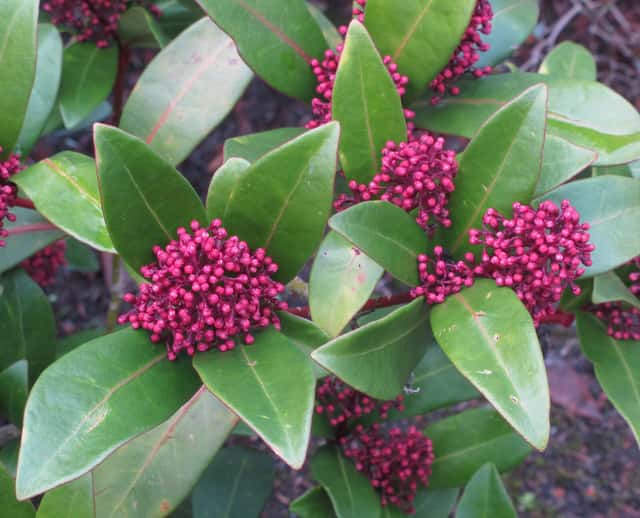
Japanese Skimmia (Skimmia japonica) is a easy-care plant from the Rutaceae family. Japanese Skimmia (Skimmia japonica) is a compact, slow-growing evergreen shrub from the Rutaceae family. It is an ornamental shrub native to Japan, notable for its fragrant, creamy-white to pink flowers in spring, followed by bright red berries that persist throughout fall and winter. The foliage re...
Japanese Skimmia grows up to 2.0m, spread of 180cm, watering every 4 days, -17.8°C – 21°C, 30–50% humidity. It is not suitable for indoor environments and not safe for pets.
Unlike many tropical plants, Japanese Skimmia tolerates watering mistakes. Best for beginners. Without precautions, ingestion can cause irritation in pets. Keep out of reach of cats and dogs.
How to Care for Japanese Skimmia?
TLDR: Japanese Skimmia needs Partial shade, watering every 4 days, and temperatures between -17.8-21°C with 30-50% humidity.
How Often Should You Water Japanese Skimmia?
Maintain regular moisture without waterlogging. Water approximately every 4 days so that the top inch (2-3 cm) becomes thoroughly moist. Yellow leaves indicate overwatering. Always ensure excellent drainage.
How Much Light Does Japanese Skimmia Need?
Place the plant in partial shade to deep shade. Avoid bright direct sunlight, which can cause leaf scorch. Ideally, provide 4-6 hours of indirect light per day in a sheltered spot.
What Is the Best Soil for Japanese Skimmia?
Use well-draining, acidic, humus-rich soil with a pH of 4.8-6.0. For containers, use ericaceous (lime-free) potting mix. Add compost when planting.
What Pot Should You Use for Japanese Skimmia?
Heavy pots with good drainage holes, as the plant is sensitive to waterlogging. Use ericaceous or acidic potting soil.
Care Schedule
Fertilize
Every 90 days
Repot
Every 730 days
What Is Japanese Skimmia and Where Does It Come From?
Japanese Skimmia (Skimmia japonica) is a compact, slow-growing evergreen shrub from the Rutaceae family. It is an ornamental shrub native to Japan, notable for its fragrant, creamy-white to pink flowers in spring, followed by bright red berries that persist throughout fall and winter. The foliage releases an aromatic scent when crushed.
How Big Does Japanese Skimmia Grow?
TLDR: Japanese Skimmia can reach up to 2.0m tall with Slow growth rate.
Max height
2.0m
Spread
1.8m
Growth rate
Slow
Foliage
Evergreen
Warning: Toxic Plant
This plant can be toxic if ingested. Keep out of reach of:
Plant Uses
Ornamental
Great for decoration
Is your plant showing symptoms?
Click on the symptom to discover possible causes:
What Diseases Commonly Affect Japanese Skimmia?
TLDR: Japanese Skimmia is susceptible to 7 known diseases. Monitor regularly for early detection.
Phytophthora Root Rot
Disease caused by fungus-like organisms (oomycetes) that live in soil and can survive for years. It affects roots, stem, and crown of plants, being especially severe in waterlogged or poorly drained soils. It is the second most common cause of root rot in trees and shrubs.
Phytophthora Root Rot
The Phytophthora genus consists of soil-borne oomycetes (water molds) that act as plant pathogens, primarily affecting trees and woody plants. It typically spreads through the root system, leading to systemic decline and eventual plant collapse.
Root Rot
Root rot is a serious fungal disease that affects the root system of plants, causing them to decay and die. It is primarily caused by overwatering, poor drainage, or soil-borne fungi such as Pythium, Phytophthora, Rhizoctonia, and Fusarium. The disease thrives in waterlogged conditions where roots are deprived of oxygen, making them susceptible to fungal infection.
Scale Insects
Scale insects are small sap-sucking pests that appear as brown, shell-like bumps on plant stems and leaves. There are over 25 species, divided into armored (hard) and unarmored (soft) scales. They feed by piercing plant tissue and extracting sap, which weakens the plant and can lead to yellowing, stunted growth, and even death if left untreated. They also excrete honeydew, which attracts ants and promotes sooty mold growth.
Meaning & Symbolism
Japanese Skimmia symbolizes elegance and winter beauty due to its striking red berries and fragrant flowers during the darker months.
Compare with similar plants
| Attribute | Difficulty | Light | Watering | Pet Safe |
|---|---|---|---|---|
| Field Maple | Easy | Bright indirect | 14d | ✓ |
| Silver Birch | Easy | Direct sun | 14d | ✓ |
| Common Blanketflower | Easy | Direct sun | 10d | ✓ |
| Cushion Bush | Easy | Direct sun | 14d | ✓ |





