Buxaceae
Japanese spurge: Ground Cover Plant
Pachysandra terminalis
A low-maintenance, slow-growing groundcover suitable for full or partial shade. It thrives best in moist, acidic (pH 5.0-6.0), well-drained soil rich in organic matter. Once established, it tolerates short-term drought but is sensitive to permanently waterlogged soil, which causes root rot. It requires almost no fertilization - excessive fertilizing weakens the tissues and increases susceptibility to fungal diseases like Volutella blight.
Every 10 days
Low light
-34° - 32°C
% - %
Categories
What is Japanese spurge?
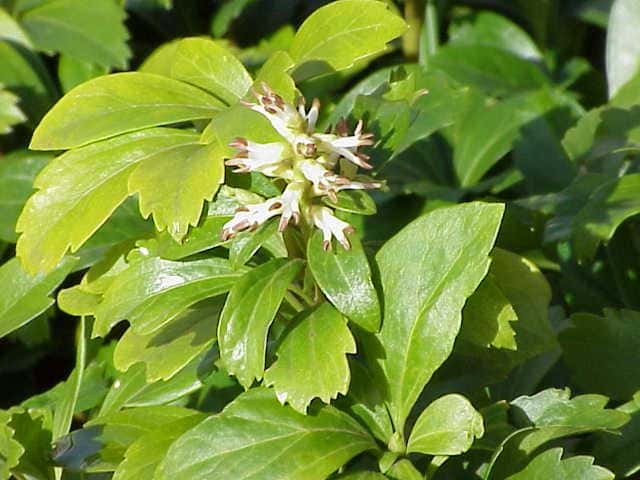
Japanese spurge (Pachysandra terminalis) is a easy-care plant from the Buxaceae family. Pachysandra terminalis (Japanese spurge) is a low-growing, evergreen perennial groundcover from the boxwood family (Buxaceae), native to the forests of Japan. It forms dense, 15-30 cm high mats of leathery, dark green leaves clustered at the ends of the stems - hence the specific name "terminalis"....
Japanese spurge grows up to 30cm, spread of 45cm, watering every 10 days, -34°C – 32°C. It is not suitable for indoor environments and safe for pets.
Unlike many tropical plants, Japanese spurge tolerates watering mistakes. Best for beginners. Unlike many popular species, Japanese spurge is safe to keep around pets.
How to Care for Japanese spurge?
TLDR: Japanese spurge needs Low light, watering every 10 days, and temperatures between -34-32°C with 40-70% humidity.
How Often Should You Water Japanese spurge?
Water regularly during the first year after planting to ensure the plant establishes well. Once established, watering is only necessary during prolonged dry periods. Avoid overhead watering on the leaves - it increases the risk of fungal diseases.
How Much Light Does Japanese spurge Need?
Full to partial shade is ideal. Direct afternoon sun causes leaf scorch and bleaching, especially when planted on the southwest side; the plant tolerates mild morning sun (2-4 hours).
What Is the Best Soil for Japanese spurge?
Prefers moist, acidic soil (pH below 6.0) with high organic matter content and good drainage. It also tolerates clay or sandy soils as long as they are not permanently waterlogged.
What Pot Should You Use for Japanese spurge?
Primarily used as a groundcover directly in the garden; it is not typical for pots as it needs space to spread via rhizomes.
Care Schedule
Fertilize
Every 365 days
What Is Japanese spurge and Where Does It Come From?
Pachysandra terminalis (Japanese spurge) is a low-growing, evergreen perennial groundcover from the boxwood family (Buxaceae), native to the forests of Japan. It forms dense, 15-30 cm high mats of leathery, dark green leaves clustered at the ends of the stems - hence the specific name "terminalis". It spreads slowly via underground rhizomes and forms a continuous carpet within 2-3 years. In early spring, it produces small, inconspicuous white flowers in spike-like clusters. It is hardy in USDA zones 4a to 9b and excels in its ability to grow in deep shade where most other plants fail to thrive.
How to Propagate Japanese spurge?
Rhizome division
- Repeat division approximately every 4-5 years for established stands.
- 1 Preparation
Water the established stand thoroughly the day before division.
- 2 Digging up the plant
Carefully dig up a portion of the stand with the root ball, preferably in early spring before new growth begins.
- 3 Division
Using a sharp knife, divide the rhizomes into smaller sections so that each part has roots and leaves.
- 4 Planting
Plant the new sections immediately in the desired location in moist, humus-rich soil and water thoroughly.
Materials needed:
Stem cuttings
- Roots usually form in 6-8 weeks with constant moisture.
- 1 Taking the cutting
Cut a terminal shoot approximately 10 cm long with healthy leaves, without buds or flowers.
- 2 Preparing the cutting
Remove leaves from the bottom half of the stem and dip the cut end into rooting hormone.
- 3 Rooting
Plant the cutting in a moist substrate so that the lower nodes are below the surface, and maintain a consistently humid environment.
Materials needed:
How Big Does Japanese spurge Grow?
TLDR: Japanese spurge can reach up to 30cm tall with Slow growth rate.
Max height
30cm
Spread
45cm
Growth rate
Slow
Foliage
Evergreen
Plant Uses
Ground Cover
Soil coverage
Ornamental
Great for decoration
Is your plant showing symptoms?
Click on the symptom to discover possible causes:
What Diseases Commonly Affect Japanese spurge?
TLDR: Japanese spurge is susceptible to 4 known diseases. Monitor regularly for early detection.
Leaf Spot
Leaf spot is a common fungal disease caused by various pathogens including Alternaria, Ascochyta, Colletotrichum, Septoria, and Venturia. It primarily affects leaves, causing discolored spots that can lead to premature leaf drop if left untreated.
Canker
Canker is a disease caused by various fungi and bacteria that create necrotic, sunken areas on bark of branches, stems, and trunks. Pathogens enter through wounds and natural openings, especially when plants are stressed. Canker can gradually weaken or kill branches by disrupting water and nutrient flow.
Scale Insects
Scale insects are small sap-sucking pests that appear as brown, shell-like bumps on plant stems and leaves. There are over 25 species, divided into armored (hard) and unarmored (soft) scales. They feed by piercing plant tissue and extracting sap, which weakens the plant and can lead to yellowing, stunted growth, and even death if left untreated. They also excrete honeydew, which attracts ants and promotes sooty mold growth.
Root Rot
Root rot is a serious fungal disease that affects the root system of plants, causing them to decay and die. It is primarily caused by overwatering, poor drainage, or soil-borne fungi such as Pythium, Phytophthora, Rhizoctonia, and Fusarium. The disease thrives in waterlogged conditions where roots are deprived of oxygen, making them susceptible to fungal infection.
Meaning & Symbolism
Represents endurance and the ability to flourish in deep shade, in places where other plants fail.
Compare with similar plants
| Attribute | Difficulty | Light | Watering | Pet Safe |
|---|---|---|---|---|
| Field Maple | Easy | Bright indirect | 14d | ✓ |
| Silver Birch | Easy | Direct sun | 14d | ✓ |
| Common Blanketflower | Easy | Direct sun | 10d | ✓ |
| Cushion Bush | Easy | Direct sun | 14d | ✓ |
Choose & Compare
Sources & References
- Pachysandra terminalis - NC State Extension Gardener Plant Toolbox
- Pachysandra Leaf and Stem Blight - UConn IPM
- Volutella Blight of Pachysandra - University of Illinois Extension
- Pachysandra - Master Gardeners of Mercer County
- Toxic and Non-Toxic Plants - ASPCA
- How To Plant, Fertilize, Water & Prune Pachysandra Japanese Spurge Plants
- Pachysandra terminalis - Wikipedia





