Sciadopityaceae
Japanese umbrella pine: Pet-Safe Plant
Sciadopitys verticillata
The Japanese umbrella pine requires a sunny or semi-shaded location protected from wind, where the soil does not dry out completely even in summer. It thrives best when planted in acidic, nutrient-rich, well-drained soil with consistent watering. Due to its exceptionally slow growth, it requires patience; in return, it is virtually unaffected by pests or diseases and requires minimal pruning or fertilization.
Every 7 days
Bright indirect
-23° - 32°C
50% - 85%
Categories
What is Japanese umbrella pine?
Japanese umbrella pine (Sciadopitys verticillata) is a medium-care plant from the Sciadopityaceae family. The Japanese umbrella pine (Sciadopitys verticillata) is the only living species in the Sciadopityaceae family—a true "living fossil," as its closest relatives are known only from fossil records. Endemic to Japan, it is native to the mountain forests of Shikoku, Kyushu, and the Kii Peninsula, typica...
Japanese umbrella pine grows up to 9.0m, spread of 550cm, watering every 7 days, -23°C – 32°C, 50–85% humidity. It is not suitable for indoor environments and safe for pets.
Unlike many popular species, Japanese umbrella pine is safe to keep around pets.
How to Care for Japanese umbrella pine?
TLDR: Japanese umbrella pine needs Bright indirect, watering every 7 days, and temperatures between -23-32°C with 50-85% humidity.
How Often Should You Water Japanese umbrella pine?
Keep the soil consistently moist, especially during summer and while the plant is young—the Japanese umbrella pine is not drought-tolerant. Water thoroughly once a week if there is insufficient rainfall, but avoid waterlogged, suffocating soil, as this can lead to root rot.
How Much Light Does Japanese umbrella pine Need?
Choose a sunny or slightly semi-shaded spot. In regions with hot summers, afternoon shade is beneficial, while in cooler, wetter climates, it tolerates full sun well.
What Is the Best Soil for Japanese umbrella pine?
Plant in acidic soil (pH 4.5–6.0) that is rich in humus, well-aerated, yet moisture-retentive. Avoid lime-rich (alkaline) or compacted, poorly drained soils, as these will lead to root problems.
What Pot Should You Use for Japanese umbrella pine?
Young specimens are suitable for container or bonsai cultivation, requiring a deep pot filled with a well-drained, acidic soil mix. For permanent outdoor planting, choose a wind-protected site with ample root space, as the species does not tolerate transplanting well.
What Is Japanese umbrella pine and Where Does It Come From?
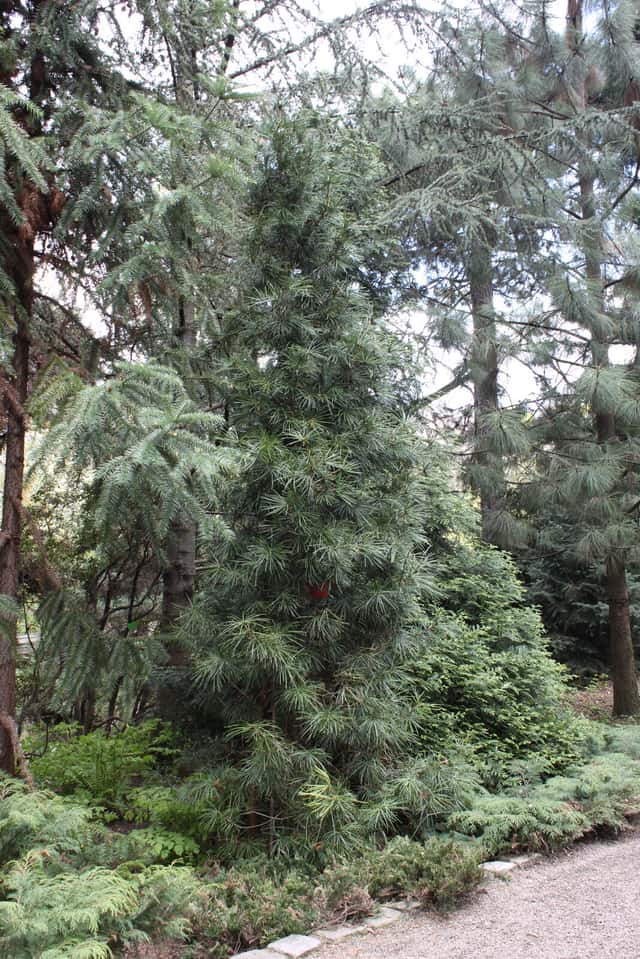
The Japanese umbrella pine (Sciadopitys verticillata) is the only living species in the Sciadopityaceae family—a true "living fossil," as its closest relatives are known only from fossil records. Endemic to Japan, it is native to the mountain forests of Shikoku, Kyushu, and the Kii Peninsula, typically growing at altitudes of 700–1400 meters on rocky slopes and in river gorges. Its most distinctive feature is the umbrella-like whorls of flattened, 4–14 cm long needle-like structures (cladodes) at the tips of the shoots, from which its common name is derived. It is an extremely slow-growing evergreen tree: in its homeland, centuries-old specimens can reach 30–40 meters in height, while in garden cultivation, it may only reach a few meters even after several decades.
How Big Does Japanese umbrella pine Grow?
TLDR: Japanese umbrella pine can reach up to 9.0m tall with Slow growth rate.
Max height
9.0m
Spread
5.5m
Growth rate
Slow
Foliage
Evergreen
Plant Uses
Ornamental
Great for decoration
Is your plant showing symptoms?
Click on the symptom to discover possible causes:
What Diseases Commonly Affect Japanese umbrella pine?
TLDR: Japanese umbrella pine is susceptible to 2 known diseases. Monitor regularly for early detection.
Phytophthora Root Rot
Disease caused by fungus-like organisms (oomycetes) that live in soil and can survive for years. It affects roots, stem, and crown of plants, being especially severe in waterlogged or poorly drained soils. It is the second most common cause of root rot in trees and shrubs.
Spider Mites
Spider mites are tiny arachnids (less than 1/20 inch long) related to spiders and ticks that feed on plant sap. They thrive in hot, dry conditions and can cause significant damage to ornamental and vegetable plants. During severe infestations, crop losses can reach 14% or higher as these pests disrupt vital plant processes including photosynthesis, carbon dioxide absorption, and transpiration.
Meaning & Symbolism
In Japan, the Japanese umbrella pine (koyamaki) is one of the sacred trees: it is one of the Five Sacred Trees of Kiso, alongside the Hinoki and Sawara cypresses. In historical Japan, its wood was reserved exclusively for the Imperial Court, and unauthorized felling could be punishable by death. Today, it is still planted in temple gardens and shrines as a symbol of spiritual presence, longevity, and spiritual purity.
Compare with similar plants
| Attribute | Difficulty | Light | Watering | Pet Safe |
|---|---|---|---|---|
| Dark Fieldcap | Medium | Low light | 2d | ⚠️ |
| Azalea | Medium | Partial shade | 3d | ⚠️ |
| Muriel's Bamboo | Medium | Partial shade | 3d | ✓ |
| Bougainvillea | Medium | Direct sun | 7d | ⚠️ |




