Orchidaceae
Jewel Orchid: Best for Low Light
Macodes petola
Macodes petola requires a consistently moist, well-draining substrate, high humidity (60–90%), and a warm environment without direct sunlight. It thrives best in terrariums or vivarium conditions where stable humidity and temperatures of 18–28°C (64–82°F) can be maintained. It is moderately difficult to grow—the main risk is root rot caused by overwatering in poorly draining substrate.
Every 4 days
Low light
16° - 28°C
60% - 90%
Categories
What is Jewel Orchid?
Jewel Orchid (Macodes petola) is a medium-care plant from the Orchidaceae family. Macodes petola, known as the jewel orchid, is a terrestrial orchid native to the tropical rainforests of Southeast Asia—including Java, Malaysia, Sumatra, Borneo, the Philippines, and the Ryukyu Islands. Unlike most orchids, it does not grow epiphytically on trees but directly on the moist soil of s...
Jewel Orchid grows up to 20cm, spread of 30cm, watering every 4 days, 16°C – 28°C, 60–90% humidity. It is suitable for indoor environments and not safe for pets.
Without precautions, ingestion can cause irritation in pets. Keep out of reach of cats and dogs. Without adequate drainage, root rot can develop within 8 days.
How to Care for Jewel Orchid?
TLDR: Jewel Orchid needs Low light, watering every 4 days, and temperatures between 16-28°C with 60-90% humidity.
How Often Should You Water Jewel Orchid?
Keep the substrate consistently slightly moist, never waterlogged—water when the top third of the substrate has slightly dried out. Use lukewarm, settled water (ideally rainwater or distilled water), as the plant is sensitive to hard water and excess salts.
How Much Light Does Jewel Orchid Need?
The jewel orchid tolerates shaded to semi-shaded locations and prefers bright, indirect light without direct sun, which could burn the leaves. It also does well under artificial lighting, making it a suitable plant for terrariums or rooms without natural light.
What Is the Best Soil for Jewel Orchid?
Use a light, well-draining yet moisture-retentive substrate—a mix of fine pine bark, perlite, and peat, or live sphagnum moss. Grow in wider, shallower containers since the plant grows horizontally via creeping rhizomes.
What Pot Should You Use for Jewel Orchid?
Choose a wider, shallow pot (approximately 12 cm deep) with good drainage holes, or grow in a closed terrarium where high humidity is easier to maintain. Repot approximately every four years, as the plant is a slow grower.
Care Schedule
Fertilize
Every 30 days
Misting
Every 3 days
Rotate
Every 14 days
Repot
Every 1460 days
What Is Jewel Orchid and Where Does It Come From?
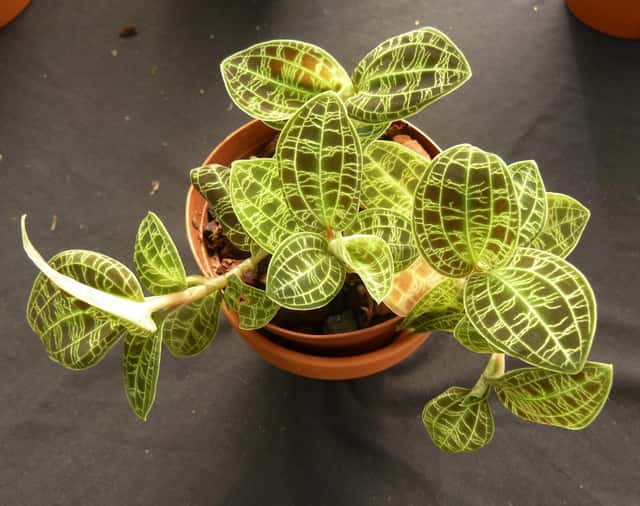
Macodes petola, known as the jewel orchid, is a terrestrial orchid native to the tropical rainforests of Southeast Asia—including Java, Malaysia, Sumatra, Borneo, the Philippines, and the Ryukyu Islands. Unlike most orchids, it does not grow epiphytically on trees but directly on the moist soil of shaded swampy forests and riverbanks. Its leaves are dark green to velvety, featuring a striking network of gold and silver veins that resemble lightning bolts or veins of precious metal—hence its nickname 'jewel orchid.' The flowers are small, reddish-brown with a white lip, and appear rarely, usually in late fall or winter; however, the plant's primary attraction remains its foliage pattern rather than its blooms.
How to Propagate Jewel Orchid?
Rhizome cutting division
- Maintain consistent humidity throughout the rooting process.
- Avoid direct sunlight to prevent the cutting from drying out.
- 1 Selecting the cutting
In spring, select a healthy rhizome tip at least 8 cm long from the edge of the plant and cut it with a sterile knife.
- 2 Preparation
Remove the bottom third of the leaves from the cutting to reduce water loss.
- 3 Rooting
Place the cutting loosely on moist substrate or sphagnum moss and cover with a transparent bag with ventilation holes.
Materials needed:
How Big Does Jewel Orchid Grow?
TLDR: Jewel Orchid can reach up to 20cm tall with Slow growth rate.
Max height
20cm
Spread
30cm
Growth rate
Slow
Foliage
Evergreen
Warning: Toxic Plant
This plant can be toxic if ingested. Keep out of reach of:
Plant Uses
Ornamental
Great for decoration
Medicinal
Medicinal properties
Medicinal Uses
- In traditional Bornean folk medicine, it was used as a stimulant
- Scientific research into its medicinal effects is currently limited, and the plant is not recommended for self-medication
Is your plant showing symptoms?
Click on the symptom to discover possible causes:
What Diseases Commonly Affect Jewel Orchid?
TLDR: Jewel Orchid is susceptible to 10 known diseases. Monitor regularly for early detection.
Root Rot
Root rot is a serious fungal disease that affects the root system of plants, causing them to decay and die. It is primarily caused by overwatering, poor drainage, or soil-borne fungi such as Pythium, Phytophthora, Rhizoctonia, and Fusarium. The disease thrives in waterlogged conditions where roots are deprived of oxygen, making them susceptible to fungal infection.
Mealybugs
Mealybugs are small, soft-bodied insects covered with a white, waxy, cottony material. They are common pests of houseplants and outdoor plants in mild climates. These sap-sucking insects feed on plant tissue, causing damage, stunted growth, and can lead to plant death if left untreated. They produce sticky honeydew which attracts sooty mold.
Powdery Mildew
Powdery mildew is a common fungal disease caused by various fungi species including Erysiphe, Podosphaera, Oïdium, and Leveillula. It affects over 10,000 plant species worldwide. The disease thrives in warm, dry climates with high humidity and appears as a distinctive white powdery coating on plant surfaces.
Leaf Spot
Leaf spot is a common fungal disease caused by various pathogens including Alternaria, Ascochyta, Colletotrichum, Septoria, and Venturia. It primarily affects leaves, causing discolored spots that can lead to premature leaf drop if left untreated.
Meaning & Symbolism
The name 'jewel orchid' refers to the shimmering leaf patterns that resemble lightning or veins of precious metals on a velvety background. In horticultural culture, it symbolizes hidden beauty and rarity, manifesting not through flashy flowers but through delicate, almost jewelry-like leaf patterns.
Compare with similar plants
| Attribute | Difficulty | Light | Watering | Pet Safe |
|---|---|---|---|---|
| Dark Fieldcap | Medium | Low light | 2d | ⚠️ |
| Azalea | Medium | Partial shade | 3d | ⚠️ |
| Muriel's Bamboo | Medium | Partial shade | 3d | ✓ |
| Bougainvillea | Medium | Direct sun | 7d | ⚠️ |




