Rosaceae
Lady's mantle: Ground Cover Plant
Alchemilla mollis
Lady's mantle grows best in a spot with full sun or partial shade, in moisture-retentive but well-drained soil. Water as soon as the top layer of soil dries out and prune the plant back to the ground after flowering to encourage fresh new foliage. The plant is hardy, requires little care, and is rarely affected by pests or diseases.
Every 6 days
Partial shade
-37° - 32°C
40% - 70%
Categories
What is Lady's mantle?
Lady's mantle (Alchemilla mollis) is a easy-care plant from the Rosaceae family. Lady's mantle (Alchemilla mollis) is a hardy perennial from the rose family (Rosaceae), native to Southeast Europe. The plant forms elegant, rounded mounds of softly hairy, fan-shaped leaves with scalloped edges. Thanks to these fine hairs, rain and dew water bead up on the leaves—an effect that alc...
Lady's mantle grows up to 45cm, spread of 60cm, watering every 6 days, -37°C – 32°C, 40–70% humidity. It is not suitable for indoor environments and safe for pets.
Unlike many tropical plants, Lady's mantle tolerates watering mistakes. Best for beginners. Unlike many popular species, Lady's mantle is safe to keep around pets.
How to Care for Lady's mantle?
TLDR: Lady's mantle needs Partial shade, watering every 6 days, and temperatures between -37-32°C with 40-70% humidity.
How Often Should You Water Lady's mantle?
Keep the soil slightly moist, especially in the first year after planting. Once well-established, the plant is reasonably drought-tolerant, but supplemental watering is recommended during prolonged dry spells. Avoid 'wet feet,' as lady's mantle does not tolerate stagnant water well.
How Much Light Does Lady's mantle Need?
This plant feels at home in both full sun and partial shade. In cooler, moist gardens, it can handle full sun; in warmer, drier locations, partial shade is preferred to prevent leaf scorch.
What Is the Best Soil for Lady's mantle?
Choose a nutrient-rich, humus-heavy soil that retains moisture yet drains well, such as loam. The plant is adaptable and also grows well in clay soil, as long as water does not pool.
What Pot Should You Use for Lady's mantle?
When growing in pots, choose a wide, sturdy container with sufficient drainage holes, preferably made of terracotta so that excess moisture can evaporate. Use a well-draining, humus-rich potting mix and ensure a layer of drainage material at the bottom.
Care Schedule
Fertilize
Every 90 days
What Is Lady's mantle and Where Does It Come From?
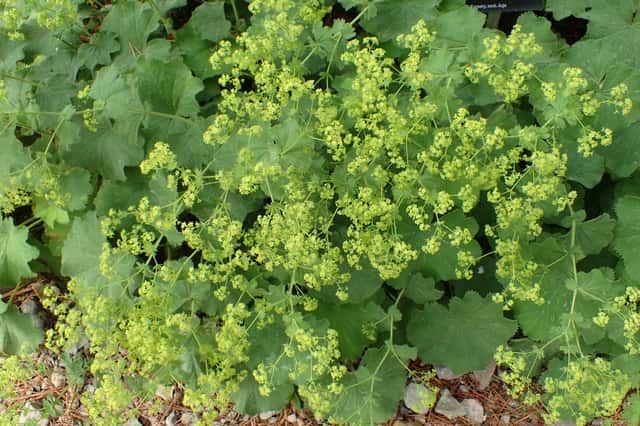
Lady's mantle (Alchemilla mollis) is a hardy perennial from the rose family (Rosaceae), native to Southeast Europe. The plant forms elegant, rounded mounds of softly hairy, fan-shaped leaves with scalloped edges. Thanks to these fine hairs, rain and dew water bead up on the leaves—an effect that alchemists once considered the purest form of water and used in their experiments. In summer, loose clusters of countless tiny, chartreuse flowers appear above the foliage. Lady's mantle is a very low-maintenance groundcover that is excellent for borders, under trees, and along paths, and it naturalizes easily through self-seeding.
How Big Does Lady's mantle Grow?
TLDR: Lady's mantle can reach up to 45cm tall with Medium growth rate.
Max height
45cm
Spread
60cm
Growth rate
Medium
Foliage
Deciduous
Plant Uses
Ornamental
Great for decoration
Medicinal
Medicinal properties
Ground Cover
Soil coverage
Medicinal Uses
- Traditionally used as a herbal tea to support menstrual complaints
- Historically applied as a mild astringent for light diarrhea
- Used to support digestive health
- Applied topically to the skin for minor irritations and small wounds
Is your plant showing symptoms?
Click on the symptom to discover possible causes:
What Diseases Commonly Affect Lady's mantle?
TLDR: Lady's mantle is susceptible to 5 known diseases. Monitor regularly for early detection.
Slugs and Snails
Slugs and snails are mollusks that feed on plant tissue, causing irregular holes in leaves and damage to young seedlings. They are most active at night and in moist conditions, leaving characteristic silvery slime trails. These pests can quickly devastate gardens, especially during wet seasons.
Powdery Mildew
Powdery mildew is a common fungal disease caused by various fungi species including Erysiphe, Podosphaera, Oïdium, and Leveillula. It affects over 10,000 plant species worldwide. The disease thrives in warm, dry climates with high humidity and appears as a distinctive white powdery coating on plant surfaces.
Aphids
Aphids are small, soft-bodied, pear-shaped insects (1/16 to 1/8 inch long) that feed by sucking nutrient-rich sap from plants. They reproduce rapidly and can quickly weaken plants, causing distorted growth and transmitting plant viruses. Aphids come in various colors including green, black, red, yellow, brown, and gray. They secrete honeydew, a sticky substance that attracts ants and encourages sooty mold growth.
Leaf Spot
Leaf spot is a common fungal disease caused by various pathogens including Alternaria, Ascochyta, Colletotrichum, Septoria, and Venturia. It primarily affects leaves, causing discolored spots that can lead to premature leaf drop if left untreated.
Meaning & Symbolism
Lady's mantle has been associated with femininity, motherhood, and protection for centuries. The name refers to the Virgin Mary's cloak, whose folds are said to have inspired the lobed leaves. The dew drops that collect in the leaves were considered magical, pure water by alchemists, hence the botanical name Alchemilla.
Compare with similar plants
| Attribute | Difficulty | Light | Watering | Pet Safe |
|---|---|---|---|---|
| Field Maple | Easy | Bright indirect | 14d | ✓ |
| Silver Birch | Easy | Direct sun | 14d | ✓ |
| Common Blanketflower | Easy | Direct sun | 10d | ✓ |
| Cushion Bush | Easy | Direct sun | 14d | ✓ |
Choose & Compare
Sources & References
- How to grow alchemilla / RHS Growing Guide
- Alchemilla mollis | BBC Gardeners World Magazine
- Alchemilla mollis - Wikipedia
- Vrouwenmantel (Alchemilla) | Plantengids | Intratuin
- Ladys Mantle (Alchemilla vulgaris): Benefits, Safety, Uses | Herbal Reality
- Ladys Mantle: Complete Plant Care And Growing Guide





