Apocynaceae
Lanceleaf Wax Flower (Hoya lanceolata)
Hoya lanceolata
Grow it in a hanging basket in bright, indirect light, with a little gentle morning or late-afternoon sun to help it bloom. Use a loose, fast-draining mix, water when the mix is almost dry and never leave the pot standing in water. It likes warmth and humidity: keep it above 16 C at night and raise humidity with a tray of damp pebbles. Feed every two weeks in spring and summer. Do not cut off old flower stalks, because new flowers grow from them, and avoid moving the pot once buds appear.
Every 7 days
Bright indirect
16° - 30°C
60% - 80%
Categories
What is Lanceleaf Wax Flower?
Lanceleaf Wax Flower (Hoya lanceolata) is a medium-care plant from the Apocynaceae family. Hoya lanceolata is an epiphytic shrub in the dogbane family (Apocynaceae) that grows on trees in the Himalayan forests, from Kumaon and Nepal through north-eastern India, Bangladesh and Myanmar to south-central China and Vietnam, at about 1000-2000 m. Its stems are thin and trail or hang down, the y...
Lanceleaf Wax Flower grows up to 60cm, spread of 60cm, watering every 7 days, 16°C – 30°C, 60–80% humidity. It is suitable for indoor environments and safe for pets.
Unlike many popular species, Lanceleaf Wax Flower is safe to keep around pets. Without adequate drainage, root rot can develop within 14 days.
How to Care for Lanceleaf Wax Flower?
TLDR: Lanceleaf Wax Flower needs Bright indirect, watering every 7 days, and temperatures between 16-30°C with 60-80% humidity.
How Often Should You Water Lanceleaf Wax Flower?
Water thoroughly when the top of the mix is nearly dry, roughly once a week in spring and summer, and let excess water drain away. In autumn and winter water less often, but do not let the mix dry out completely: this hoya is less drought-tolerant than the thick-leaved species. Soggy soil quickly leads to root rot.
How Much Light Does Lanceleaf Wax Flower Need?
Bright, indirect light, such as near an east- or west-facing window. A few hours of soft morning or late-afternoon sun encourage flowering, but strong midday summer sun scorches the leaves. In low light it grows long and weak and rarely blooms.
What Is the Best Soil for Lanceleaf Wax Flower?
Use a coarse, airy mix that drains fast, for example equal parts orchid bark, peat-free potting compost and coarse perlite, or cactus compost with extra perlite. A slightly acidic to neutral pH (about 6-7) suits it. Flush the pot with plain water now and then to wash out fertilizer salts.
What Pot Should You Use for Lanceleaf Wax Flower?
A shallow pot or hanging basket with drainage holes, not much bigger than the root ball. Terracotta or a basket with bark mix helps the roots dry out between waterings.
Care Schedule
Fertilize
Every 14 days
What Is Lanceleaf Wax Flower and Where Does It Come From?
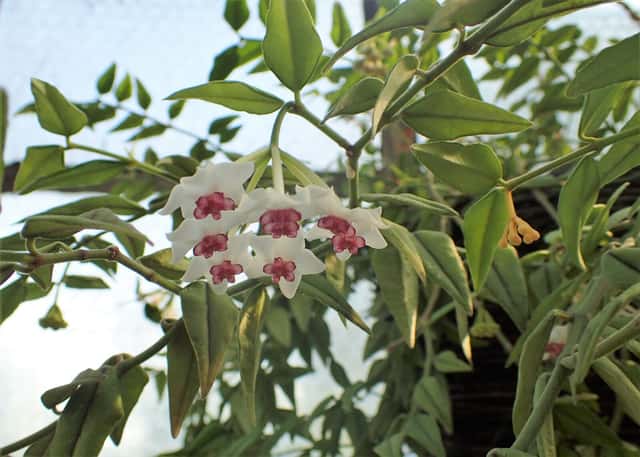
Hoya lanceolata is an epiphytic shrub in the dogbane family (Apocynaceae) that grows on trees in the Himalayan forests, from Kumaon and Nepal through north-eastern India, Bangladesh and Myanmar to south-central China and Vietnam, at about 1000-2000 m. Its stems are thin and trail or hang down, the young shoots covered in fine hairs. The leaves are small, lance-shaped, fleshy and leathery, 1.5-6 cm long. From late spring to late summer it carries hanging clusters of small, waxy, star-shaped white flowers with a pink to purple-red centre, fragrant especially in the evening. The plant most often sold in shops is the subspecies bella, the beautiful or miniature wax plant, which holds the RHS Award of Garden Merit and is sometimes treated as its own species, Hoya bella.
How to Propagate Lanceleaf Wax Flower?
Stem cuttings
Wear gloves, because the milky sap can irritate skin. Several cuttings in one pot give a fuller plant.
- 1 In spring or early summer, cut a healthy semi-ripe stem with at least two pairs of leaves
- 2 Remove the lowest leaves so one or two nodes are bare
- 3 Stand the cutting in a glass of water, or insert it in a moist, very free-draining mix
- 4 Keep it warm and in bright, indirect light
- 5 Pot it up once the roots are a few centimetres long
Materials needed:
How Big Does Lanceleaf Wax Flower Grow?
TLDR: Lanceleaf Wax Flower can reach up to 60cm tall with Slow growth rate.
Max height
60cm
Spread
60cm
Growth rate
Slow
Foliage
Evergreen
Plant Uses
Ornamental
Great for decoration
Is your plant showing symptoms?
Click on the symptom to discover possible causes:
What Diseases Commonly Affect Lanceleaf Wax Flower?
TLDR: Lanceleaf Wax Flower is susceptible to 7 known diseases. Monitor regularly for early detection.
Mealybugs
Mealybugs are small, soft-bodied insects covered with a white, waxy, cottony material. They are common pests of houseplants and outdoor plants in mild climates. These sap-sucking insects feed on plant tissue, causing damage, stunted growth, and can lead to plant death if left untreated. They produce sticky honeydew which attracts sooty mold.
Scale Insects
Scale insects are small sap-sucking pests that appear as brown, shell-like bumps on plant stems and leaves. There are over 25 species, divided into armored (hard) and unarmored (soft) scales. They feed by piercing plant tissue and extracting sap, which weakens the plant and can lead to yellowing, stunted growth, and even death if left untreated. They also excrete honeydew, which attracts ants and promotes sooty mold growth.
Whiteflies
Whiteflies are small, soft-bodied, winged insects closely related to aphids and mealybugs. They are moth-like in appearance, about 1/16 inch long, triangular in shape, and gray-white in color. These sap-sucking pests feed on plant tissue, causing yellowing, stunted growth, and wilting. They also excrete honeydew, which attracts ants and promotes sooty mold growth. Whiteflies can transmit serious plant viruses.
Spider Mites
Spider mites are tiny arachnids (less than 1/20 inch long) related to spiders and ticks that feed on plant sap. They thrive in hot, dry conditions and can cause significant damage to ornamental and vegetable plants. During severe infestations, crop losses can reach 14% or higher as these pests disrupt vital plant processes including photosynthesis, carbon dioxide absorption, and transpiration.
Fun Facts
In the wild it grows on trees in Himalayan forests at about 1000-2000 m.
Its flowers smell strongest in the evening.
New flowers appear on the same short stalks year after year, so the old stalks should not be cut off.
Its subspecies bella holds the RHS Award of Garden Merit.
Frequently asked questions
How often should I water Hoya lanceolata?
Why is my Hoya bella not flowering?
Is Hoya lanceolata toxic to cats and dogs?
What temperature does it need?
Is Hoya bella the same as Hoya lanceolata?
Compare with similar plants
| Attribute | Difficulty | Light | Watering | Pet Safe |
|---|---|---|---|---|
| Dark Fieldcap | Medium | Low light | 2d | ⚠️ |
| Azalea | Medium | Partial shade | 3d | ⚠️ |
| Muriel's Bamboo | Medium | Partial shade | 3d | ✓ |
| Bougainvillea | Medium | Direct sun | 7d | ⚠️ |