Solanaceae
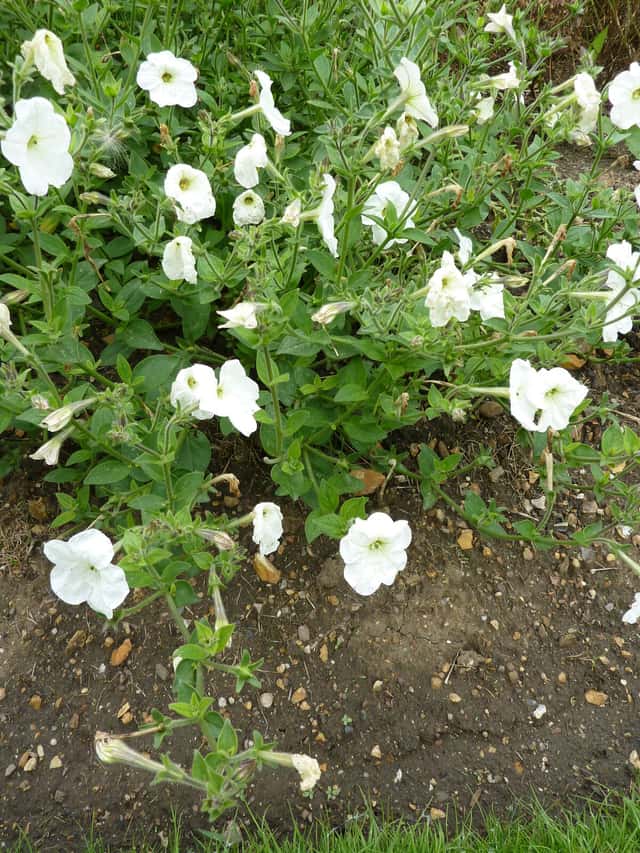
Large White Petunia (Petunia axillaris)
Petunia axillaris
Grow the large white petunia in full sun, water once the topsoil dries out (roughly weekly), and use well-draining soil to prevent root rot.
Every 7 days
Direct sun
° - °C
% - %
Categories
What is Large White Petunia?
Large White Petunia (Petunia axillaris) is a easy-care plant from the Solanaceae family. Petunia axillaris, the large white petunia, is an erect annual to short-lived subshrub native to the temperate and subtropical grasslands of southern Brazil, Argentina, and Uruguay. It grows to about 60 cm tall, with sticky, glandular stems and opposite, elliptic to ovate leaves. Its trumpet-shaped...
Large White Petunia grows up to 60cm, spread of 40cm, watering every 7 days. It is suitable for indoor environments and safe for pets.
Unlike many tropical plants, Large White Petunia tolerates watering mistakes. Best for beginners. Unlike many popular species, Large White Petunia is safe to keep around pets. Without adequate drainage, root rot can develop within 14 days.
How to Care for Large White Petunia?
TLDR: Large White Petunia needs Direct sun, watering every 7 days, and temperatures between 15-30°C with 40-70% humidity.
How Often Should You Water Large White Petunia?
Let the top layer of soil dry between waterings; water deeply about once a week and avoid shallow watering or soggy soil, since the plant is sensitive to overwatering.
How Much Light Does Large White Petunia Need?
Needs abundant direct sunlight — at least 5 to 6 hours a day. Does not tolerate low light or deep shade.
What Is the Best Soil for Large White Petunia?
Use a light, well-draining loam with a slightly acidic to neutral pH (6.0-7.0); avoid waterlogged soil.
What Pot Should You Use for Large White Petunia?
Wide, shallow, well-draining pots or garden beds with loose soil; also thrives in hanging baskets.
Care Schedule
Fertilize
Every 14 days
Repot
Every 365 days
What Is Large White Petunia and Where Does It Come From?
Petunia axillaris, the large white petunia, is an erect annual to short-lived subshrub native to the temperate and subtropical grasslands of southern Brazil, Argentina, and Uruguay. It grows to about 60 cm tall, with sticky, glandular stems and opposite, elliptic to ovate leaves. Its trumpet-shaped white flowers, 3-7 cm long, are the only pure-white blooms in the genus Petunia and release a strong fragrance after dusk to attract nocturnal hawkmoths (Manduca sexta), their primary pollinator. Along with Petunia integrifolia, it is the wild ancestor of nearly all garden petunias grown today.
How to Propagate Large White Petunia?
Seed propagation
Use well-draining seed trays and keep the mix lightly moist until germination.
- 1 Sow 8 to 10 weeks before the last frost directly onto a light, moist seed-starting mix
- 2 Do not cover the seeds, as they need light to germinate
- 3 Keep in a warm spot (18-24°C / 65-75°F) with 12 to 16 hours of light a day
- 4 Transplant seedlings once the first true leaves appear
Materials needed:
Stem cutting
Change the water weekly if rooting in a glass of water; pot up once roots are clearly visible.
- 1 Take a 10-15 cm cutting with at least two pairs of leaves
- 2 Remove the lower leaves and dip the cut end in rooting hormone
- 3 Plant in a light, well-draining mix or place in water
- 4 Keep warm (21-24°C) in indirect light until roots form
Materials needed:
How Big Does Large White Petunia Grow?
TLDR: Large White Petunia can reach up to 60cm tall with Fast growth rate.
Max height
60cm
Spread
40cm
Growth rate
Fast
Foliage
Deciduous
Plant Uses
Ornamental
Great for decoration
Is your plant showing symptoms?
Click on the symptom to discover possible causes:
What Diseases Commonly Affect Large White Petunia?
TLDR: Large White Petunia is susceptible to 12 known diseases. Monitor regularly for early detection.
Aphids
Aphids are small, soft-bodied, pear-shaped insects (1/16 to 1/8 inch long) that feed by sucking nutrient-rich sap from plants. They reproduce rapidly and can quickly weaken plants, causing distorted growth and transmitting plant viruses. Aphids come in various colors including green, black, red, yellow, brown, and gray. They secrete honeydew, a sticky substance that attracts ants and encourages sooty mold growth.
Thrips
Thrips are tiny cigar-shaped insects (1/25-inch long) that damage plants by sucking plant juices and scraping at fruits, flowers, and leaves. With over 6,000 species and rapid reproduction (lifecycle as short as 14 days), they can quickly infest plants and transmit viruses like tomato spotted wilt virus.
Spider Mites
Spider mites are tiny arachnids (less than 1/20 inch long) related to spiders and ticks that feed on plant sap. They thrive in hot, dry conditions and can cause significant damage to ornamental and vegetable plants. During severe infestations, crop losses can reach 14% or higher as these pests disrupt vital plant processes including photosynthesis, carbon dioxide absorption, and transpiration.
Caterpillars
Caterpillars are the larval stage of moths and butterflies that feed voraciously on plant foliage, stems, flowers, and fruits. Common species include cabbage loopers, tomato hornworms, armyworms, and cutworms. These pests can cause extensive damage by consuming large amounts of plant tissue in a short time. They vary in size from small (1/4 inch) to large (5 inches), with colors ranging from green to brown, often featuring stripes or spots. Caterpillars are highly mobile and can quickly spread throughout gardens, making them one of the most destructive common pests.
Meaning & Symbolism
In the Victorian language of flowers, the petunia symbolized anger and resentment (its name comes from the French petun, "tobacco"); today it is more often associated with comfort and the sentiment "your presence soothes me."
Fun Facts
It is the wild species that, crossed with Petunia integrifolia, gave rise to most of the colorful garden petunias sold today.
Its white flowers are the only fully white blooms in the entire Petunia genus.
Its floral scent intensifies at night to attract hawkmoths (Manduca sexta), its natural pollinator.
Its name comes from the French petun, a Tupi-Guarani word for "tobacco," since petunias are relatives of the tobacco plant.
Frequently asked questions
How often should I water the large white petunia?
Does it need full sun?
Why does it smell stronger at night?
Is it toxic to cats and dogs?
Compare with similar plants
| Attribute | Difficulty | Light | Watering | Pet Safe |
|---|---|---|---|---|
| Field Maple | Easy | Bright indirect | 14d | ✓ |
| Silver Birch | Easy | Direct sun | 14d | ✓ |
| Common Blanketflower | Easy | Direct sun | 10d | ✓ |
| Cushion Bush | Easy | Direct sun | 14d | ✓ |
Choose & Compare
Sources & References
- Petunia axillaris - Wikipedia
- Petunia axillaris subsp. axillaris - Plants of the World Online, Kew Science
- The Complete Large White Petunia Plant Care Guide - Greg App
- Petunia Diseases And Pests - Gardening Know How
- The composition and timing of flower odour emission by wild Petunia axillaris coincide with the antennal perception and nocturnal activity of the pollinator Manduca sexta - PubMed
- Toxic and Non-toxic Plants: Petunia - ASPCA
- Petunia Flower Meaning & Symbolism - Bouqs Blog
- How to Propagate Petunias: Cuttings and Seeds - Blooming Expert
- Petunia axillaris - Petunia blanca / Coroyuyo - Psamofila





