Rosaceae
Late Cotoneaster Care Guide
Cotoneaster coriaceus
Low-maintenance evergreen shrub: plant in full sun to partial shade in any well-drained soil, water regularly while establishing then only in drought, and prune lightly after flowering to keep hedges tidy. Watch for fire blight, which is the main disease risk in this genus.
Every 10 days
Bright indirect
° - °C
% - %
Categories
What is Late Cotoneaster?
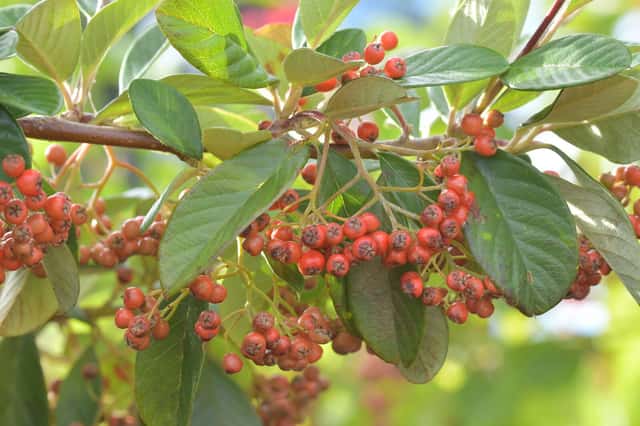
Late Cotoneaster (Cotoneaster coriaceus) is a easy-care plant from the Rosaceae family. Late cotoneaster (Cotoneaster coriaceus, widely sold under its synonym Cotoneaster lacteus) is a vigorous evergreen shrub native to the Chinese provinces of Guizhou, Sichuan, Xizang and Yunnan. It forms a dense, arching mound of leathery, glossy dark-green leaves with felted grey-white undersides, r...
Late Cotoneaster grows up to 4.0m, spread of 400cm, watering every 10 days. It is not suitable for indoor environments and not safe for pets.
Unlike many tropical plants, Late Cotoneaster tolerates watering mistakes. Best for beginners. Without precautions, ingestion can cause irritation in pets. Keep out of reach of cats and dogs.
How to Care for Late Cotoneaster?
TLDR: Late Cotoneaster needs Bright indirect, watering every 10 days, and temperatures between 15-30°C with 40-70% humidity.
How Often Should You Water Late Cotoneaster?
Water when the top of the soil is nearly dry during spring and summer growth; once established, this shrub is drought tolerant and only needs supplemental water in prolonged dry spells. Avoid waterlogging, which encourages root and fungal diseases.
How Much Light Does Late Cotoneaster Need?
Thrives in full sun for the best flowering and fruiting, but tolerates partial shade. Suitable for north, south, east or west aspects and both exposed and sheltered sites.
What Is the Best Soil for Late Cotoneaster?
Adapts to chalk, clay, loam and sandy soils as long as drainage is good; ideal pH is slightly acidic to neutral (around 6-7) but alkaline soils are tolerated well.
What Is Late Cotoneaster and Where Does It Come From?
Late cotoneaster (Cotoneaster coriaceus, widely sold under its synonym Cotoneaster lacteus) is a vigorous evergreen shrub native to the Chinese provinces of Guizhou, Sichuan, Xizang and Yunnan. It forms a dense, arching mound of leathery, glossy dark-green leaves with felted grey-white undersides, reaching 2.5-4 m in height and spread over 10-20 years. Clusters of small white flowers appear in late spring through summer, followed by long-lasting bright red berries that persist into winter and are a valuable food source for birds. It is a popular choice for informal hedges, screens and wildlife gardens thanks to its toughness and tolerance of poor soils, wind and coastal exposure.
How to Propagate Late Cotoneaster?
Semi-ripe stem cutting
Semi-ripe wood roots more reliably than soft new growth; keep the compost moist but never waterlogged.
- 1 Take a 10-15 cm semi-ripe cutting from a healthy side shoot in mid to late summer
- 2 Remove the lower leaves and dip the cut end in rooting hormone
- 3 Insert into a free-draining cutting mix of perlite and compost
- 4 Keep in a shaded, humid propagator until roots form
Materials needed:
Seed sowing
Germination is slow and irregular; cuttings are the far more reliable propagation method for this species.
- 1 Clean the pulp from ripe red berries and extract the seeds
- 2 Stratify seeds in moist sand in a fridge for 3 months to break dormancy
- 3 Sow in free-draining seed compost in autumn or after stratification
- 4 Keep outdoors or in a cold frame, germination can take over a year
Materials needed:
How Big Does Late Cotoneaster Grow?
TLDR: Late Cotoneaster can reach up to 4.0m tall with Medium growth rate.
Max height
4.0m
Spread
4.0m
Growth rate
Medium
Foliage
Evergreen
Warning: Toxic Plant
This plant can be toxic if ingested. Keep out of reach of:
Plant Uses
Ornamental
Great for decoration
Is your plant showing symptoms?
Click on the symptom to discover possible causes:
What Diseases Commonly Affect Late Cotoneaster?
TLDR: Late Cotoneaster is susceptible to 5 known diseases. Monitor regularly for early detection.
Fire Blight
Fire blight is a highly destructive and contagious bacterial disease caused by Erwinia amylovora. It primarily affects plants in the Rosaceae family, including apple, pear, quince trees, and various ornamental plants. The disease can destroy an entire orchard in a single growing season under ideal conditions, with the bacterium moving approximately 11 inches per week in new growth.
Canker
Canker is a disease caused by various fungi and bacteria that create necrotic, sunken areas on bark of branches, stems, and trunks. Pathogens enter through wounds and natural openings, especially when plants are stressed. Canker can gradually weaken or kill branches by disrupting water and nutrient flow.
Scale Insects
Scale insects are small sap-sucking pests that appear as brown, shell-like bumps on plant stems and leaves. There are over 25 species, divided into armored (hard) and unarmored (soft) scales. They feed by piercing plant tissue and extracting sap, which weakens the plant and can lead to yellowing, stunted growth, and even death if left untreated. They also excrete honeydew, which attracts ants and promotes sooty mold growth.
Aphids
Aphids are small, soft-bodied, pear-shaped insects (1/16 to 1/8 inch long) that feed by sucking nutrient-rich sap from plants. They reproduce rapidly and can quickly weaken plants, causing distorted growth and transmitting plant viruses. Aphids come in various colors including green, black, red, yellow, brown, and gray. They secrete honeydew, a sticky substance that attracts ants and encourages sooty mold growth.
Fun Facts
The species epithet 'lacteus' means milky, referring to the milk-white color of the flower clusters.
Its bright red berries persist on the shrub through winter, making it an important food source for birds like blackbirds and thrushes.
Despite being an evergreen shrub, it belongs to the same family as apples and roses, Rosaceae.
Frequently asked questions
Is Cotoneaster coriaceus the same as Cotoneaster lacteus?
How often should I water late cotoneaster?
Is late cotoneaster toxic to pets?
What is the biggest disease risk for cotoneaster?
How do I propagate late cotoneaster?
Compare with similar plants
| Attribute | Difficulty | Light | Watering | Pet Safe |
|---|---|---|---|---|
| Field Maple | Easy | Bright indirect | 14d | ✓ |
| Silver Birch | Easy | Direct sun | 14d | ✓ |
| Common Blanketflower | Easy | Direct sun | 10d | ✓ |
| Cushion Bush | Easy | Direct sun | 14d | ✓ |
Choose & Compare
Sources & References
- Cotoneaster lacteus | late cotoneaster - RHS
- Complete and Updated Guide to Cotoneaster lacteus
- Cotoneaster Diseases - Penn State Extension
- Late Cotoneaster Plant Care & Growing Basics - PlantIn
- Espécie Cotoneaster coriaceus - Jardim Botânico UTAD
- Susceptibility Of Cotoneasters to Fire Blight - Arboriculture & Urban Forestry





