Lentibulariaceae
Leafy Bladderwort: Fast Growing
Utricularia foliosa
Grow Leafy Bladderwort fully submerged or floating in still, clean, nutrient-poor water, preferably rainwater or distilled water. It does not require fertilizer, as it obtains nutrients by capturing small aquatic organisms with its bladders. It prefers filtered light or partial shade, mild to warm temperatures, and slightly acidic water.
Every 1 days
Partial shade
18° - 32°C
80% - 100%
Categories
What is Leafy Bladderwort?
Leafy Bladderwort (Utricularia foliosa) is a medium-care plant from the Lentibulariaceae family. Utricularia foliosa is an aquatic carnivorous plant in the Lentibulariaceae family, native to tropical and subtropical regions of the Americas and Africa. It floats freely or remains submerged in the still waters of ponds, marshes, and slow-moving rivers, forming dense mats of thin, branched stems t...
Leafy Bladderwort grows up to 40cm, spread of 300cm, watering every 1 days, 18°C – 32°C, 80–100% humidity. It is suitable for indoor environments and safe for pets.
Unlike many popular species, Leafy Bladderwort is safe to keep around pets. Without adequate drainage, root rot can develop within 7 days.
How to Care for Leafy Bladderwort?
TLDR: Leafy Bladderwort needs Partial shade, watering every 1 days, and temperatures between 18-32°C with 80-100% humidity.
How Often Should You Water Leafy Bladderwort?
Keep the container always filled with still or very slow-flowing water—strong currents damage the delicate branches. Use rainwater, distilled, or demineralized water, as tap water contains chlorine and minerals that harm the plant. Top up the level as it evaporates, avoiding sudden changes.
How Much Light Does Leafy Bladderwort Need?
Provide filtered sunlight or partial shade for 4 to 6 hours daily. Avoid direct, intense sun all day, as it promotes algae growth in the water, which competes with the plant and can suffocate it.
What Is the Best Soil for Leafy Bladderwort?
It does not require a substrate: it can live entirely floating. If you prefer to anchor it, use a thin layer of peat (sphagnum) and sand at the bottom of the container, nutrient-poor and slightly acidic (pH 5 to 7).
What Pot Should You Use for Leafy Bladderwort?
Use containers without drainage holes—aquariums, tanks, ornamental ponds, or waterproof plastic pots—to retain the still water the plant needs. Avoid pots with traditional soil substrate.
What Is Leafy Bladderwort and Where Does It Come From?
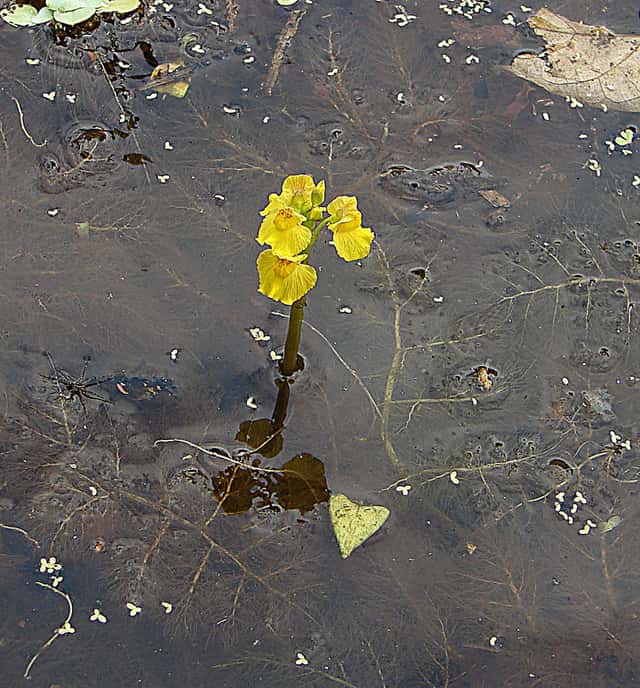
Utricularia foliosa is an aquatic carnivorous plant in the Lentibulariaceae family, native to tropical and subtropical regions of the Americas and Africa. It floats freely or remains submerged in the still waters of ponds, marshes, and slow-moving rivers, forming dense mats of thin, branched stems that can reach several meters in length. Its filiform leaves, up to 30 cm long, support small bladder-like traps (utricles) that suck in and capture microcrustaceans, mosquito larvae, and other small aquatic invertebrates. During the reproductive period, it produces an erect flower stalk that rises above the water, up to 40 cm high, displaying several yellow flowers similar to small snapdragons.
How to Propagate Leafy Bladderwort?
How Big Does Leafy Bladderwort Grow?
TLDR: Leafy Bladderwort can reach up to 40cm tall with Fast growth rate.
Max height
40cm
Spread
3.0m
Growth rate
Fast
Foliage
Evergreen
Plant Uses
Ornamental
Great for decoration
Is your plant showing symptoms?
Click on the symptom to discover possible causes:
What Diseases Commonly Affect Leafy Bladderwort?
TLDR: Leafy Bladderwort is susceptible to 5 known diseases. Monitor regularly for early detection.
Root Rot
Root rot is a serious fungal disease that affects the root system of plants, causing them to decay and die. It is primarily caused by overwatering, poor drainage, or soil-borne fungi such as Pythium, Phytophthora, Rhizoctonia, and Fusarium. The disease thrives in waterlogged conditions where roots are deprived of oxygen, making them susceptible to fungal infection.
Leaf Spot
Leaf spot is a common fungal disease caused by various pathogens including Alternaria, Ascochyta, Colletotrichum, Septoria, and Venturia. It primarily affects leaves, causing discolored spots that can lead to premature leaf drop if left untreated.
Grey Mould
Powdery Mildew
Powdery mildew is a common fungal disease caused by various fungi species including Erysiphe, Podosphaera, Oïdium, and Leveillula. It affects over 10,000 plant species worldwide. The disease thrives in warm, dry climates with high humidity and appears as a distinctive white powdery coating on plant surfaces.
Compare with similar plants
| Attribute | Difficulty | Light | Watering | Pet Safe |
|---|---|---|---|---|
| Dark Fieldcap | Medium | Low light | 2d | ⚠️ |
| Azalea | Medium | Partial shade | 3d | ⚠️ |
| Muriel's Bamboo | Medium | Partial shade | 3d | ✓ |
| Bougainvillea | Medium | Direct sun | 7d | ⚠️ |




