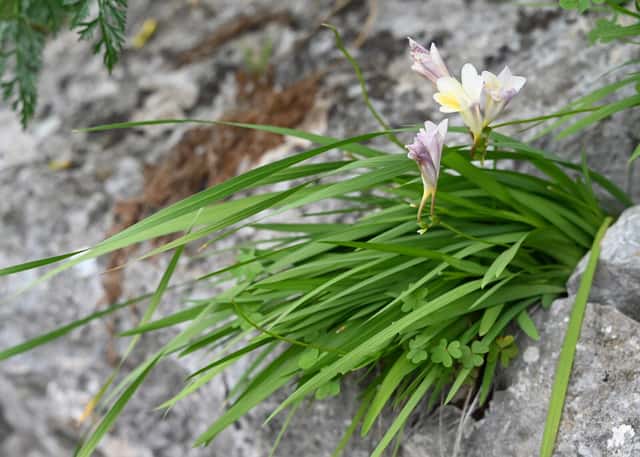
Iridaceae
Freesia: Aromatic Plant
Freesia leichtlinii
Thrives with regular watering during growth and flowering, bright light without scorching sun, well-drained substrate, and a dry rest period after flowering when the foliage withers and the corm enters dormancy.
Every 6 days
Bright indirect
5° - 24°C
40% - 60%
Categories
What is Freesia?
Freesia (Freesia leichtlinii) is a medium-care plant from the Iridaceae family. Freesia leichtlinii is a perennial cormous bulbous plant in the Iridaceae family, native to the Cape Provinces of South Africa. It produces arching flower spikes with highly fragrant tubular flowers, typically in shades of cream and yellow with throat markings, although the subspecies alba features...
Freesia grows up to 45cm, spread of 20cm, watering every 6 days, 5°C – 24°C, 40–60% humidity. It is suitable for indoor environments and safe for pets.
Unlike many popular species, Freesia is safe to keep around pets. Without adequate drainage, root rot can develop within 12 days.
How to Care for Freesia?
TLDR: Freesia needs Bright indirect, watering every 6 days, and temperatures between 5-24°C with 40-60% humidity.
How Often Should You Water Freesia?
Water regularly from planting until the end of flowering, keeping the substrate moist but not waterlogged. If leaves turn yellow, reduce frequency. After flowering, stop watering and allow the corm to dry out during its summer dormancy.
How Much Light Does Freesia Need?
Place the freesia in a bright spot with soft sun or bright indirect light; intense midday sun wilts flowers prematurely, so protect it with partial shade in hot climates.
What Is the Best Soil for Freesia?
Use a well-drained, light substrate rich in organic matter; mixing soil with one-third coarse sand or perlite helps prevent waterlogging that rots the corm.
What Pot Should You Use for Freesia?
Clay or terracotta pots with good drainage, shallow but wide, as corms are planted in groups near the surface.
Care Schedule
Fertilize
Every 14 days
Repot
Every 365 days
What Is Freesia and Where Does It Come From?
Freesia leichtlinii is a perennial cormous bulbous plant in the Iridaceae family, native to the Cape Provinces of South Africa. It produces arching flower spikes with highly fragrant tubular flowers, typically in shades of cream and yellow with throat markings, although the subspecies alba features white flowers. It is widely cultivated as an ornamental pot plant and for cut flowers due to its intense perfume.
How to Propagate Freesia?
Division of offsets
Use gloves and clean tools when handling corms. Discard any soft or discolored corms before replanting.
- 1 Allow the foliage to dry out completely after flowering before lifting the corms.
- 2 Dig up the corms in late summer or autumn and carefully separate the offsets (bulblets) from the mother corm.
- 3 Store the corms in a cool, dry, and ventilated place until the next planting season.
- 4 Plant each corm tip-up at a depth of 3-5 cm and 5 cm apart in well-drained substrate.
- 5 Water well after planting; smaller offsets may take 1-2 seasons to bloom.
Materials needed:
Sowing from seeds
Seed propagation is slower and less reliable than corm division; it is primarily used for hybridization purposes.
- 1 Collect seeds from mature pods after flowering.
- 2 Sow in moist, well-drained substrate at a depth of 1 cm.
- 3 Keep in a warm place (18-22°C) with bright indirect light.
- 4 Germination takes between 3 and 6 weeks.
- 5 Seed-grown plants take 2-3 years to reach their first flowering.
Materials needed:
How Big Does Freesia Grow?
TLDR: Freesia can reach up to 45cm tall with Medium growth rate.
Max height
45cm
Spread
20cm
Growth rate
Medium
Foliage
Deciduous
Plant Uses
Ornamental
Great for decoration
Aromatic
Pleasant fragrance
Is your plant showing symptoms?
Click on the symptom to discover possible causes:
What Diseases Commonly Affect Freesia?
TLDR: Freesia is susceptible to 8 known diseases. Monitor regularly for early detection.
Fusarium Wilt
Fusarium wilt is a serious fungal disease caused by the soil-borne fungus Fusarium oxysporum. The fungus invades roots and blocks the water-conducting vessels (xylem) of the plant, causing progressive wilting and eventual death. Host-specific forms of the pathogen exist that attack different plant species.
Grey Mould
Root Rot
Root rot is a serious fungal disease that affects the root system of plants, causing them to decay and die. It is primarily caused by overwatering, poor drainage, or soil-borne fungi such as Pythium, Phytophthora, Rhizoctonia, and Fusarium. The disease thrives in waterlogged conditions where roots are deprived of oxygen, making them susceptible to fungal infection.
Aphids
Aphids are small, soft-bodied, pear-shaped insects (1/16 to 1/8 inch long) that feed by sucking nutrient-rich sap from plants. They reproduce rapidly and can quickly weaken plants, causing distorted growth and transmitting plant viruses. Aphids come in various colors including green, black, red, yellow, brown, and gray. They secrete honeydew, a sticky substance that attracts ants and encourages sooty mold growth.
Meaning & Symbolism
A symbol of trust, friendship, and innocence; its fragrant flowers also represent understated elegance.
Compare with similar plants
| Attribute | Difficulty | Light | Watering | Pet Safe |
|---|---|---|---|---|
| Dark Fieldcap | Medium | Low light | 2d | ⚠️ |
| Azalea | Medium | Partial shade | 3d | ⚠️ |
| Muriel's Bamboo | Medium | Partial shade | 3d | ✓ |
| Bougainvillea | Medium | Direct sun | 7d | ⚠️ |




