Brassicaceae
Lesser Swinecress: Aromatic Plant
Lepidium didymum
A hardy and easy-to-grow plant, lesser swinecress adapts to sandy, clay, or loamy soils as long as they remain slightly moist. It prefers full sun to partial shade and grows rapidly, completing its life cycle in a few months. It does not require special fertilization or intensive care, being more frequently found growing wild than cultivated in pots.
Every 4 days
Bright indirect
° - °C
% - %
Categories
What is Lesser Swinecress?
Lesser Swinecress (Lepidium didymum) is a easy-care plant from the Brassicaceae family. Lesser swinecress (Lepidium didymum, syn. Coronopus didymus) is an annual or biennial herb in the Brassicaceae family, native to South America (Brazil, Argentina, Bolivia, Chile, Paraguay, Peru, Uruguay, and Venezuela) and now naturalized throughout most of the world. It forms a basal rosette from w...
Lesser Swinecress grows up to 40cm, spread of 30cm, watering every 4 days. It is not suitable for indoor environments and safe for pets.
Unlike many tropical plants, Lesser Swinecress tolerates watering mistakes. Best for beginners. Unlike many popular species, Lesser Swinecress is safe to keep around pets.
How to Care for Lesser Swinecress?
TLDR: Lesser Swinecress needs Bright indirect, watering every 4 days, and temperatures between 15-30°C with 40-70% humidity.
How Often Should You Water Lesser Swinecress?
Keep the soil consistently slightly moist without waterlogging. Water more frequently during dry and hot periods; the plant tolerates various soil types but does not thrive in substrate that remains completely dry for long periods.
How Much Light Does Lesser Swinecress Need?
It grows best in full sun, where it becomes more vigorous, but it tolerates partial shade and even light shade well in hotter climates.
What Is the Best Soil for Lesser Swinecress?
It is not demanding regarding soil type, developing well in sandy, loamy, or clay soils with a pH ranging from slightly acidic to slightly alkaline (about 6.0 to 7.5). It prefers soils that retain some moisture.
What Pot Should You Use for Lesser Swinecress?
When grown in a pot, prefer wide and shallow containers with good drainage, as the plant has a low profile and spreading growth habit; a ceramic or plastic pot with drainage holes is sufficient, with no need for special substrate.
What Is Lesser Swinecress and Where Does It Come From?
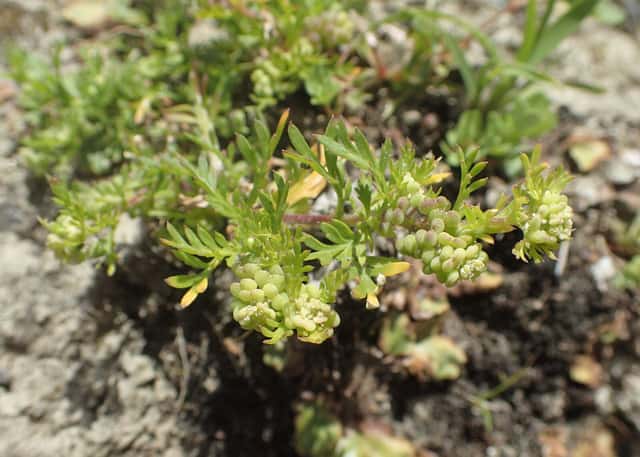
Lesser swinecress (Lepidium didymum, syn. Coronopus didymus) is an annual or biennial herb in the Brassicaceae family, native to South America (Brazil, Argentina, Bolivia, Chile, Paraguay, Peru, Uruguay, and Venezuela) and now naturalized throughout most of the world. It forms a basal rosette from which highly branched, decumbent or ascending stems emerge, reaching up to 40 cm in length. The leaves are alternate and pinnatifid with narrow segments, and the entire plant emits a strong, characteristic odor when crushed. The flowers are tiny, whitish or nearly petal-less, gathered in racemes, giving rise to the bilobed fruits typical of the Lepidium genus. It is common in disturbed ground, roadsides, gardens, lawns, and cultivated areas, where it behaves as a vigorous, fast-growing spontaneous plant.
How to Propagate Lesser Swinecress?
Direct Sowing
The plant self-seeds easily in favorable locations, eliminating the need for manual replanting in subsequent years.
- 1 Collect seeds from dry fruits between late summer and fall
- 2 Sow directly in the permanent location in slightly moist soil during spring or fall
- 3 Lightly cover the seeds with a thin layer of substrate
- 4 Keep the soil moist until germination, which usually occurs within a few weeks
Materials needed:
How Big Does Lesser Swinecress Grow?
TLDR: Lesser Swinecress can reach up to 40cm tall with Fast growth rate.
Max height
40cm
Spread
30cm
Growth rate
Fast
Foliage
Deciduous
Plant Uses
Edible
Can be consumed
Medicinal
Medicinal properties
Aromatic
Pleasant fragrance
Medicinal Uses
- Traditionally used as a digestive and stomach tonic
- Employed as an expectorant in teas for coughs and respiratory conditions
- Used as a febrifuge in South American folk medicine
- Possesses antiscorbutic properties (rich in vitamin C)
- Leaves contain flavonoids, saponins, and tannins with antioxidant activity
Culinary Uses
- Young leaves consumed raw in salads, with a peppery flavor similar to watercress
- Leaves cooked and sautéed as a green in regional South American dishes
- Occasionally used as a pungent seasoning in homemade preparations
Is your plant showing symptoms?
Click on the symptom to discover possible causes:
What Diseases Commonly Affect Lesser Swinecress?
TLDR: Lesser Swinecress is susceptible to 2 known diseases. Monitor regularly for early detection.
Aphids
Aphids are small, soft-bodied, pear-shaped insects (1/16 to 1/8 inch long) that feed by sucking nutrient-rich sap from plants. They reproduce rapidly and can quickly weaken plants, causing distorted growth and transmitting plant viruses. Aphids come in various colors including green, black, red, yellow, brown, and gray. They secrete honeydew, a sticky substance that attracts ants and encourages sooty mold growth.
Flea beetle damage
Flea beetles are small, jumping insects that feed on the leaves of many vegetable crops. They chew numerous small, circular holes, creating a characteristic 'shothole' appearance. While established plants can often tolerate the damage, young seedlings are highly susceptible and can be stunted or killed if the infestation is severe.
Meaning & Symbolism
Due to its spontaneous and resistant growth in disturbed lands, lesser swinecress is popularly associated with resilience and vitality. It is also remembered in Brazilian folk culture for its traditional use as a home remedy passed down through generations.
Compare with similar plants
| Attribute | Difficulty | Light | Watering | Pet Safe |
|---|---|---|---|---|
| Field Maple | Easy | Bright indirect | 14d | ✓ |
| Silver Birch | Easy | Direct sun | 14d | ✓ |
| Common Blanketflower | Easy | Direct sun | 10d | ✓ |
| Cushion Bush | Easy | Direct sun | 14d | ✓ |





