Amaryllidaceae
Lily of the Nile — Complete Care Guide
Agapanthus africanus
Easy to grow. Prefers full sun to partial shade in very hot climates, moderate watering, and well-draining soil. Tolerates drought better than overly wet conditions.
Every 4 days
Bright indirect
-8° - 35°C
40% - 60%
Categories
What is Lily of the Nile?
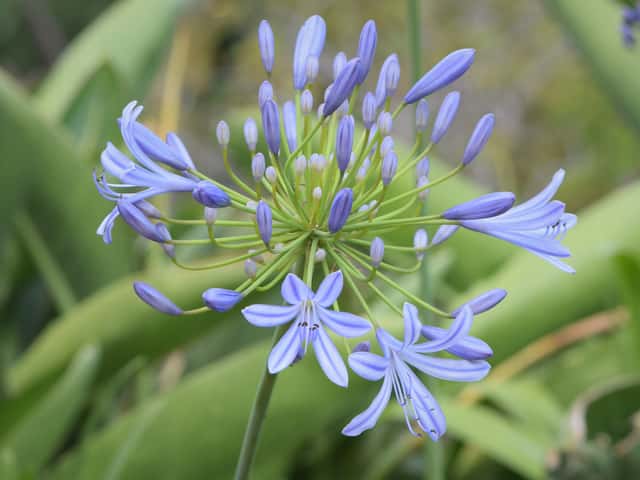
Lily of the Nile (Agapanthus africanus) is a easy-care plant from the Amaryllidaceae family. Lily of the Nile (Agapanthus africanus) is a perennial plant native to the Western Cape region of South Africa. It forms compact clumps of long, strap-like evergreen leaves, from which sturdy flower stalks emerge, topped with dense umbels of trumpet-shaped flowers ranging from blue to violet. It is...
Lily of the Nile grows up to 90cm, spread of 60cm, watering every 4 days, -8°C – 35°C, 40–60% humidity. It is suitable for indoor environments and not safe for pets.
Unlike many tropical plants, Lily of the Nile tolerates watering mistakes. Best for beginners. Without precautions, ingestion can cause irritation in pets. Keep out of reach of cats and dogs. Without adequate drainage, root rot can develop within 8 days.
How to Care for Lily of the Nile?
TLDR: Lily of the Nile needs Bright indirect, watering every 4 days, and temperatures between -8-35°C with 40-60% humidity.
How Often Should You Water Lily of the Nile?
Water 2 to 3 times a week during summer and flowering, keeping the substrate lightly moist but never waterlogged. In winter, reduce watering significantly, letting the plant dry out between waterings.
How Much Light Does Lily of the Nile Need?
Needs at least 6 hours of direct sunlight per day to bloom well. In very hot regions, it tolerates partial afternoon shade.
What Is the Best Soil for Lily of the Nile?
Use fertile, organically rich, and above all well-draining soil. A mix of 60% garden soil and 40% coarse sand works well. Avoid waterlogged soil, as the plant does not tolerate "wet feet".
What Pot Should You Use for Lily of the Nile?
Wide, not-too-deep pots with generous drainage holes; the plant blooms best when its roots are slightly pot-bound.
Care Schedule
Fertilize
Every 30 days
Repot
Every 1095 days
What Is Lily of the Nile and Where Does It Come From?
Lily of the Nile (Agapanthus africanus) is a perennial plant native to the Western Cape region of South Africa. It forms compact clumps of long, strap-like evergreen leaves, from which sturdy flower stalks emerge, topped with dense umbels of trumpet-shaped flowers ranging from blue to violet. It is widely used in gardens, borders, and containers, prized for its striking summer blooms and toughness.
How to Propagate Lily of the Nile?
Clump division
Divide the clump every 3-4 years to renew the plant's vigor and prevent overcrowding. Use clean tools to avoid spreading disease.
- 1 Remove the clump from its pot or the ground in late winter or early spring
- 2 Carefully separate the rhizomes by hand or with a clean knife, making sure each division has roots and a few leaves
- 3 Replant immediately in well-draining soil at the same depth as before
- 4 Water thoroughly after planting to help establishment
Materials needed:
Seeds
Seed propagation is slower and plants may take 2 to 3 years to bloom for the first time.
- 1 Sow in a light, well-draining seed mix, covering seeds lightly
- 2 Keep the substrate moist and at 18-22°C
- 3 Wait for germination, which can take 1 to 8 weeks
- 4 Transplant seedlings once they have a few true leaves
Materials needed:
How Big Does Lily of the Nile Grow?
TLDR: Lily of the Nile can reach up to 90cm tall with Medium growth rate.
Max height
90cm
Spread
60cm
Growth rate
Medium
Foliage
Evergreen
Warning: Toxic Plant
This plant can be toxic if ingested. Keep out of reach of:
Plant Uses
Ornamental
Great for decoration
Ground Cover
Soil coverage
Is your plant showing symptoms?
Click on the symptom to discover possible causes:
What Diseases Commonly Affect Lily of the Nile?
TLDR: Lily of the Nile is susceptible to 8 known diseases. Monitor regularly for early detection.
Crown Rot
Crown rot is a serious fungal disease that attacks the crown (base) of the plant where the stem meets the soil. It is caused by various fungal pathogens including Phytophthora, Fusarium, and Rhizoctonia. The disease thrives in waterlogged conditions and can quickly spread to kill the entire plant if not addressed promptly.
Rust
Rust is a common fungal disease caused by fungi in the order Pucciniales that affects a wide variety of plants. The disease gets its name from the characteristic orange, yellow, or reddish-brown pustules that appear on leaves, resembling metal rust. This obligate fungal parasite requires living plants to survive and can cause significant economic losses in agricultural crops.
Powdery Mildew
Powdery mildew is a common fungal disease caused by various fungi species including Erysiphe, Podosphaera, Oïdium, and Leveillula. It affects over 10,000 plant species worldwide. The disease thrives in warm, dry climates with high humidity and appears as a distinctive white powdery coating on plant surfaces.
Gray Mold (Botrytis Blight)
Gray mold, caused by the fungus Botrytis cinerea, is one of the most common fungal diseases in plants. It affects over 200 plant species, including ornamentals, vegetables, fruits, and houseplants. The disease thrives in cool, humid conditions with poor air circulation, causing grayish spots and soft rot on infected tissues.
Meaning & Symbolism
The Lily of the Nile symbolizes love, beauty, and fertility; its name comes from the Greek "agape" (love) and "anthos" (flower).
Fun Facts
The name Agapanthus comes from the Greek "agape" (love) and "anthos" (flower), literally meaning "love flower".
It is native only to the Cape region of South Africa but is now cultivated in gardens worldwide.
Some Agapanthus varieties are evergreen, while others are deciduous and lose their leaves in winter.
Its seeds are black and form in capsules after flowering, dispersed by wind.
Frequently asked questions
How often should I water Lily of the Nile?
Is Lily of the Nile toxic to pets?
How long does it take for Lily of the Nile to bloom?
Does Lily of the Nile need full sun?
How often should I divide the clump?
Compare with similar plants
| Attribute | Difficulty | Light | Watering | Pet Safe |
|---|---|---|---|---|
| Field Maple | Easy | Bright indirect | 14d | ✓ |
| Silver Birch | Easy | Direct sun | 14d | ✓ |
| Common Blanketflower | Easy | Direct sun | 10d | ✓ |
| Cushion Bush | Easy | Direct sun | 14d | ✓ |
Choose & Compare
Sources & References
- Learn How To Plant, Care and Grow Bountiful Agapanthus - Gardenia
- Agapanthus africanus - Care, Propagation & Tips - Viriar
- African Lily Care: How to Grow Agapanthus (Lily of the Nile) - Southern Living Plants
- Common Agapanthus Diseases - Gardening Know How
- How to Identify and Treat Agapanthus Diseases - Gardener's Path
- Agapanthus africanus - PFAF Plant Database
- Agapanthus, Agapanthus africanus - Monrovia





