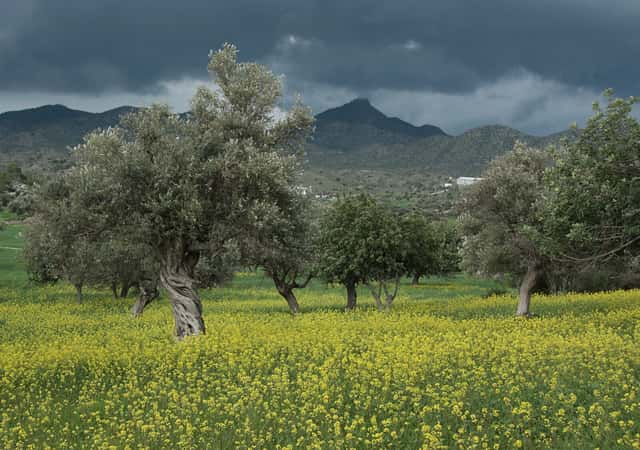
Oleaceae
Little Ollie Dwarf Olive (Olea europaea 'Montra')
Olea europaea 'Montra'
Give Little Ollie full sun and well-drained soil. Water deeply but infrequently once established, and shear periodically to maintain its naturally rounded, compact form. It tolerates heat, drought, salt spray, and poor soil with ease.
Every 14 days
Direct sun
-9° - 40°C
30% - 50%
Categories
What is Little Ollie?
Little Ollie (Olea europaea 'Montra') is a easy-care plant from the Oleaceae family. Little Ollie is a compact, non-fruiting cultivar of the Mediterranean olive tree, prized for its dense, rounded form and silvery-green evergreen foliage. Bred by Monrovia, this sterile selection produces the classic olive look without the mess of dropped fruit, making it a popular choice for hedges,...
Little Ollie grows up to 1.8m, spread of 183cm, watering every 14 days, -9°C – 40°C, 30–50% humidity. It is suitable for indoor environments and safe for pets.
Unlike many tropical plants, Little Ollie tolerates watering mistakes. Best for beginners. Unlike many popular species, Little Ollie is safe to keep around pets. Without adequate drainage, root rot can develop within 28 days.
How to Care for Little Ollie?
TLDR: Little Ollie needs Direct sun, watering every 14 days, and temperatures between -9-40°C with 30-50% humidity.
How Often Should You Water Little Ollie?
Water deeply during the first year to establish roots, then let the top few inches of soil dry out between waterings; this drought-tolerant shrub resents soggy soil.
How Much Light Does Little Ollie Need?
Plant in full sun (6-8+ hours of direct light daily) for the densest, most compact growth; it tolerates partial shade but becomes leggier.
What Is the Best Soil for Little Ollie?
Use well-draining, average-to-lean soil; sandy or loamy mixes are ideal. Good drainage is essential, as this cultivar is highly susceptible to root rot in soggy soil.
What Pot Should You Use for Little Ollie?
A wide, unglazed terracotta or ceramic container with generous drainage holes suits its root system and helps soil dry between waterings.
Care Schedule
Fertilize
Every 365 days
Repot
Every 730 days
What Is Little Ollie and Where Does It Come From?
Little Ollie is a compact, non-fruiting cultivar of the Mediterranean olive tree, prized for its dense, rounded form and silvery-green evergreen foliage. Bred by Monrovia, this sterile selection produces the classic olive look without the mess of dropped fruit, making it a popular choice for hedges, containers, and topiary. Extremely drought-, heat-, and salt-tolerant once established, it thrives in full sun with minimal care.
How to Propagate Little Ollie?
Semi-hardwood stem cuttings
Bottom heat and a humidity dome speed up rooting; olives can be slow and inconsistent to root from cuttings.
- 1 Take a 10-15 cm semi-hardwood cutting from a healthy branch in mid-to-late summer.
- 2 Strip the leaves from the lower half and dip the cut end in rooting hormone.
- 3 Insert into a well-draining mix of perlite and potting soil.
- 4 Keep consistently moist and in bright, indirect light until roots form.
- 5 Transplant to a larger pot once a healthy root system develops.
Materials needed:
How Big Does Little Ollie Grow?
TLDR: Little Ollie can reach up to 1.8m tall with Medium growth rate.
Max height
1.8m
Spread
1.8m
Growth rate
Medium
Foliage
Evergreen
Plant Uses
Ornamental
Great for decoration
Is your plant showing symptoms?
Click on the symptom to discover possible causes:
What Diseases Commonly Affect Little Ollie?
TLDR: Little Ollie is susceptible to 5 known diseases. Monitor regularly for early detection.
Root Rot
Root rot is a serious fungal disease that affects the root system of plants, causing them to decay and die. It is primarily caused by overwatering, poor drainage, or soil-borne fungi such as Pythium, Phytophthora, Rhizoctonia, and Fusarium. The disease thrives in waterlogged conditions where roots are deprived of oxygen, making them susceptible to fungal infection.
Scale Insects
Scale insects are small sap-sucking pests that appear as brown, shell-like bumps on plant stems and leaves. There are over 25 species, divided into armored (hard) and unarmored (soft) scales. They feed by piercing plant tissue and extracting sap, which weakens the plant and can lead to yellowing, stunted growth, and even death if left untreated. They also excrete honeydew, which attracts ants and promotes sooty mold growth.
Aphids
Aphids are small, soft-bodied, pear-shaped insects (1/16 to 1/8 inch long) that feed by sucking nutrient-rich sap from plants. They reproduce rapidly and can quickly weaken plants, causing distorted growth and transmitting plant viruses. Aphids come in various colors including green, black, red, yellow, brown, and gray. They secrete honeydew, a sticky substance that attracts ants and encourages sooty mold growth.
Spider Mites
Spider mites are tiny arachnids (less than 1/20 inch long) related to spiders and ticks that feed on plant sap. They thrive in hot, dry conditions and can cause significant damage to ornamental and vegetable plants. During severe infestations, crop losses can reach 14% or higher as these pests disrupt vital plant processes including photosynthesis, carbon dioxide absorption, and transpiration.
Meaning & Symbolism
Since antiquity, the olive branch has symbolized peace, wisdom, and abundance.
Fun Facts
Little Ollie was developed by Monrovia as a sterile, fruitless sport of the Mediterranean olive tree.
Despite producing virtually no fruit, its silvery-green foliage and gnarled branching give it the same timeless look as full-size olive trees.
It can be sheared into hedges, mounds, or trained as a miniature topiary tree.
The olive branch has symbolized peace since ancient Greek and Roman times.
Frequently asked questions
Does Little Ollie produce olives?
How much sun does Little Ollie need?
How often should I water Little Ollie?
Is Little Ollie toxic to pets?
How do I keep Little Ollie compact?
Compare with similar plants
| Attribute | Difficulty | Light | Watering | Pet Safe |
|---|---|---|---|---|
| Field Maple | Easy | Bright indirect | 14d | ✓ |
| Silver Birch | Easy | Direct sun | 14d | ✓ |
| Common Blanketflower | Easy | Direct sun | 10d | ✓ |
| Cushion Bush | Easy | Direct sun | 14d | ✓ |





