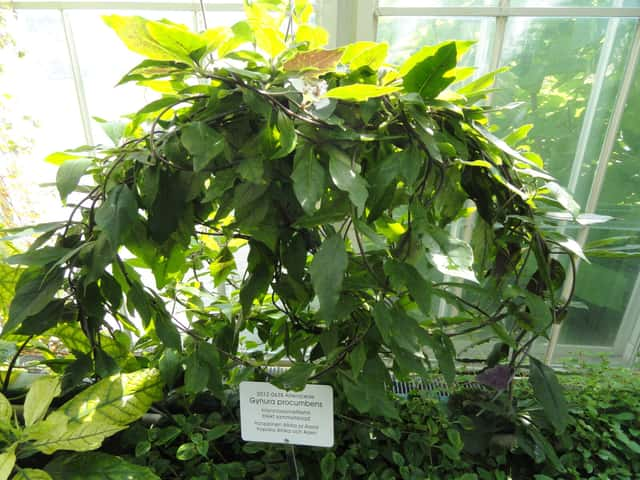
Asteraceae
Longevity spinach (Gynura procumbens)
Gynura procumbens
An easy plant for the garden or a pot. Give it bright light with part shade (more than 4 hours of strong sun scorches the leaves and makes them bitter), loose, compost-rich, well-drained soil, and water about once a week once established. It is tropical: perennial in warm climates (USDA zones 9-11) and does not survive prolonged cold. Harvest and cut back often to keep it compact.
Every 7 days
Partial shade
° - °C
% - %
Categories
What is Longevity spinach?
Longevity spinach (Gynura procumbens) is a easy-care plant from the Asteraceae family. Longevity spinach (Gynura procumbens), also known by its Malay name sambung nyawa, is a perennial in the daisy family (Asteraceae) native to a broad belt from tropical Africa to China, Southeast Asia and New Guinea. It grows as a scrambling or trailing plant with succulent stems that sprawl to 60 cm...
Longevity spinach grows up to 1.2m, watering every 7 days. It is suitable for indoor environments and safe for pets.
Unlike many tropical plants, Longevity spinach tolerates watering mistakes. Best for beginners. Unlike many popular species, Longevity spinach is safe to keep around pets. Without adequate drainage, root rot can develop within 14 days.
How to Care for Longevity spinach?
TLDR: Longevity spinach needs Partial shade, watering every 7 days, and temperatures between 15-30°C with 40-70% humidity.
How Often Should You Water Longevity spinach?
Water new transplants every day until they settle in, then about once a week. Keep the soil moist but never soggy: the roots rot easily. Wilting with wet soil means too much water or poor drainage.
How Much Light Does Longevity spinach Need?
Prefers 4-8 hours of indirect light or part shade. More than 4 hours of direct sun causes scorching and bitter leaves. Indoors, place it by a bright window.
What Is the Best Soil for Longevity spinach?
Loose, loamy soil enriched with compost and with good drainage. In containers, use a light mix in a pot at least 10 cm deep with drainage holes.
What Pot Should You Use for Longevity spinach?
A pot of at least 10 litres (about 3 gallons) with good drainage holes; larger pots or a garden bed give a more vigorous plant.
What Is Longevity spinach and Where Does It Come From?
Longevity spinach (Gynura procumbens), also known by its Malay name sambung nyawa, is a perennial in the daisy family (Asteraceae) native to a broad belt from tropical Africa to China, Southeast Asia and New Guinea. It grows as a scrambling or trailing plant with succulent stems that sprawl to 60 cm-1.2 m. The leaves are glossy green and slightly fleshy, oval to lance-shaped, 3.5-8 cm long (up to 15 cm in cultivation). Now and then it produces small yellow flower heads. It is grown in vegetable gardens and pots as a leafy green: young leaves are eaten raw in salads or cooked in soups and stir-fries, where they turn slightly mucilaginous. In Southeast Asian traditional medicine it is used for diabetes, high blood pressure and kidney problems, uses that are still being studied.
How to Propagate Longevity spinach?
Tip cutting
Root cuttings straight in soil: cuttings placed in water tend to rot. Seeds germinate very poorly, so cuttings are the usual method.
- 1 Cut a healthy tip 10-12 cm long with 2-4 nodes
- 2 Remove the lower leaves and cut the remaining leaves in half to reduce water loss
- 3 Bury the lower nodes directly in moist potting mix
- 4 Keep the soil moist, in part shade, until new leaves appear
Materials needed:
How Big Does Longevity spinach Grow?
TLDR: Longevity spinach can reach up to 1.2m tall with Medium growth rate.
Max height
1.2m
Foliage
Evergreen
Plant Uses
Edible
Can be consumed
Medicinal
Medicinal properties
Medicinal Uses
- Traditional Southeast Asian remedy for diabetes
- Traditional use for high blood pressure
- Traditional use for kidney problems, rheumatism and constipation
Culinary Uses
- Young leaves raw in salads and smoothies
- Leaves and stems cooked in soups and stir-fries
Is your plant showing symptoms?
Click on the symptom to discover possible causes:
What Diseases Commonly Affect Longevity spinach?
TLDR: Longevity spinach is susceptible to 7 known diseases. Monitor regularly for early detection.
Root Rot
Root rot is a serious fungal disease that affects the root system of plants, causing them to decay and die. It is primarily caused by overwatering, poor drainage, or soil-borne fungi such as Pythium, Phytophthora, Rhizoctonia, and Fusarium. The disease thrives in waterlogged conditions where roots are deprived of oxygen, making them susceptible to fungal infection.
Aphids
Aphids are small, soft-bodied, pear-shaped insects (1/16 to 1/8 inch long) that feed by sucking nutrient-rich sap from plants. They reproduce rapidly and can quickly weaken plants, causing distorted growth and transmitting plant viruses. Aphids come in various colors including green, black, red, yellow, brown, and gray. They secrete honeydew, a sticky substance that attracts ants and encourages sooty mold growth.
Spider Mites
Spider mites are tiny arachnids (less than 1/20 inch long) related to spiders and ticks that feed on plant sap. They thrive in hot, dry conditions and can cause significant damage to ornamental and vegetable plants. During severe infestations, crop losses can reach 14% or higher as these pests disrupt vital plant processes including photosynthesis, carbon dioxide absorption, and transpiration.
Whiteflies
Whiteflies are small, soft-bodied, winged insects closely related to aphids and mealybugs. They are moth-like in appearance, about 1/16 inch long, triangular in shape, and gray-white in color. These sap-sucking pests feed on plant tissue, causing yellowing, stunted growth, and wilting. They also excrete honeydew, which attracts ants and promotes sooty mold growth. Whiteflies can transmit serious plant viruses.
Fun Facts
The Malay name sambung nyawa roughly means "life extender"
Cooked leaves turn slightly slimy, a bit like okra
Seeds germinate so poorly that the plant is almost always grown from cuttings
Frequently asked questions
Does longevity spinach like full sun?
How often should I water it?
How do I harvest it?
Can I root it in water?
Compare with similar plants
| Attribute | Difficulty | Light | Watering | Pet Safe |
|---|---|---|---|---|
| Field Maple | Easy | Bright indirect | 14d | ✓ |
| Iberian Houseleek | Easy | Direct sun | 14d | ✓ |
| Silver Birch | Easy | Direct sun | 14d | ✓ |
| Common Blanketflower | Easy | Direct sun | 10d | ✓ |





